Department of Biological Sciences, Vanderbilt University, Nashville, Tennessee, United States of America.
PLoS One. 2012;7(6):e38985. doi: 10.1371/journal.pone.0038985. Epub 2012 Jun 11.
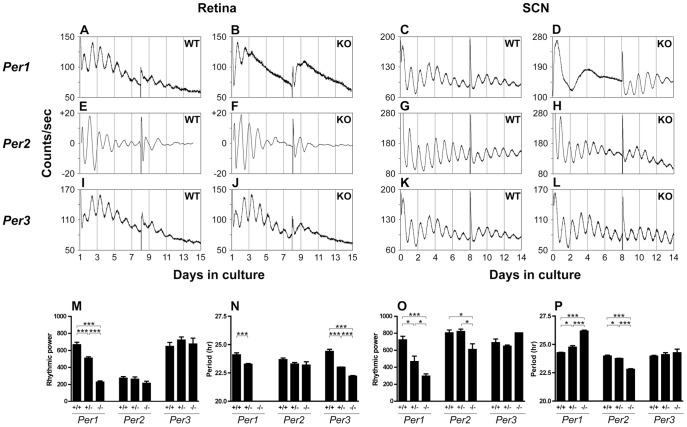
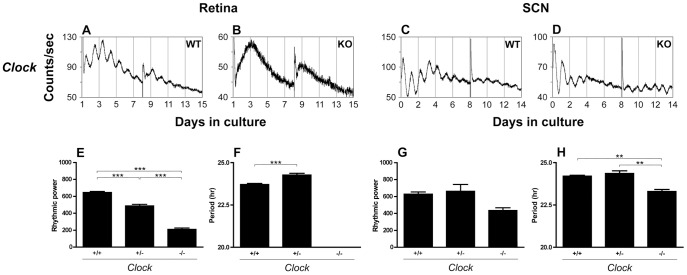
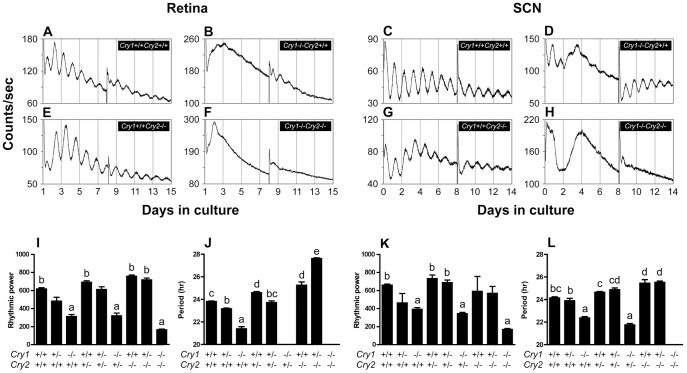
The retina is both a sensory organ and a self-sustained circadian clock. Gene targeting studies have revealed that mammalian circadian clocks generate molecular circadian rhythms through coupled transcription/translation feedback loops which involve 6 core clock genes, namely Period (Per) 1 and 2, Cryptochrome (Cry) 1 and 2, Clock, and Bmal1 and that the roles of individual clock genes in rhythms generation are tissue-specific. However, the mechanisms of molecular circadian rhythms in the mammalian retina are incompletely understood and the extent to which retinal neural clocks share mechanisms with the suprachiasmatic nucleus (SCN), the central neural clock, is unclear. In the present study, we examined the rhythmic amplitude and period of real-time bioluminescence rhythms in explants of retina from Per1-, Per2-, Per3-, Cry1-, Cry2-, and Clock-deficient mice that carried transgenic PERIOD2::LUCIFERASE (PER2::LUC) or Period1::luciferase (Per1::luc) circadian reporters. Per1-, Cry1- and Clock-deficient retinal and SCN explants showed weakened or disrupted rhythms, with stronger effects in retina compared to SCN. Per2, Per3, and Cry2 were individually dispensable for sustained rhythms in both tissues. Retinal and SCN explants from double knockouts of Cry1 and Cry2 were arrhythmic. Gene effects on period were divergent with reduction in the number of Per1 alleles shortening circadian period in retina, but lengthening it in SCN, and knockout of Per3 substantially shortening retinal clock period, but leaving SCN unaffected. Thus, the retinal neural clock has a unique pattern of clock gene dependence at the tissue level that it is similar in pattern, but more severe in degree, than the SCN neural clock, with divergent clock gene regulation of rhythmic period.
视网膜既是一种感觉器官,也是一种自我维持的生物钟。基因靶向研究表明,哺乳动物生物钟通过涉及 6 个核心时钟基因(即 Period(Per)1 和 2、Cryptochrome(Cry)1 和 2、Clock 和 Bmal1)的转录/翻译反馈环耦合产生分子生物钟节律,并且单个时钟基因在节律产生中的作用具有组织特异性。然而,哺乳动物视网膜中分子生物钟节律的机制尚不完全清楚,视网膜神经时钟与中枢神经时钟(视交叉上核,SCN)共享机制的程度尚不清楚。在本研究中,我们检查了来自 Per1-、Per2-、Per3-、Cry1-、Cry2-和 Clock 缺陷小鼠视网膜外植体中实时生物发光节律的振幅和周期,这些外植体携带转基因 PERIOD2::LUCIFERASE(PER2::LUC)或 Period1::luciferase(Per1::luc)生物钟报告基因。Per1-、Cry1-和 Clock 缺陷的视网膜和 SCN 外植体显示出减弱或破坏的节律,与 SCN 相比,视网膜中的影响更强。Per2、Per3 和 Cry2 单独缺失对于两种组织中持续的节律都是可有可无的。Cry1 和 Cry2 双敲除的视网膜和 SCN 外植体呈无节律性。基因对周期的影响是不同的,减少 Per1 等位基因的数量缩短了视网膜的生物钟周期,但延长了 SCN 的生物钟周期,而 Per3 的敲除则大大缩短了视网膜时钟周期,但对 SCN 没有影响。因此,视网膜神经时钟在组织水平上具有独特的时钟基因依赖性模式,其模式与 SCN 神经时钟相似,但程度更严重,节律周期的时钟基因调节存在分歧。