Department of Biochemistry and Biophysics, School of Medicine, University of North Carolina, Chapel Hill, North Carolina 27599-7568, USA.
Biochemistry. 2010 Mar 2;49(8):1606-15. doi: 10.1021/bi901798g.
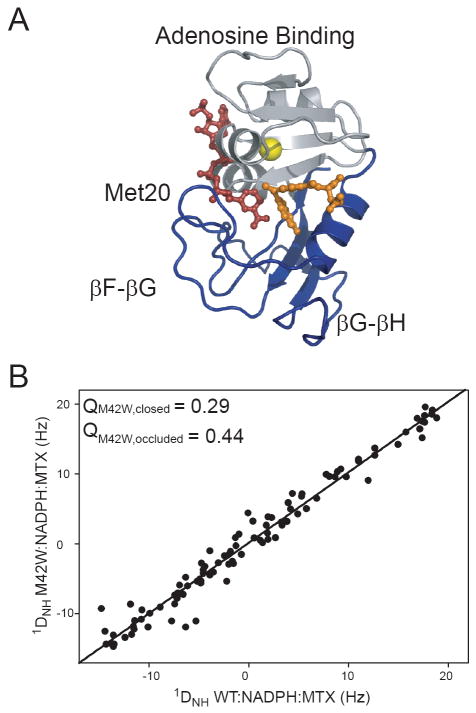
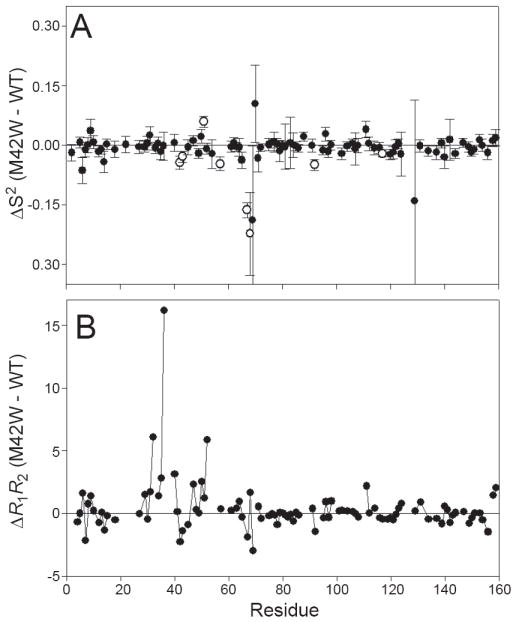
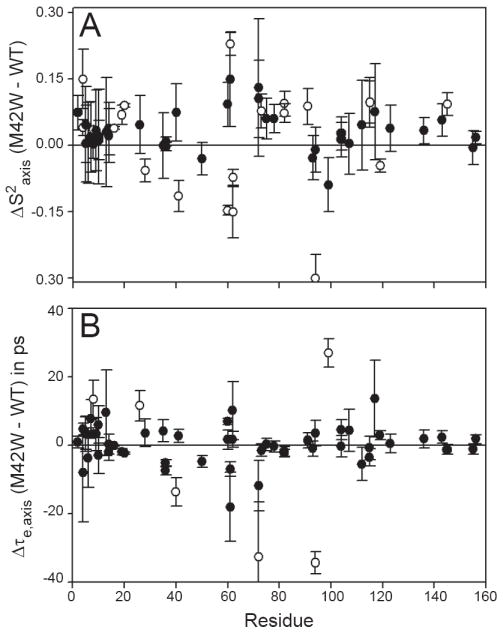
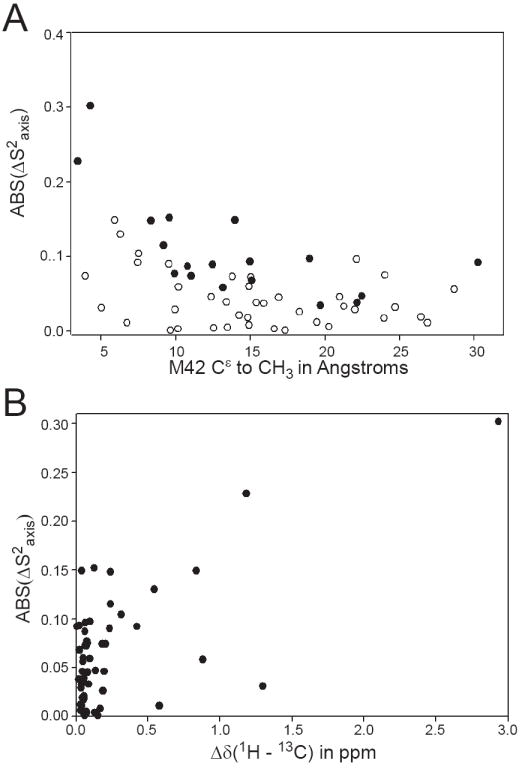
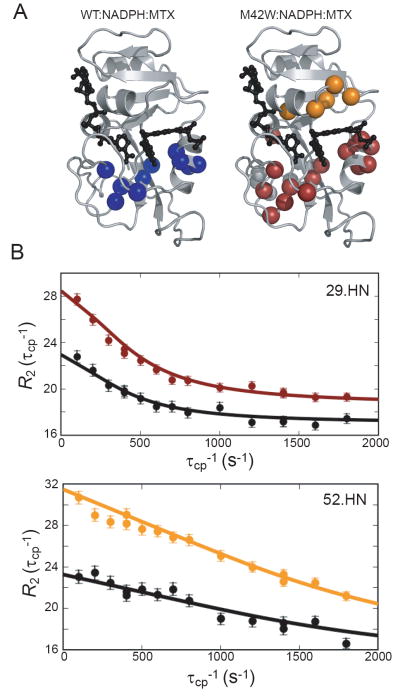
It is widely recognized that key positions throughout a protein's structure contribute unequally to function. In light of recent studies that suggest protein dynamics are required for function, a number of these residues may serve to promote motions required for ligand binding and catalysis. In this nuclear magnetic resonance (NMR) study, the conformational dynamics of the dihydrofolate reductase (DHFR) mutant M42W, in the presence of methotrexate and NADPH, are characterized and compared to those of the wild-type enzyme. M42 is distal to the active site, yet the M42W substitution regulates catalysis and ligand affinity and is therefore analogous to an allosteric modulator of DHFR function. To gain understanding of how this mutation regulates activity, we employ a "pandynamic" strategy by measuring conformational fluctuations of backbone amide and side-chain methyl groups on multiple time scales. Changes in pico- to nanosecond dynamics indicate that the mutational effects are propagated throughout a network of interacting residues within DHFR, consistent with a role for M42 as a dynamic communication hub. On the micro- to millisecond time scale, mutation increases the rate of switching in the catalytic core. Mutation also introduces switching in the adenosine binding subdomain that occurs at a higher frequency than in the catalytic core and which correlates with the rate of product release for M42W-DHFR. Finally, a structurally inferred analysis of side-chain dynamics suggests that the M42W mutation dampens motional contributions from nonlocal sources. These data show that the M42W mutation alters the dynamics of DHFR and are consistent with theoretical analysis that suggests this mutation disrupts motion that promotes catalysis.
人们普遍认为,蛋白质结构中的关键位置对功能的贡献并不均等。鉴于最近的研究表明,蛋白质动力学是功能所必需的,因此,这些残基中的许多可能有助于促进配体结合和催化所需的运动。在这项核磁共振(NMR)研究中,测定了二氢叶酸还原酶(DHFR)突变体 M42W 在甲氨蝶呤和 NADPH 存在下的构象动力学,并将其与野生型酶进行了比较。M42 远离活性部位,但 M42W 取代调节催化和配体亲和力,因此类似于 DHFR 功能的变构调节剂。为了了解这种突变如何调节活性,我们采用了一种“泛动态”策略,通过测量多个时间尺度上的骨架酰胺和侧链甲基的构象波动。皮秒到纳秒动力学的变化表明,突变的影响在 DHFR 内相互作用残基的网络中传播,这与 M42 作为动态通信枢纽的作用一致。在微秒到毫秒时间尺度上,突变增加了催化核心的开关速率。突变还引入了在腺苷结合亚结构中发生的开关,其频率高于催化核心,并且与 M42W-DHFR 的产物释放速率相关。最后,对侧链动力学的结构推断分析表明,M42W 突变抑制了来自非局部来源的运动贡献。这些数据表明,M42W 突变改变了 DHFR 的动力学,并且与理论分析一致,该分析表明该突变破坏了促进催化的运动。