Detection and Diagnostics Laboratory, DSO National Laboratories, Singapore.
J Clin Virol. 2010 Mar;47(3):289-92. doi: 10.1016/j.jcv.2009.12.011. Epub 2010 Jan 15.
Military personnel are highly susceptible to febrile respiratory illnesses (FRI), likely due to crowding, stress and other risk factors present in the military environment.
Our objective was to investigate the viral etiological agents responsible for FRI among military recruits training in a tropical climate in Singapore.
From March 2006 through April 2007, a total of 1354 oropharyngeal (throat) swabs were collected from military recruits who reported sick with an oral temperature of > or =38 degrees C and a cough and/or sore throat. Real-time polymerase chain reaction (PCR) was used to assay for the presence of influenza A and B viruses and adenoviruses (H-AdV), and conventional PCR used for the remaining respiratory viruses in all specimens.
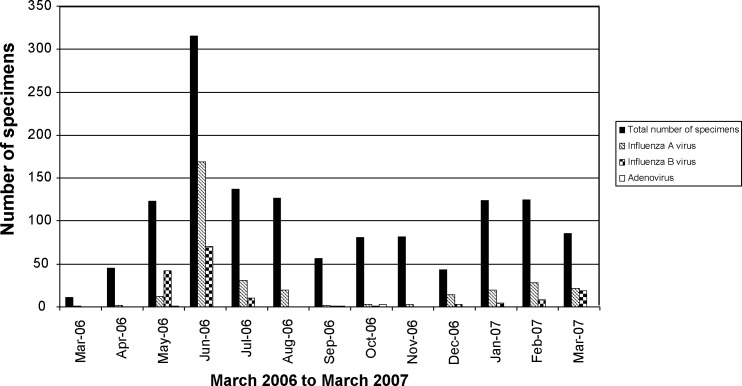
Influenza A virus was the dominant infection with a laboratory-confirmed incidence of 24% (326/1354) and a predominance of the H3N2 subtype. The temporal pattern for influenza A virus infections coincided with the nation-wide pattern in the civilian community. Detection rates of 12% (159/1354) and 2.7% (5/1354) were obtained for influenza B virus and other respiratory viruses, respectively.
The laboratory findings identified influenza A virus as the primary causative viral agent for FRI in the Singapore military, in strong contrast to findings from temperate countries and countries where recruits are often vaccinated for influenza. Our results suggest that influenza vaccination should be considered as a requirement to reduce the incidence of influenza infections. This is the first report describing respiratory infections in a tropical military setting, in a developed country in Asia.
军人极易罹患发热性呼吸道疾病(FRI),这可能是由于在军队环境中存在拥挤、压力和其他危险因素。
我们的目的是调查在新加坡热带气候条件下接受训练的新兵中引起 FRI 的病毒病原体。
2006 年 3 月至 2007 年 4 月,共采集了 1354 例咽拭子(喉咙)标本,这些标本来自体温≥38°C 并伴有咳嗽和/或喉咙痛的报告患病的新兵。实时聚合酶链反应(PCR)用于检测流感 A 和 B 病毒以及腺病毒(H-AdV),而所有标本的其余呼吸道病毒均使用常规 PCR 进行检测。
流感 A 病毒是主要感染病原体,实验室确诊率为 24%(326/1354),且以 H3N2 亚型为主。流感 A 病毒感染的时间模式与全国范围内的平民社区模式一致。流感 B 病毒和其他呼吸道病毒的检出率分别为 12%(159/1354)和 2.7%(5/1354)。
实验室结果表明,流感 A 病毒是新加坡军队 FRI 的主要病原体,与温带国家和新兵常接种流感疫苗的国家的发现形成鲜明对比。我们的结果表明,应考虑接种流感疫苗以降低流感感染的发生率。这是首次在亚洲发达国家描述热带军队环境中的呼吸道感染。