Biodefence Centre, Ministry of Defence, Singapore, Singapore.
PLoS One. 2011 Mar 2;6(3):e17468. doi: 10.1371/journal.pone.0017468.
Influenza infections present with wide-ranging clinical features. We aim to compare the differences in presentation between influenza and non-influenza cases among those with febrile respiratory illness (FRI) to determine predictors of influenza infection.
Personnel with FRI (defined as fever ≥ 37.5 °C, with cough or sore throat) were recruited from the sentinel surveillance system in the Singapore military. Nasal washes were collected, and tested using the Resplex II and additional PCR assays for etiological determination. Interviewer-administered questionnaires collected information on patient demographics and clinical features. Univariate comparison of the various parameters was conducted, with statistically significant parameters entered into a multivariate logistic regression model. The final multivariate model for influenza versus non-influenza cases was used to build a predictive probability clinical diagnostic model.
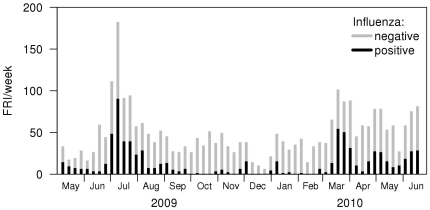
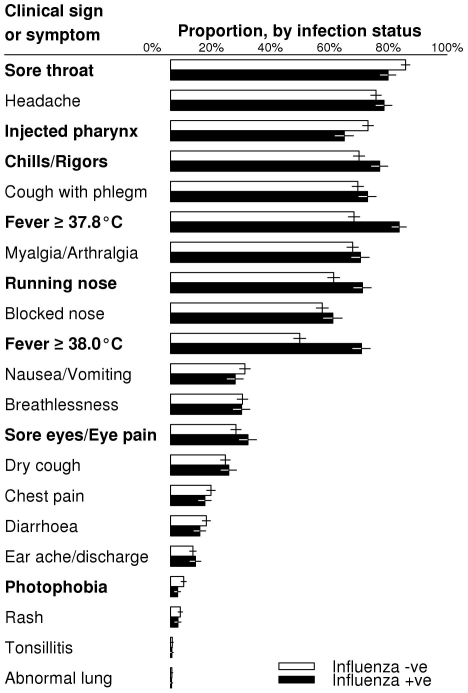
821 out of 2858 subjects recruited from 11 May 2009 to 25 Jun 2010 had influenza, of which 434 (52.9%) had 2009 influenza A (H1N1), 58 (7.1%) seasonal influenza A (H3N2) and 269 (32.8%) influenza B. Influenza-positive cases were significantly more likely to present with running nose, chills and rigors, ocular symptoms and higher temperature, and less likely with sore throat, photophobia, injected pharynx, and nausea/vomiting. Our clinical diagnostic model had a sensitivity of 65% (95% CI: 58%, 72%), specificity of 69% (95% CI: 62%, 75%), and overall accuracy of 68% (95% CI: 64%, 71%), performing significantly better than conventional influenza-like illness (ILI) criteria.
Use of a clinical diagnostic model may help predict influenza better than the conventional ILI definition among young adults with FRI.
流感感染表现出广泛的临床特征。我们旨在比较发热性呼吸道疾病(FRI)中流感和非流感病例之间的表现差异,以确定流感感染的预测因素。
从新加坡军队的哨点监测系统中招募了患有 FRI(定义为体温≥37.5°C,伴有咳嗽或喉咙痛)的人员。采集鼻洗液,使用 Resplex II 进行检测,并进行额外的 PCR 检测以确定病因。访谈者管理的问卷收集了患者人口统计学和临床特征的信息。对各种参数进行了单变量比较,将统计学上显著的参数纳入多变量逻辑回归模型。用于建立预测概率临床诊断模型的流感与非流感病例的最终多变量模型。
2009 年 5 月 11 日至 2010 年 6 月 25 日期间,从 2858 名招募的受试者中,有 821 名患有流感,其中 434 名(52.9%)患有 2009 年甲型 H1N1 流感,58 名(7.1%)季节性甲型 H3N2 流感和 269 名(32.8%)乙型流感。流感阳性病例更有可能出现流鼻涕、寒战和肌痛、眼部症状和更高的体温,而不太可能出现喉咙痛、畏光、充血咽和恶心/呕吐。我们的临床诊断模型的敏感性为 65%(95%CI:58%,72%),特异性为 69%(95%CI:62%,75%),总准确率为 68%(95%CI:64%,71%),表现明显优于传统的流感样疾病(ILI)标准。
在患有 FRI 的年轻成年人中,使用临床诊断模型预测流感可能比传统的 ILI 定义更好。