Departments of Medicine, University of Rochester Medical Center, Rochester, NY, USA.
Crit Care Med. 2010 Apr;38(4):1069-77. doi: 10.1097/CCM.0b013e3181d16a3e.
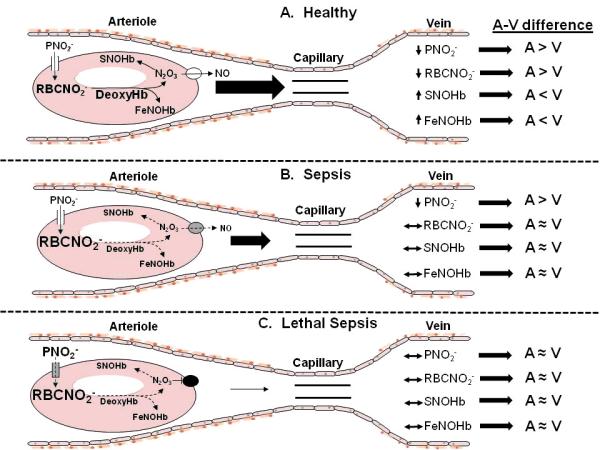
Nitric oxide deficiency may contribute to microvascular dysfunction in sepsis. Current physiologic paradigms contend that nitrite and/or S-nitrosohemoglobin mediate intravascular delivery of nitric oxide. These nitric oxide metabolites are purportedly consumed during hemoglobin deoxygenation, producing nitric oxide and coupling intravascular nitric oxide delivery with metabolic demand. Systemic nitrite and S-nitrosohemoglobin consumption can be assessed by comparing their concentrations in arterial vs. venous blood. We hypothesized that arterial vs. venous differences in nitrite and S-nitrosohemoglobin are diminished in sepsis and associated with mortality.
Case-control and prospective cohort study.
Adult intensive care units of an academic medical center.
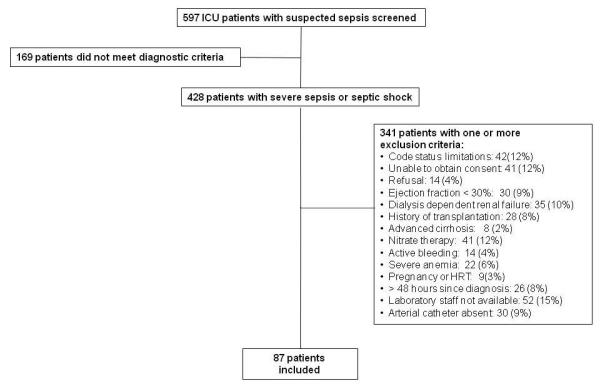
Eighty-seven critically ill septic patients and 52 control subjects.
None.
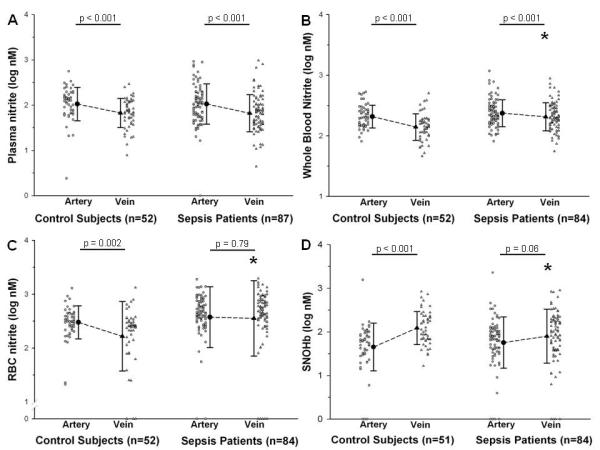
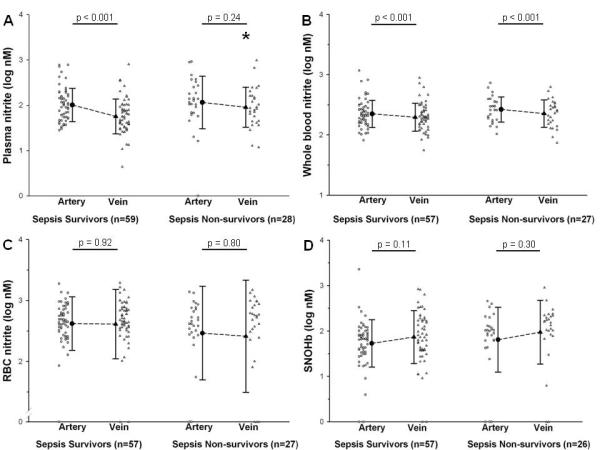
Nitrite and S-nitrosohemoglobin were measured using tri-iodide-based reductive chemiluminescence. In control subjects, arterial plasma, whole blood, and red blood cell nitrite levels were higher than the corresponding venous levels. In contrast, S-nitrosohemoglobin was higher in venous compared to arterial blood. In septic patients, arterial vs. venous red blood cell nitrite and S-nitrosohemoglobin differences were absent. Furthermore, the plasma nitrite arterial vs. venous difference was absent in nonsurvivors.
In health, nitrite levels are higher in arterial vs. venous blood (suggesting systemic nitrite consumption), whereas S-nitrosohemoglobin levels are higher in venous vs. arterial blood (suggesting systemic S-nitrosohemoglobin production). These arterial vs. venous differences are diminished in sepsis, and diminished arterial vs. venous plasma nitrite differences are associated with mortality. These data suggest pathologic disruption of systemic nitrite utilization in sepsis.
一氧化氮缺乏可能导致脓毒症中的微血管功能障碍。目前的生理模式认为,亚硝酸盐和/或 S-亚硝基血红蛋白介导血管内一氧化氮的输送。据称,这些一氧化氮代谢物在血红蛋白脱氧时被消耗,产生一氧化氮并将血管内一氧化氮输送与代谢需求相偶联。通过比较动脉血与静脉血中亚硝酸盐和 S-亚硝基血红蛋白的浓度,可以评估系统中亚硝酸盐和 S-亚硝基血红蛋白的消耗。我们假设,脓毒症中动脉与静脉之间亚硝酸盐和 S-亚硝基血红蛋白的差异减小,并与死亡率相关。
病例对照和前瞻性队列研究。
学术医疗中心的成人重症监护病房。
87 例危重脓毒症患者和 52 例对照受试者。
无。
使用三碘化物还原化学发光法测量亚硝酸盐和 S-亚硝基血红蛋白。在对照组中,动脉血浆、全血和红细胞中亚硝酸盐水平高于相应的静脉水平。相比之下,S-亚硝基血红蛋白在静脉血中高于动脉血。在脓毒症患者中,动脉与静脉之间红细胞亚硝酸盐和 S-亚硝基血红蛋白的差异消失。此外,在非幸存者中,血浆中亚硝酸盐的动脉与静脉差异也消失了。
在健康状态下,动脉血中亚硝酸盐水平高于静脉血(提示系统中亚硝酸盐消耗),而 S-亚硝基血红蛋白水平在静脉血中高于动脉血(提示系统 S-亚硝基血红蛋白生成)。这些动脉与静脉之间的差异在脓毒症中减少,并且减少的动脉与静脉血浆中亚硝酸盐差异与死亡率相关。这些数据表明脓毒症中系统性亚硝酸盐利用的病理性破坏。