Department of Biological Chemistry, Chao Family Comprehensive Cancer Center, University of California Irvine, Irvine, CA, USA.
Exp Mol Med. 2022 Sep;54(9):1354-1366. doi: 10.1038/s12276-022-00803-2. Epub 2022 Sep 8.
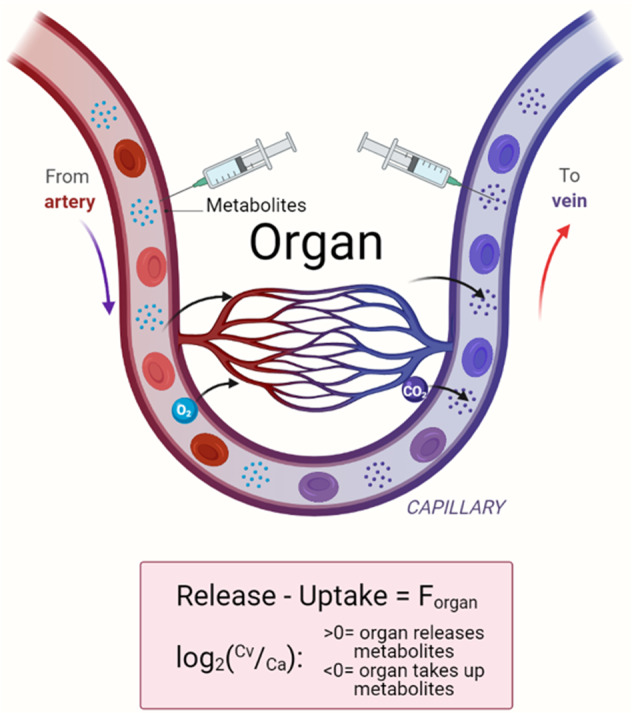
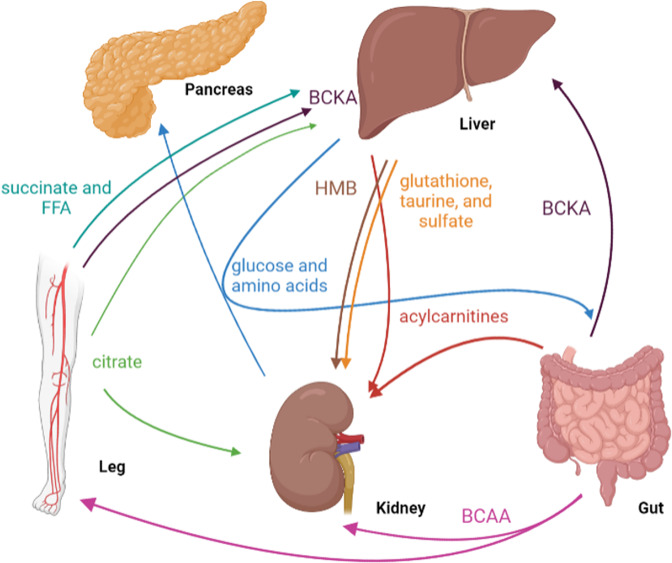
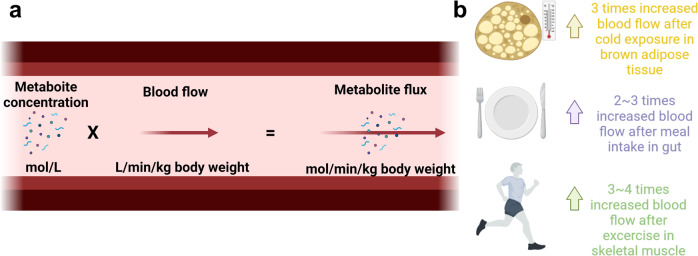
Mammalian organs convert dietary nutrients into circulating metabolites and share them to maintain whole-body metabolic homeostasis. While the concentrations of circulating metabolites have been frequently measured in a variety of pathophysiological conditions, the exchange flux of circulating metabolites between organs is not easily measurable due to technical difficulties. Isotope tracing is useful for measuring such fluxes for a metabolite of interest, but the shuffling of isotopic atoms between metabolites requires mathematical modeling. Arteriovenous metabolite gradient measurements can complement isotope tracing to infer organ-specific net fluxes of many metabolites simultaneously. Here, we review the historical development of arteriovenous measurements and discuss their advantages and limitations with key example studies that have revealed metabolite exchange flux between organs in diverse pathophysiological contexts.
哺乳动物器官将膳食营养素转化为循环代谢物,并进行分享以维持全身代谢稳态。虽然循环代谢物的浓度在各种病理生理条件下经常被测量,但由于技术困难,循环代谢物在器官之间的交换通量不容易被测量。同位素示踪法对于测量感兴趣的代谢物的这种通量是有用的,但是同位素原子在代谢物之间的混合需要数学建模。动静脉代谢物梯度测量可以补充同位素示踪法,以同时推断许多代谢物在器官特异性的净通量。在这里,我们回顾了动静脉测量的历史发展,并讨论了它们的优点和局限性,同时还讨论了一些关键的例子研究,这些研究揭示了不同病理生理背景下器官之间的代谢物交换通量。