Center for Microbial Genetics and Genomics, Northern Arizona University, Flagstaff, AZ 86011-4073, USA.
BMC Plant Biol. 2010 Jan 18;10:13. doi: 10.1186/1471-2229-10-13.
Castor bean (Ricinus communis) is an agricultural crop and garden ornamental that is widely cultivated and has been introduced worldwide. Understanding population structure and the distribution of castor bean cultivars has been challenging because of limited genetic variability. We analyzed the population genetics of R. communis in a worldwide collection of plants from germplasm and from naturalized populations in Florida, U.S. To assess genetic diversity we conducted survey sequencing of the genomes of seven diverse cultivars and compared the data to a reference genome assembly of a widespread cultivar (Hale). We determined the population genetic structure of 676 samples using single nucleotide polymorphisms (SNPs) at 48 loci.
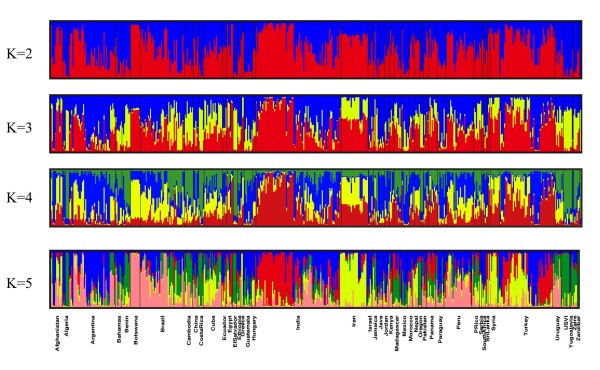
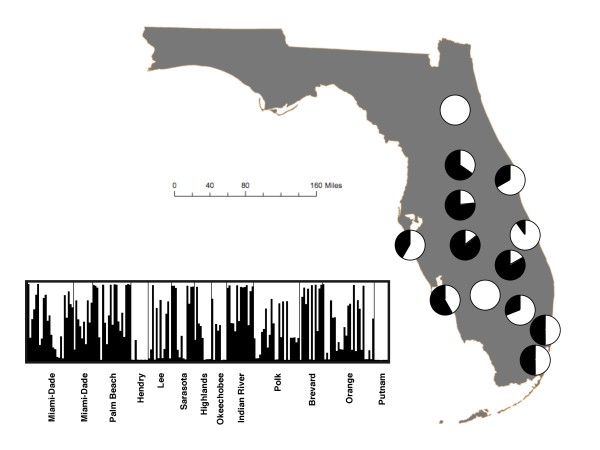
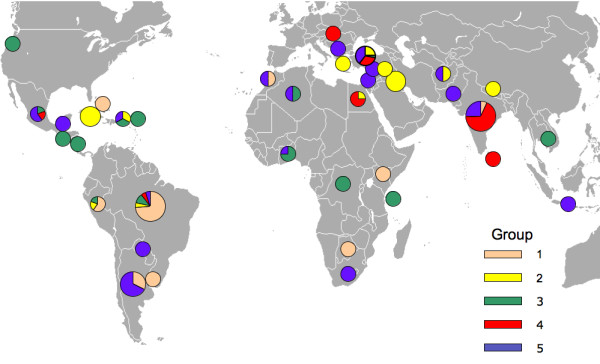
Bayesian clustering indicated five main groups worldwide and a repeated pattern of mixed genotypes in most countries. High levels of population differentiation occurred between most populations but this structure was not geographically based. Most molecular variance occurred within populations (74%) followed by 22% among populations, and 4% among continents. Samples from naturalized populations in Florida indicated significant population structuring consistent with local demes. There was significant population differentiation for 56 of 78 comparisons in Florida (pairwise population phiPT values, p < 0.01).
Low levels of genetic diversity and mixing of genotypes have led to minimal geographic structuring of castor bean populations worldwide. Relatively few lineages occur and these are widely distributed. Our approach of determining population genetic structure using SNPs from genome-wide comparisons constitutes a framework for high-throughput analyses of genetic diversity in plants, particularly in species with limited genetic diversity.
蓖麻(Ricinus communis)是一种农业作物和园林观赏植物,广泛种植,已在全球范围内引种。由于遗传变异有限,了解蓖麻种群结构和品种分布一直具有挑战性。我们分析了来自种质资源和美国佛罗里达州归化种群的蓖麻植物的世界范围的种群遗传结构。为了评估遗传多样性,我们对七个不同品种的基因组进行了调查测序,并将数据与广泛种植的品种(Hale)的参考基因组组装进行了比较。我们使用 48 个位点的单核苷酸多态性(SNP)对 676 个样本进行了种群遗传结构分析。
贝叶斯聚类表明,全世界有五个主要群体,大多数国家的基因型混合模式重复出现。大多数种群之间存在高水平的种群分化,但这种结构不是基于地理的。大多数分子方差发生在种群内(74%),其次是种群间(22%),最后是各大陆间(4%)。佛罗里达州归化种群的样本表明存在显著的种群结构,与当地种群一致。在佛罗里达州,56 对 78 个比较中有 56 对存在显著的种群分化(成对种群 phiPT 值,p < 0.01)。
遗传多样性水平低,基因型混合导致全世界蓖麻种群的地理结构最小化。相对较少的谱系发生,而且分布广泛。我们使用来自全基因组比较的 SNP 来确定种群遗传结构的方法为植物遗传多样性的高通量分析提供了一个框架,特别是在遗传多样性有限的物种中。