School of Public Health, University of California, Berkeley, CA 94720, USA.
Anal Biochem. 2010 May 1;400(1):123-9. doi: 10.1016/j.ab.2010.01.018. Epub 2010 Jan 18.
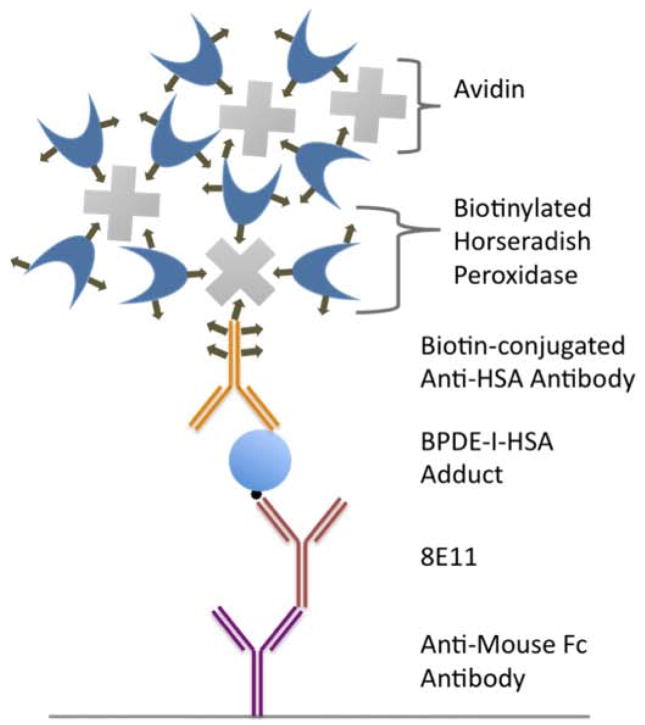
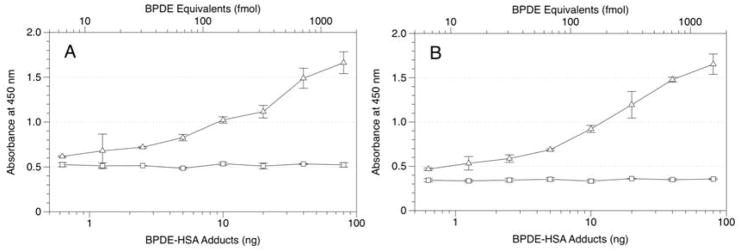
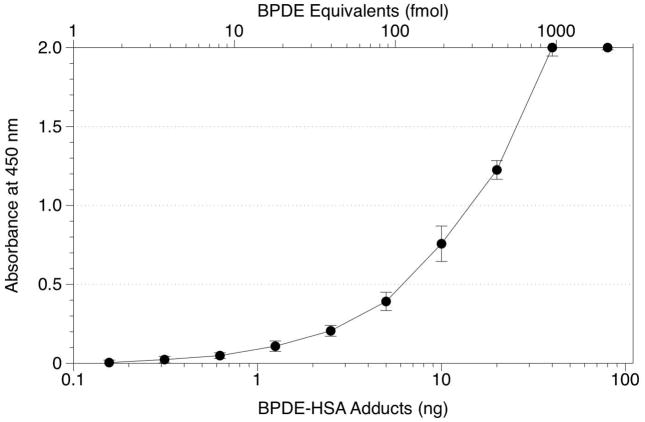
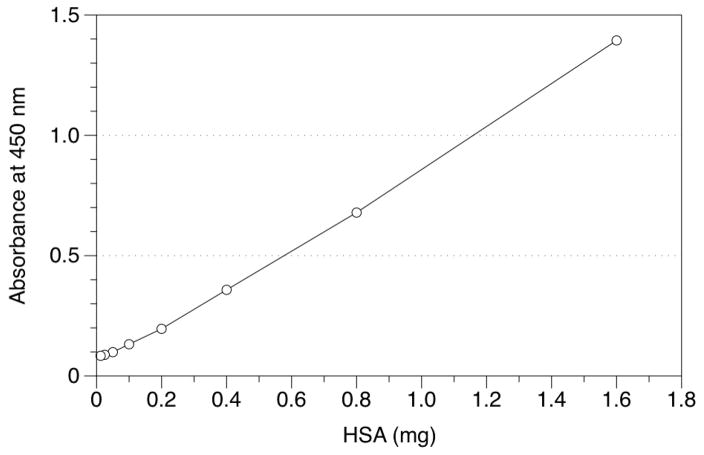
Adducts of benzo[a]pyrene-diolepoxide (BPDE) with blood nucleophiles have been used as biomarkers of exposure to polycyclic aromatic hydrocarbons (PAHs). The most popular such assay is a competitive enzyme-linked immunosorbent assay (ELISA) that employs monoclonal antibody 8E11 to detect benzo[a]pyrene tetrols following hydrolysis of BPDE adducts from lymphocyte DNA or human serum albumin (HSA). Here we used 8E11 as the capture antibody in a sandwich ELISA to detect BPDE-HSA adducts directly in 1-mg samples of HSA or 20 microl of serum/plasma. The assay employs an anti-HSA antibody for detection, and this is amplified by an avidin/biotinylated horseradish peroxidase complex. The sandwich ELISA has advantages of specificity and simplicity and is approximately 10 times more sensitive than the competitive ELISA. To validate the assay, HSA samples were assayed from three populations with known high PAH exposures (coke oven workers), medium PAH exposures (steel factory control workers), and low PAH exposures (volunteer subjects) (n=30). The respective geometric mean levels of BPDE-HSA adducts--67.8, 14.7, and 1.93 ng/mg HSA (1010, 220, and 28.9 fmol BPDE equiv/mg HSA)--were significantly different (P<0.05). The sandwich ELISA will be useful for screening PAH exposures in large epidemiologic studies and can be extended to other adducts for which capture antibodies are available.
苯并[a]芘二环氧醚(BPDE)与血液亲核试剂的加合物已被用作多环芳烃(PAHs)暴露的生物标志物。最受欢迎的此类测定方法是竞争性酶联免疫吸附测定(ELISA),该方法使用单克隆抗体 8E11 检测淋巴细胞 DNA 或人血清白蛋白(HSA)中 BPDE 加合物水解后形成的苯并[a]芘四醇。在这里,我们在夹心 ELISA 中使用 8E11 作为捕获抗体,直接检测 1mg HSA 样品或 20 微升血清/血浆中的 BPDE-HSA 加合物。该测定法使用针对 HSA 的抗体进行检测,该抗体通过亲和素/生物素化辣根过氧化物酶复合物进行放大。夹心 ELISA 具有特异性和简单性的优点,其灵敏度比竞争性 ELISA 高约 10 倍。为了验证该测定法,我们对来自高 PAH 暴露(焦炉工人)、中 PAH 暴露(钢铁厂对照工人)和低 PAH 暴露(志愿者)三个群体的 HSA 样本进行了检测(n=30)。BPDE-HSA 加合物的几何平均水平分别为 67.8、14.7 和 1.93ng/mg HSA(1010、220 和 28.9fmol BPDE 等效/mg HSA),差异有统计学意义(P<0.05)。夹心 ELISA 将有助于在大型流行病学研究中筛选 PAH 暴露情况,并且可以扩展到其他具有捕获抗体的加合物。