Cardio-Thoracic and Vascular Department, University of Pisa, Pisa, Italy.
Respir Res. 2010 Jan 19;11(1):5. doi: 10.1186/1465-9921-11-5.
The discrepancy between functional and inflammatory airway response to ozone has been reported in normal subjects, but few data are available for stable asthmatics regularly treated with inhaled corticosteroids.
Twenty-three well controlled, regularly treated, mild-to-moderate asthmatic patients underwent two sequential randomised exposures to either filtered air or ozone (0.3 ppm for 2 hours) in a challenge chamber. Pulmonary function (PF) was monitored, and patients with FEV1 decrease greater than 10% from pre-challenge value were considered as responders. Immediately after each exposure, exhaled breath condensate (EBC) was collected to measure malondialdehyde (MDA). Six hours after each exposure, PF and EBC collection were repeated, and sputum was induced to measure inflammatory cell counts and soluble mediators (IL-8 and neutrophil elastase). The response to ozone was also evaluated according to the presence of polymorphism in oxidative stress related NQO1 and GSTM1 genes.
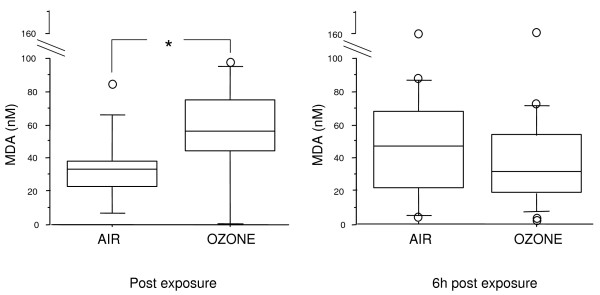
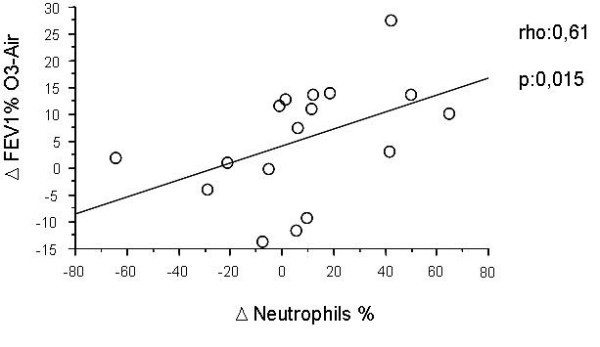
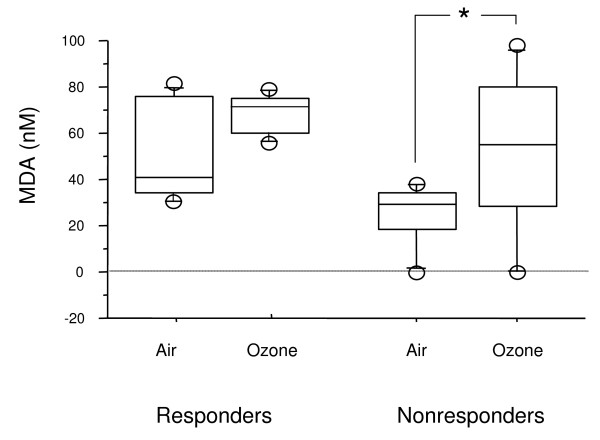
After ozone exposure, sputum neutrophils significantly increased in responders (n = 8), but not in nonresponders (n = 15). Other markers of neutrophil activation in sputum supernatant and MDA in EBC significantly increased in all patients, but only in nonresponders the increase was significant. In nonresponders, sputum eosinophils also significantly increased after ozone. There was a positive correlation between ozone-induced FEV1 fall and increase in sputum neutrophils. No difference in functional or inflammatory response to ozone was observed between subjects with or without the combination of NQO1wt- GSTM1null genotypes.
Markers of neutrophilic inflammation and oxidative stress increase also in asthmatic subjects not responding to ozone. A greater functional response to ozone is associated with greater neutrophil airway recruitment in asthmatic subjects.
在正常受试者中,已经报道了功能和炎症性气道对臭氧的反应之间存在差异,但对于经常接受吸入性皮质类固醇治疗的稳定哮喘患者,可用的数据很少。
23 名控制良好、经常接受治疗、轻度至中度哮喘患者在挑战室内先后进行两次随机暴露于过滤空气或臭氧(0.3ppm,持续 2 小时)。监测肺功能(PF),FEV1 较预挑战值下降超过 10%的患者被认为是反应者。在每次暴露后立即收集呼出气冷凝液(EBC)以测量丙二醛(MDA)。在每次暴露后 6 小时,重复 PF 和 EBC 采集,并诱导痰液以测量炎症细胞计数和可溶性介质(IL-8 和中性粒细胞弹性蛋白酶)。还根据与氧化应激相关的 NQO1 和 GSTM1 基因的多态性评估了对臭氧的反应。
在臭氧暴露后,反应者(n=8)的痰液中性粒细胞显著增加,但非反应者(n=15)则没有。痰液上清液和 EBC 中 MDA 中其他中性粒细胞活化标志物也在所有患者中显著增加,但仅在非反应者中增加具有统计学意义。在非反应者中,臭氧后痰液嗜酸性粒细胞也显著增加。臭氧引起的 FEV1 下降与痰液中性粒细胞增加之间存在正相关。在有无 NQO1wt-GSTM1null 基因型组合的患者中,对臭氧的功能或炎症反应无差异。
在对臭氧无反应的哮喘患者中,也会增加中性粒细胞炎症和氧化应激的标志物。臭氧对功能的反应越大,与哮喘患者气道中性粒细胞募集增加相关。