Laboratoire de Parasitologie Pharmaceutique (CNRS UMR 6553), Faculté des Sciences Pharmaceutiques et Biologiques, 35043 Rennes, France.
BMC Evol Biol. 2010 Jan 20;10:18. doi: 10.1186/1471-2148-10-18.
Despite its key location between the rest of the continent and Europe, research on the phylogeography of north African species remains very limited compared to European and North American taxa. The Mediterranean land mollusc Cornu aspersum (= Helix aspersa) is part of the few species widely sampled in north Africa for biogeographical analysis. It then provides an excellent biological model to understand phylogeographical patterns across the Mediterranean basin, and to evaluate hypotheses of population differentiation. We investigated here the phylogeography of this land snail to reassess the evolutionary scenario we previously considered for explaining its scattered distribution in the western Mediterranean, and to help to resolve the question of the direction of its range expansion (from north Africa to Europe or vice versa). By analysing simultaneously individuals from 73 sites sampled in its putative native range, the present work provides the first broad-scale screening of mitochondrial variation (cyt b and 16S rRNA genes) of C. aspersum.
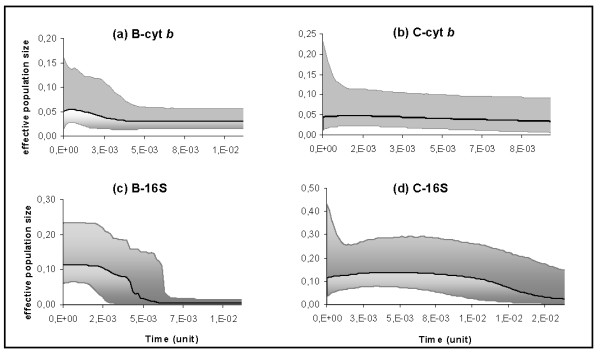
Phylogeographical structure mirrored previous patterns inferred from anatomy and nuclear data, since all haplotypes could be ascribed to a B (West) or a C (East) lineage. Alternative migration models tested confirmed that C. aspersum most likely spread from north Africa to Europe. In addition to Kabylia in Algeria, which would have been successively a centre of dispersal and a zone of secondary contacts, we identified an area in Galicia where genetically distinct west and east type populations would have regained contact.
Vicariant and dispersal processes are reviewed and discussed in the light of signatures left in the geographical distribution of the genetic variation. In referring to Mediterranean taxa which show similar phylogeographical patterns, we proposed a parsimonious scenario to account for the "east-west" genetic splitting and the northward expansion of the western (B) clade which roughly involves (i) the dispersal of ancestral (eastern) types through Oligocene terranes in the Western Mediterranean (ii) the Tell Atlas orogenesis as gene flow barrier between future west and east populations, (iii) the impact of recurrent climatic fluctuations from mid-Pliocene to the last ice age, (iv) the loss of the eastern lineage during Pleistocene northwards expansion phases.
尽管北非位于非洲大陆和欧洲之间的关键位置,但与欧洲和北美分类群相比,对北非物种系统地理学的研究仍然非常有限。地中海陆地蜗牛 Cornu aspersum(= Helix aspersa)是北非广泛采样进行生物地理分析的少数几种物种之一。它为理解地中海盆地的系统地理学模式提供了一个极好的生物学模型,并有助于评估种群分化的假说。我们在这里研究了这种陆地蜗牛的系统地理学,以重新评估我们之前用于解释其在西地中海分散分布的进化情景,并帮助解决其分布范围扩张的方向问题(从北非到欧洲还是反之亦然)。通过同时分析来自其假定原生范围内 73 个采样点的个体,本研究首次广泛筛选了 C. aspersum 的线粒体变异(cyt b 和 16S rRNA 基因)。
系统地理学结构反映了先前从解剖学和核数据推断出的模式,因为所有单倍型都可以归因于 B(西部)或 C(东部)谱系。测试的替代迁移模型证实,C. aspersum 最有可能从北非传播到欧洲。除了阿尔及利亚的 Kabylia,它可能曾经是扩散中心和二次接触区,我们还确定了加利西亚的一个地区,在那里遗传上不同的西部和东部类型种群将重新建立联系。
我们回顾和讨论了分歧和扩散过程,并根据遗传变异的地理分布留下的特征进行了讨论。在提到表现出类似系统地理学模式的地中海分类群时,我们提出了一个简约的情景来解释“东西”遗传分裂和西部(B)谱系的向北扩张,这大致涉及 (i) 古近纪terranes 中祖先(东部)类型的扩散 (ii) 特拉斯山脉造山运动作为未来西部和东部种群之间的基因流动障碍,(iii) 从中新世到最后一个冰河时代的反复气候波动的影响,(iv) 东部谱系在更新世向北扩张阶段的损失。