International Emerging Infections Program, Kenya, and Centers for Disease Control and Prevention, Nairobi and Kisumu, Kenya.
Int J Epidemiol. 2010 Apr;39(2):450-8. doi: 10.1093/ije/dyp374. Epub 2010 Jan 20.
In African settings with poor access to health care, surveillance and surveys of disease burden are often done through home visits. The optimal recall period to capture data on symptoms and health utilization is unknown.
We collected illness data among 53 000 people during fortnightly home visits in rural and urban Kenya. Dates of cough, fever and diarrhoea in the past 2 weeks and health-seeking behaviour were recorded. Incidence rates were modelled using Poisson regression for data collected from 1 July 2006 to 30 June 2007.
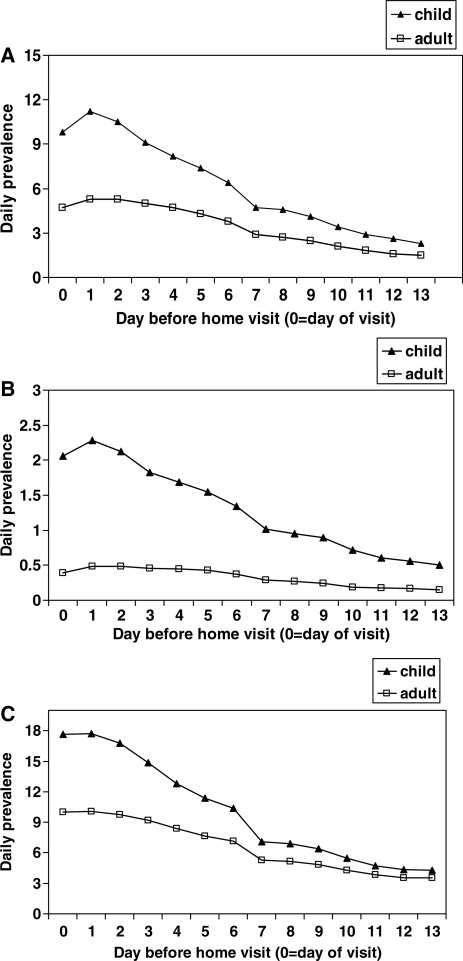
Incidence rates were higher in days 0-6 before the home visit than in days 7-13 before the home visit for all three symptoms, for the rural and urban sites, for children and adults, for self- and proxy-reported symptoms and for severe and non-severe illness in children. Recall decay was steeper in the rural than the urban sites, and for proxy- than self-reported symptoms. The daily prevalence of symptoms fell <80% of the maximum prevalence when asking about symptoms >3 days before the home visit for children and >4 days for persons > or =5 years of age. Recall of previously documented clinic visits, and prescriptions of antimalarials and antibiotics also declined by approximately 7, 15 and 23% per week, respectively, in children aged <5 years, and 6, 20 and 16%, respectively, in older persons (P < 0.0001 for each decline).
A 2-week recall period underestimates true disease rates and health-care utilization. Shorter recall periods of 3 days in children and 4 days in adults would likely yield more accurate data.
在医疗条件较差的非洲环境中,疾病负担的监测和调查通常通过家访进行。目前尚不清楚最佳的回忆期来获取有关症状和卫生利用的数据。
我们在肯尼亚农村和城市地区的每两周一次的家访中收集了 53000 人的疾病数据。记录了过去 2 周内咳嗽、发烧和腹泻的日期以及寻求医疗服务的行为。使用泊松回归模型对 2006 年 7 月 1 日至 2007 年 6 月 30 日收集的数据进行发病率的建模。
对于所有三种症状,对于农村和城市地区、儿童和成人、自我和代理报告的症状以及儿童的严重和非严重疾病,在家访前 0-6 天的发病率均高于家访前 7-13 天的发病率。在农村地区比在城市地区,以及在代理报告比自我报告的症状中,回忆衰减更陡峭。当询问家访前 >3 天的症状时,儿童的症状日流行率下降到最大流行率的 <80%以下,而年龄 >或 =5 岁的人下降到 >4 天以下。在年龄 <5 岁的儿童中,之前记录的诊所就诊、抗疟药和抗生素处方的回忆也分别每周下降约 7%、15%和 23%,在年龄较大的人群中(每种下降均为 P < 0.0001)。
2 周的回忆期低估了真实的疾病率和卫生保健利用率。对于儿童,3 天的回忆期,对于成人,4 天的回忆期可能会产生更准确的数据。