Nationwide Children's Hospital, Columbus, OH, 43205, USA.
Intensive Care Med. 2010 Apr;36(4):680-7. doi: 10.1007/s00134-009-1747-2. Epub 2010 Jan 21.
To determine the incidence of vasospasm in children who have suffered moderate to severe traumatic brain injury.
A prospective observational pilot study in a 24-bed pediatric intensive care unit was performed. Twenty-two children aged 7 months to 14 years with moderate to severe traumatic brain injury as indicated by Glasgow Coma Score </=12 and abnormal head imaging were enrolled. Transcranial Doppler ultrasound was performed to identify and follow vasospasm. Patients with a flow velocity in the middle cerebral artery (MCA) >120 cm/s were considered to have vasospasm by criterion A. If flow velocity in the MCA was >120 cm/s and the Lindegaard ratio was >3, vasospasm was considered to be present by criterion B. Patients with basilar artery (BA) flow velocity >90 cm/s met criteria for vasospasm in the posterior circulation (criterion C).
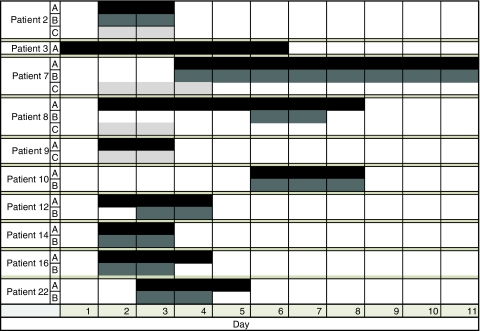
In the MCA, 45.5% of patients developed vasospasm based on criterion A and 36.3% developed vasospasm based on criterion B. A total of 18.2% of patients developed vasospasm in the BA by criterion C. Typical day of onset of vasospasm was hospital day 2-3. Duration of vasospasm in the anterior circulation was 4 +/- 2 days based on criteria A and 3 +/- 1 days based on criteria B. Vasospasm in the posterior circulation persisted for 2 +/- 1 days.
Using the adult criteria outlined above to diagnose vasospasm, a significant proportion of pediatric patients who have suffered moderate to severe traumatic brain injury develop vasospasm during the course of their treatment.
确定患有中重度创伤性脑损伤的儿童发生血管痉挛的发生率。
在 24 张病床的儿科重症监护病房进行了前瞻性观察性试点研究。共纳入 22 名年龄在 7 个月至 14 岁之间的儿童,这些儿童的格拉斯哥昏迷评分(GCS)≤12,且头部影像学异常,符合中度至重度创伤性脑损伤的标准。使用经颅多普勒超声来识别和跟踪血管痉挛。如果大脑中动脉(MCA)的血流速度>120cm/s,则通过标准 A 认为存在血管痉挛。如果 MCA 的血流速度>120cm/s 且林德加德比值>3,则通过标准 B 认为存在血管痉挛。基底动脉(BA)的血流速度>90cm/s 的患者符合后循环血管痉挛的标准(标准 C)。
根据标准 A,45.5%的患者在 MCA 中发生血管痉挛,根据标准 B,36.3%的患者发生血管痉挛。根据标准 C,18.2%的患者出现 BA 血管痉挛。血管痉挛的典型发病日期为住院第 2-3 天。根据标准 A,前循环的血管痉挛持续时间为 4 ± 2 天,根据标准 B,持续时间为 3 ± 1 天。后循环的血管痉挛持续了 2 ± 1 天。
使用上述成人标准来诊断血管痉挛,在接受治疗的中重度创伤性脑损伤的儿童中,相当一部分患者会发生血管痉挛。