Department of Medicine, University of Kuopio and Kuopio University Hospital, Kuopio, Finland.
Diabetes. 2010 Apr;59(4):829-35. doi: 10.2337/db09-1191. Epub 2010 Jan 27.
Sirtuin 1 (SIRT1) is implicated in the regulation of mitochondrial function, energy metabolism, and insulin sensitivity in rodents. No studies are available in humans to demonstrate that SIRT1 expression in insulin-sensitive tissues is associated with energy expenditure and insulin sensitivity.
Energy expenditure (EE), insulin sensitivity, and SIRT1 mRNA adipose tissue expression (n = 81) were measured by indirect calorimetry, hyperinsulinemic-euglycemic clamp, and quantitative RT-PCR in 247 nondiabetic offspring of type 2 diabetic patients.
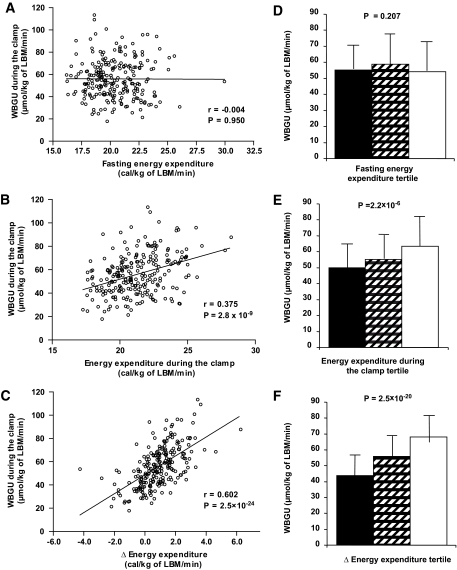
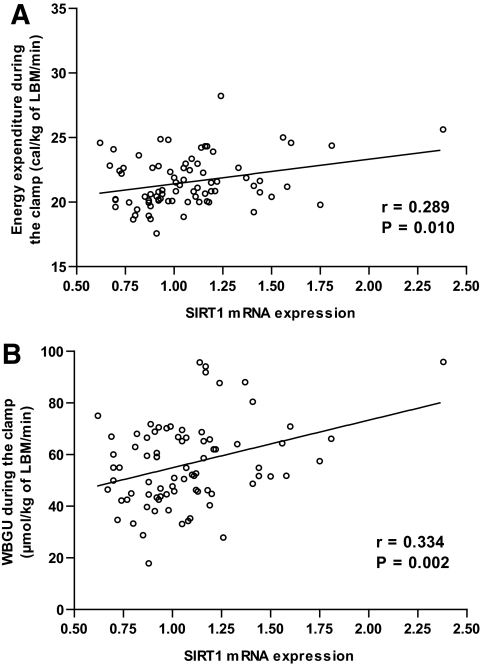
High EE during the clamp (r = 0.375, P = 2.8 x 10(-9)) and high DeltaEE (EE during the clamp - EE in the fasting state) (r = 0.602, P = 2.5 x 10(-24)) were associated with high insulin sensitivity. Adipose tissue SIRT1 mRNA expression was significantly associated with EE (r = 0.289, P = 0.010) and with insulin sensitivity (r = 0.334, P = 0.002) during hyperinsulinemic-euglycemic clamp. Furthermore, SIRT1 mRNA expression correlated significantly with the expression of several genes regulating mitochondrial function and energy metabolism (e.g., peroxisome proliferator-activated receptor gamma coactivator-1beta, estrogen-related receptor alpha, nuclear respiratory factor-1, and mitochondrial transcription factor A), and with several genes of the respiratory chain (e.g., including NADH dehydrogenase [ubiquinone] 1alpha subcomplex 2, cytochrome c, cytochrome c oxidase subunit IV, and ATP synthase).
Impaired stimulation of EE by insulin and low SIRT1 expression in insulin-sensitive tissues is likely to reflect impaired regulation of mitochondrial function associated with insulin resistance in humans.
Sirtuin 1(SIRT1)参与调节啮齿动物的线粒体功能、能量代谢和胰岛素敏感性。目前尚无人类研究表明胰岛素敏感组织中的 SIRT1 表达与能量消耗和胰岛素敏感性相关。
通过间接测热法、高胰岛素-正常血糖钳夹和定量 RT-PCR 测量了 247 名 2 型糖尿病患者的非糖尿病后代的能量消耗(EE)、胰岛素敏感性和脂肪组织 SIRT1 mRNA 表达(n = 81)。
钳夹期间高 EE(r = 0.375,P = 2.8 x 10(-9)) 和高ΔEE(EE 在钳夹期间 - EE 在禁食状态下)(r = 0.602,P = 2.5 x 10(-24)) 与高胰岛素敏感性相关。脂肪组织 SIRT1 mRNA 表达与 EE(r = 0.289,P = 0.010)和高胰岛素血症期间的胰岛素敏感性(r = 0.334,P = 0.002)显著相关。此外,SIRT1 mRNA 表达与调节线粒体功能和能量代谢的几个基因(如过氧化物酶体增殖物激活受体γ共激活因子-1β、雌激素相关受体α、核呼吸因子-1 和线粒体转录因子 A)的表达以及呼吸链的几个基因(如 NADH 脱氢酶[泛醌] 1α亚基 2、细胞色素 c、细胞色素 c 氧化酶亚基 IV 和 ATP 合酶)显著相关。
胰岛素刺激 EE 受损和胰岛素敏感组织中 SIRT1 表达降低可能反映了人类胰岛素抵抗相关的线粒体功能调节受损。