Department of Statistics and Center for Theoretical Neuroscience, Columbia University, New York, New York, USA.
PLoS One. 2010 Jan 22;5(1):e8853. doi: 10.1371/journal.pone.0008853.
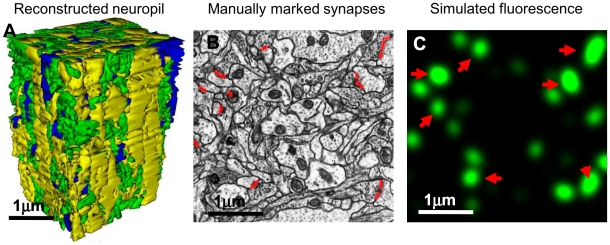
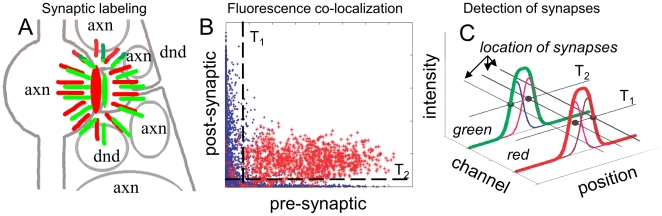
We propose a new method for mapping neural connectivity optically, by utilizing Cre/Lox system Brainbow to tag synapses of different neurons with random mixtures of different fluorophores, such as GFP, YFP, etc., and then detecting patterns of fluorophores at different synapses using light microscopy (LM). Such patterns will immediately report the pre- and post-synaptic cells at each synaptic connection, without tracing neural projections from individual synapses to corresponding cell bodies. We simulate fluorescence from a population of densely labeled synapses in a block of hippocampal neuropil, completely reconstructed from electron microscopy data, and show that high-end LM is able to detect such patterns with over 95% accuracy. We conclude, therefore, that with the described approach neural connectivity in macroscopically large neural circuits can be mapped with great accuracy, in scalable manner, using fast optical tools, and straightforward image processing. Relying on an electron microscopy dataset, we also derive and explicitly enumerate the conditions that should be met to allow synaptic connectivity studies with high-resolution optical tools.
我们提出了一种新的光学神经连接映射方法,利用 Cre/Lox 系统 Brainbow 将不同神经元的突触用不同荧光染料(如 GFP、YFP 等)的随机混合物进行标记,然后使用光学显微镜(LM)检测不同突触处的荧光模式。这种模式可以立即报告每个突触连接的前突触和后突触细胞,而无需从单个突触追踪神经投射到相应的细胞体。我们模拟了从电子显微镜数据完全重建的海马神经突块中高密度标记突触的荧光,并表明高端 LM 能够以超过 95%的准确率检测到这种模式。因此,我们得出结论,使用描述的方法,可以使用快速光学工具和简单的图像处理,以可扩展的方式,高精度地映射宏观上大型神经回路的神经连接。我们还依赖于一个电子显微镜数据集,推导出并明确列举了允许使用高分辨率光学工具进行突触连接研究的条件。