Departments of Bioengineering, The Pennsylvania State University, University Park, Pennsylvania 16802, USA.
J Am Chem Soc. 2010 Feb 24;132(7):2110-1. doi: 10.1021/ja908773a.
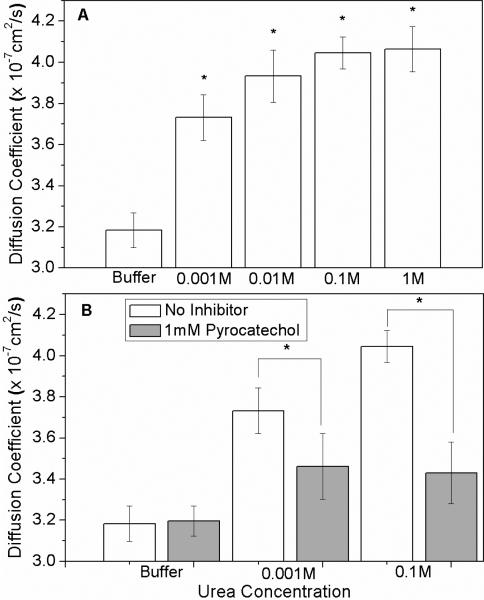
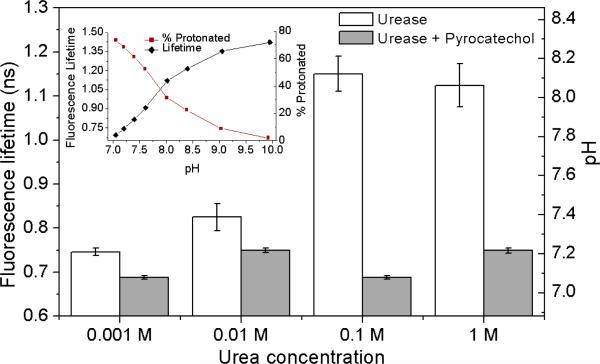
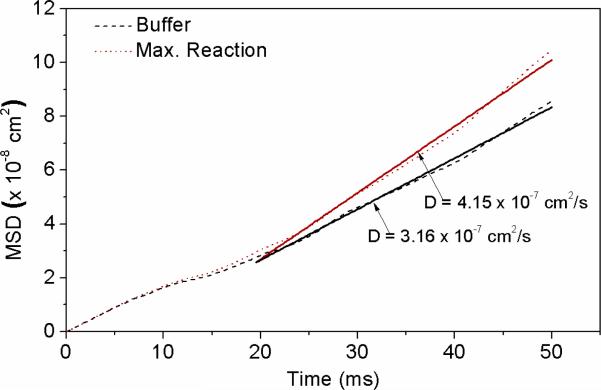
We show that diffusion of single urease enzyme molecules increases in the presence of urea in a concentration-dependent manner and calculate the force responsible for this increase. Urease diffusion measured using fluorescence correlation spectroscopy increased by 16-28% over buffer controls at urea concentrations ranging from 0.001 to 1 M. This increase was significantly attenuated when urease was inhibited with pyrocatechol, demonstrating that the increase in diffusion was the result of enzyme catalysis of urea. Local molecular pH changes as measured using the pH-dependent fluorescence lifetime of SNARF-1 conjugated to urease were not sufficient to explain the increase in diffusion. Thus, a force generated by self-electrophoresis remains the most plausible explanation. This force, evaluated using Brownian dynamics simulations, was 12 pN per reaction turnover. These measurements demonstrate force generation by a single enzyme molecule and lay the foundation for a further understanding of biological force generation and the development of enzyme-driven nanomotors.
我们证明,在存在尿素的情况下,单个脲酶分子的扩散会呈浓度依赖性增加,并计算出导致这种增加的力。使用荧光相关光谱法测量的脲酶扩散在 0.001 至 1 M 的尿素浓度范围内比缓冲对照增加了 16-28%。当脲酶被邻苯二酚抑制时,这种扩散的增加显著减弱,这表明扩散的增加是酶催化尿素的结果。使用与脲酶偶联的 SNARF-1 的 pH 依赖性荧光寿命测量的局部分子 pH 变化不足以解释扩散的增加。因此,自电泳产生的力仍然是最合理的解释。使用布朗动力学模拟评估的这种力为每个反应循环 12 pN。这些测量结果证明了单个酶分子产生力的能力,并为进一步理解生物力的产生和酶驱动纳米马达的发展奠定了基础。