MIRA: Institute for Biomedical Engineering, Department of Electrical Engineering, Mathematics, and Computer Science, University of Twente, Enschede, The Netherlands.
PLoS One. 2010 Jan 25;5(1):e8871. doi: 10.1371/journal.pone.0008871.
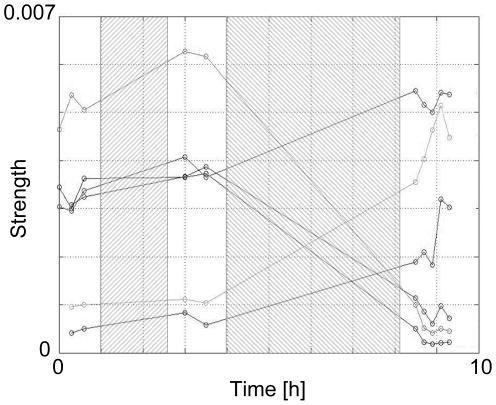
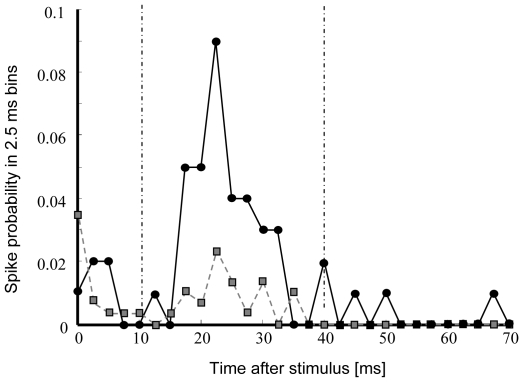
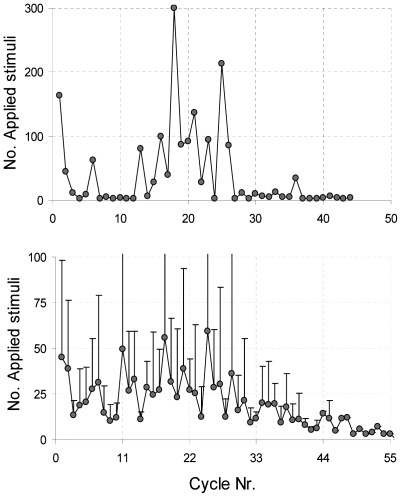
Learning, or more generally, plasticity may be studied using cultured networks of rat cortical neurons on multi electrode arrays. Several protocols have been proposed to affect connectivity in such networks. One of these protocols, proposed by Shahaf and Marom, aimed to train the input-output relationship of a selected connection in a network using slow electrical stimuli. Although the results were quite promising, the experiments appeared difficult to repeat and the training protocol did not serve as a basis for wider investigation yet. Here, we repeated their protocol, and compared our 'learning curves' to the original results. Although in some experiments the protocol did not seem to work, we found that on average, the protocol showed a significantly improved stimulus response indeed. Furthermore, the protocol always induced functional connectivity changes that were much larger than changes that occurred after a comparable period of random or no stimulation. Finally, our data shows that stimulation at a fixed electrode induces functional connectivity changes of similar magnitude as stimulation through randomly varied sites; both larger than spontaneous connectivity fluctuations. We concluded that slow electrical stimulation always induced functional connectivity changes, although uncontrolled. The magnitude of change increased when we applied the adaptive (closed-loop) training protocol. We hypothesize that networks develop an equilibrium between connectivity and activity. Induced connectivity changes depend on the combination of applied stimulus and initial connectivity. Plain stimuli may drive networks to the nearest equilibrium that accommodates this input, whereas adaptive stimulation may direct the space for exploration and force networks to a new balance, at a larger distance from the initial state.
使用多电极阵列上培养的大鼠皮质神经元网络可以研究学习,或者更一般地说,可塑性。已经提出了几种方案来影响此类网络中的连接。Shahaf 和 Marom 提出的方案之一旨在使用缓慢的电刺激训练网络中选定连接的输入-输出关系。尽管结果非常有希望,但实验似乎难以重复,并且该训练方案尚未成为更广泛研究的基础。在这里,我们重复了他们的方案,并将我们的“学习曲线”与原始结果进行了比较。尽管在一些实验中该方案似乎不起作用,但我们发现,平均而言,该方案确实显示出了显著改善的刺激反应。此外,该方案总是诱导功能连接变化,其幅度远大于随机或无刺激后发生的变化。最后,我们的数据表明,在固定电极上的刺激会引起与通过随机变化的部位进行刺激相似幅度的功能连接变化;均大于自发连接波动。我们得出结论,尽管是不可控的,但缓慢的电刺激总是会引起功能连接变化。当我们应用自适应(闭环)训练方案时,变化幅度会增加。我们假设网络在连接和活动之间形成平衡。诱导的连接变化取决于施加的刺激和初始连接的组合。普通刺激可能会使网络达到适应此输入的最近平衡点,而自适应刺激可能会为探索提供空间,并迫使网络在距离初始状态更远的新平衡点上达到新的平衡。