Department of Pathology, University of Verona Medical School, Verona, Italy.
J Transl Med. 2010 Jan 29;8:10. doi: 10.1186/1479-5876-8-10.
Pancreatic ductal adenocarcinoma (PDAC) remains a leading cause of cancer mortality for which novel gene therapy approaches relying on tumor-tropic adenoviruses are being tested.
We obtained the global transcriptional profiling of primary PDAC using RNA from eight xenografted primary PDAC, three primary PDAC bulk tissues, three chronic pancreatitis and three normal pancreatic tissues. The Affymetrix GeneChip HG-U133A was used. The results of the expression profiles were validated applying immunohistochemical and western blot analysis on a set of 34 primary PDAC and 10 established PDAC cell lines. Permissivity to viral vectors used for gene therapy, Adenovirus 5 and Adeno-Associated Viruses 5 and 6, was assessed on PDAC cell lines.
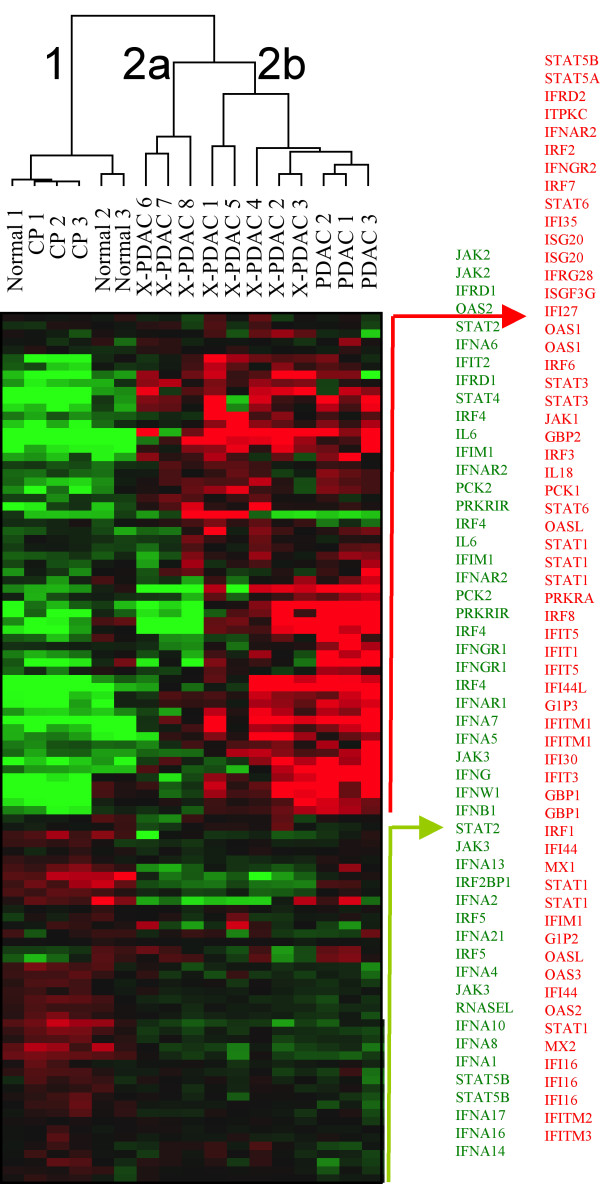
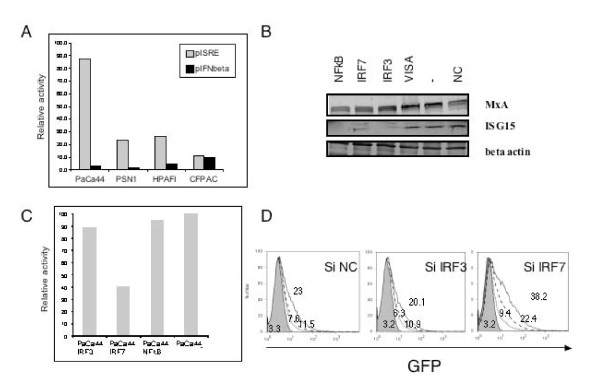
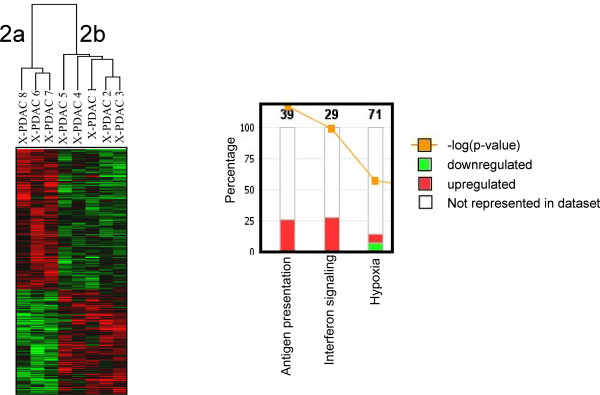
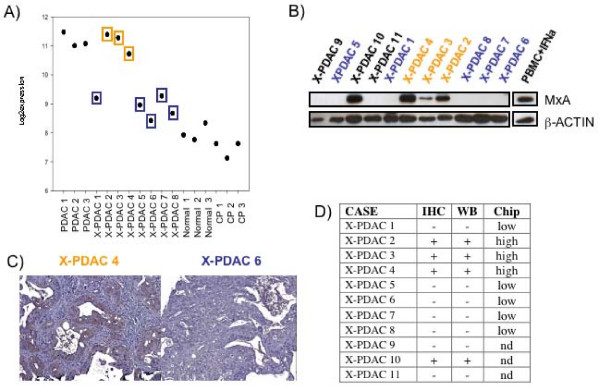
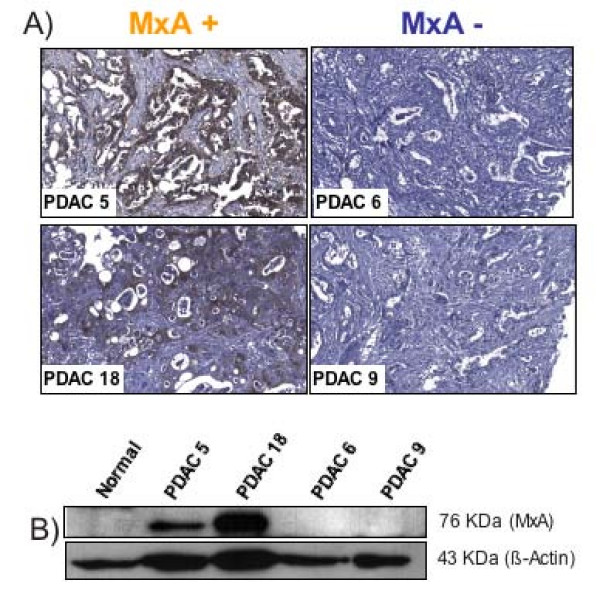
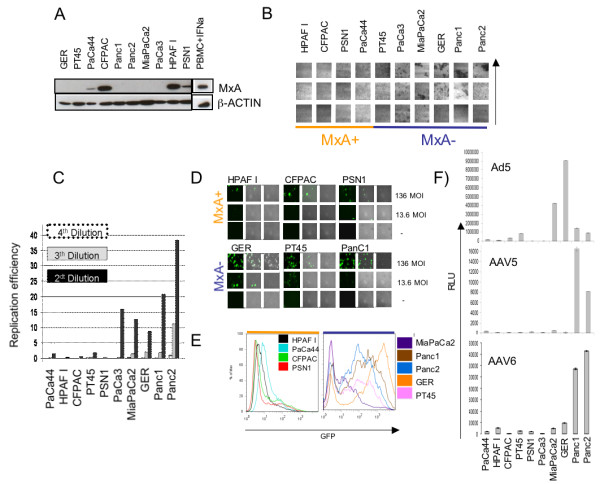
The analysis of the expression profiles allowed the identification of two clearly distinguishable phenotypes according to the expression of interferon-stimulated genes. The two phenotypes could be readily recognized by immunohistochemical detection of the Myxovirus-resistance A protein, whose expression reflects the activation of interferon dependent pathways. The two molecular phenotypes discovered in primary carcinomas were also observed among established pancreatic adenocarcinoma cell lines, suggesting that these phenotypes are an intrinsic characteristic of cancer cells independent of their interaction with the host's microenvironment. The two pancreatic cancer phenotypes are characterized by different permissivity to viral vectors used for gene therapy, as cell lines expressing interferon stimulated genes resisted to Adenovirus 5 mediated lysis in vitro. Similar results were observed when cells were transduced with Adeno-Associated Viruses 5 and 6.
Our study identified two molecular phenotypes of pancreatic cancer, characterized by a differential expression of interferon-stimulated genes and easily recognized by the expression of the Myxovirus-resistance A protein. We suggest that the detection of these two phenotypes might help the selection of patients enrolled in virally-mediated gene therapy trials.
胰腺导管腺癌(PDAC)仍然是癌症死亡的主要原因,目前正在测试依赖于肿瘤趋向性腺病毒的新型基因治疗方法。
我们使用来自 8 个异种移植的原发性 PDAC、3 个原发性 PDAC 组织、3 个慢性胰腺炎和 3 个正常胰腺组织的 RNA,获得了原发性 PDAC 的全基因组转录谱。使用 Affymetrix GeneChip HG-U133A 进行分析。使用免疫组织化学和 Western blot 分析对 34 个原发性 PDAC 和 10 个已建立的 PDAC 细胞系进行了表达谱验证。在 PDAC 细胞系上评估了用于基因治疗的病毒载体,腺病毒 5 和腺相关病毒 5 和 6 的允许性。
表达谱的分析允许根据干扰素刺激基因的表达来识别两种明显不同的表型。这两种表型可以通过 Myxovirus-resistance A 蛋白的免疫组织化学检测来轻松识别,其表达反映了干扰素依赖途径的激活。在原发性癌中发现的两种分子表型也在已建立的胰腺腺癌细胞系中观察到,这表明这些表型是癌细胞的固有特征,与它们与宿主微环境的相互作用无关。两种胰腺癌细胞表型对用于基因治疗的病毒载体的允许性不同,因为表达干扰素刺激基因的细胞系在体外抵抗腺病毒 5 介导的裂解。当用腺相关病毒 5 和 6 转导细胞时,也观察到类似的结果。
我们的研究确定了两种胰腺癌细胞的分子表型,其特征是干扰素刺激基因的差异表达,并且可以通过 Myxovirus-resistance A 蛋白的表达来识别。我们建议,检测这两种表型可能有助于选择参加病毒介导的基因治疗试验的患者。