Choo Ai Leen, Burnham Evamarie, Hicks Kristin, Chang Soo-Eun
Department of Psychiatry, University of Michigan, Ann Arbor, MI, USA.
Department of Communicative Sciences and Disorders, Michigan State University, East Lansing, MI, USA.
J Commun Disord. 2016 May-Jun;61:29-47. doi: 10.1016/j.jcomdis.2016.03.003. Epub 2016 Mar 15.
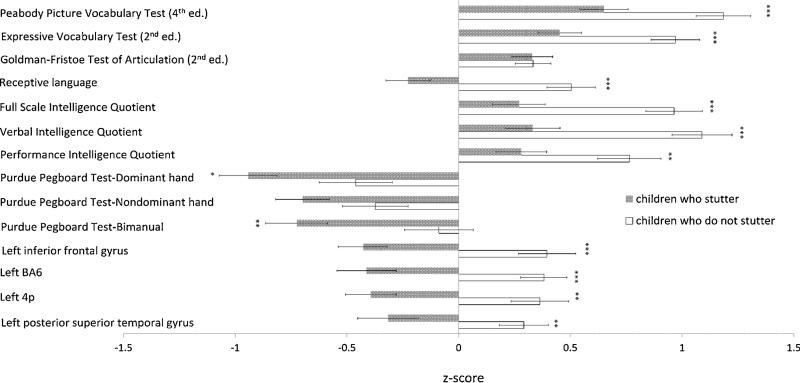
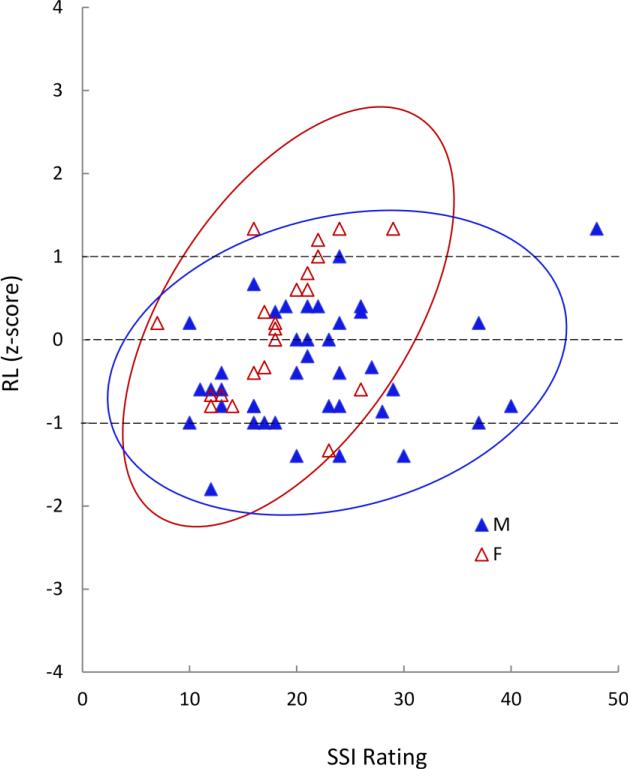
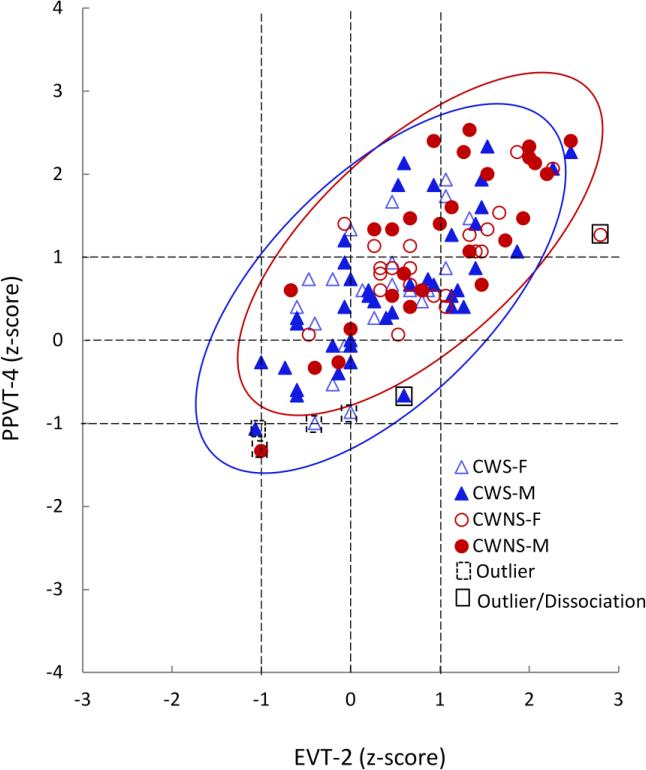
The onset of developmental stuttering typically occurs between 2 to 4 years of age, coinciding with a period of rapid development in speech, language, motor and cognitive domains. Previous studies have reported generally poorer performance and uneven, or "dissociated" development across speech and language domains in children who stutter (CWS) relative to children who do not stutter (CWNS) (Anderson, Pellowski, & Conture, 2005). The aim of this study was to replicate and expand previous findings by examining whether CWS exhibit dissociated development across speech-language, cognitive, and motor domains that are also reflected in measures of neuroanatomical development. Participants were 66CWS (23 females) and 53CWNS (26 females) ranging from 3 to 10 years. Standardized speech, language, cognitive, and motor skills measures, and fractional anisotropy (FA) values derived from diffusion tensor imaging from speech relevant "dorsal auditory" left perisylvian areas (Hickok & Poeppel, 2007) were analyzed using a correlation-based statistical procedure (Coulter, Anderson, & Conture, 2009) that quantified dissociations across domains. Overall, CWS scored consistently lower on speech, language, cognitive and motor measures, and exhibited dissociated development involving these same measures and white matter neuroanatomical indices relative to CWNS. Boys who stutter exhibited a greater number of dissociations compared to girls who stutter. Results suggest a subgroup of CWS may have incongruent development across multiple domains, and the resolution of this imbalance may be a factor in recovery from stuttering.
发育性口吃通常始于2至4岁,这一时期恰好是言语、语言、运动和认知领域快速发展的阶段。先前的研究报告称,与非口吃儿童(CWNS)相比,口吃儿童(CWS)在言语和语言领域的表现普遍较差,且发展不均衡或“分离”(Anderson、Pellowski和Conture,2005年)。本研究的目的是通过检验口吃儿童在言语-语言、认知和运动领域是否表现出分离性发展(这种分离性发展也反映在神经解剖学发展指标中)来复制和扩展先前的研究结果。参与者为66名口吃儿童(23名女性)和53名非口吃儿童(26名女性),年龄在3至10岁之间。使用基于相关性的统计程序(Coulter、Anderson和Conture,2009年)分析标准化的言语、语言、认知和运动技能测量结果,以及从与言语相关的左侧颞周“背侧听觉”区域的扩散张量成像得出的分数各向异性(FA)值,该程序量化了各领域之间的分离情况。总体而言,与非口吃儿童相比,口吃儿童在言语、语言、认知和运动测量中的得分始终较低,并且在这些相同测量以及白质神经解剖学指标方面表现出分离性发展。与口吃女孩相比,口吃男孩表现出更多的分离情况。结果表明,一部分口吃儿童可能在多个领域存在不一致的发展,而这种不平衡的解决可能是口吃恢复的一个因素。