Molecular Recognition Section, Laboratory of Bioorganic Chemistry, National Institute of Diabetes and Digestive and Kidney Diseases, National Institutes of Health, Bethesda, Maryland 20892, USA.
Bioconjug Chem. 2010 Feb 17;21(2):372-84. doi: 10.1021/bc900473v.
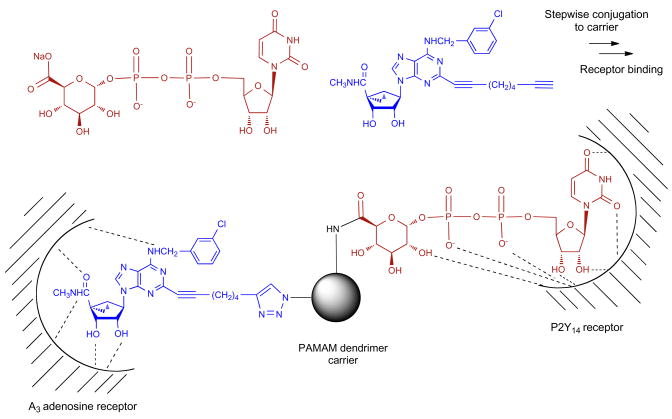
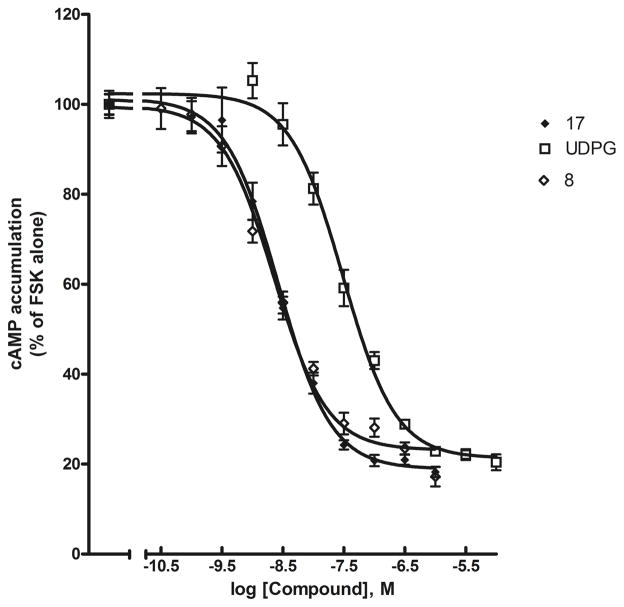
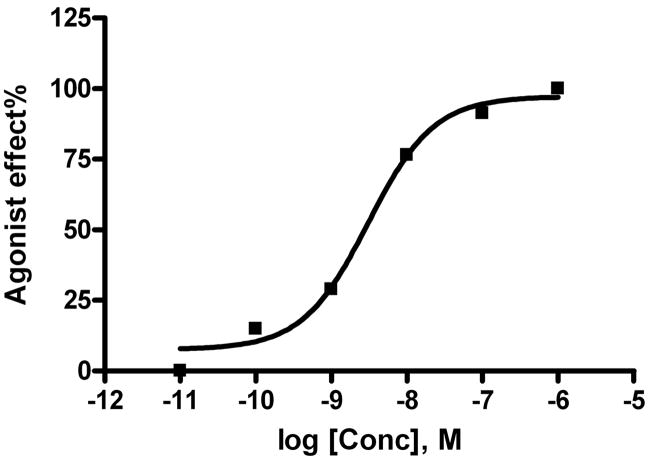
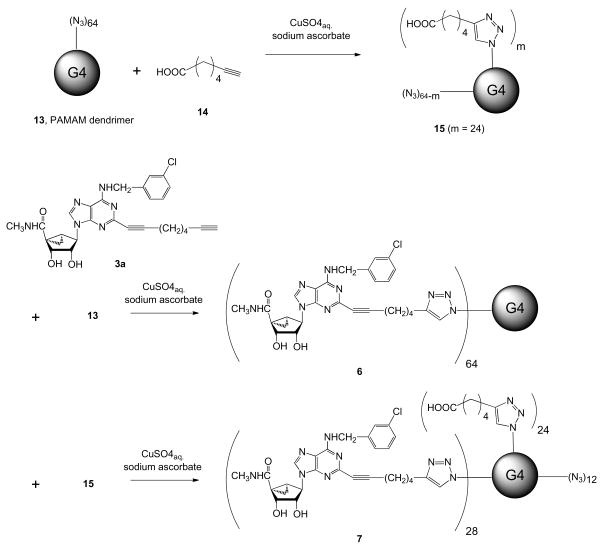
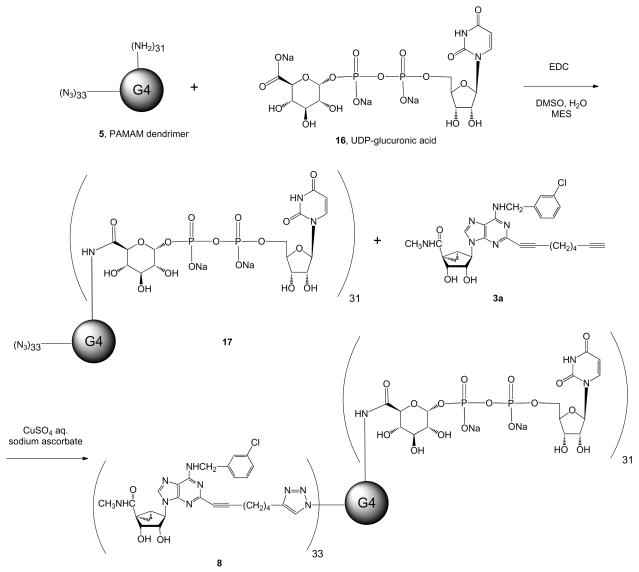
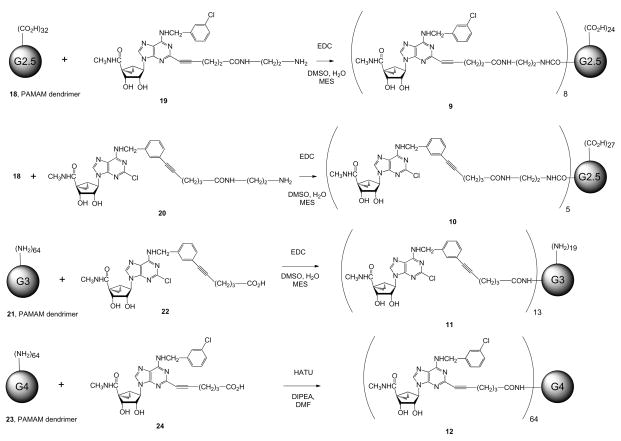
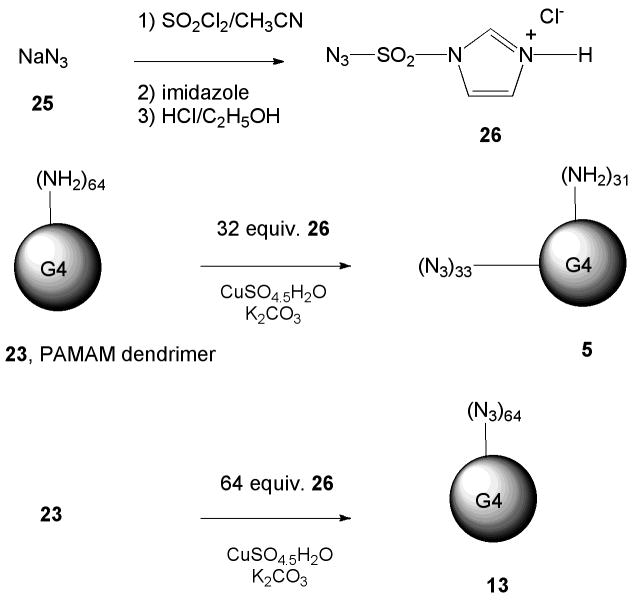
We previously synthesized a series of potent and selective A(3) adenosine receptor (AR) agonists (North-methanocarba nucleoside 5'-uronamides) containing dialkyne groups on extended adenine C2 substituents. We coupled the distal alkyne of a 2-octadiynyl nucleoside by Cu(I)-catalyzed "click" chemistry to azide-derivatized G4 (fourth-generation) PAMAM dendrimers to form triazoles. A(3)AR activation was preserved in these multivalent conjugates, which bound with apparent K(i) of 0.1-0.3 nM. They were substituted with nucleoside moieties, solely or in combination with water-solubilizing carboxylic acid groups derived from hexynoic acid. A comparison with various amide-linked dendrimers showed that triazole-linked conjugates displayed selectivity and enhanced A(3)AR affinity. We prepared a PAMAM dendrimer containing equiproportioned peripheral azido and amino groups for conjugation of multiple ligands. A bifunctional conjugate activated both A(3) and P2Y(14) receptors (via amide-linked uridine-5'-diphosphoglucuronic acid), with selectivity in comparison to other ARs and P2Y receptors. This is the first example of targeting two different GPCRs with the same dendrimer conjugate, which is intended for activation of heteromeric GPCR aggregates. Synergistic effects of activating multiple GPCRs with a single dendrimer conjugate might be useful in disease treatment.
我们之前合成了一系列含有延长腺嘌呤 C2 取代基上二炔基团的强效和选择性 A(3) 腺苷受体 (AR) 激动剂(North-甲羰咔巴核苷 5'-尿苷酰胺)。我们通过 Cu(I)-催化的“点击”化学将 2-辛二炔核苷的远端炔键与叠氮基衍生的 G4(第四代)PAMAM 树枝状大分子偶联形成三唑。这些多价缀合物保留了 A(3)AR 的激活,与阿片受体的结合亲和力为 0.1-0.3 nM。它们被核苷部分取代,仅或与来自己炔酸的水溶性羧酸基团结合。与各种酰胺连接的树枝状大分子的比较表明,三唑连接的缀合物显示出选择性和增强的 A(3)AR 亲和力。我们制备了一种含有等比例外围叠氮基和氨基的 PAMAM 树枝状大分子,用于连接多个配体。一种双功能缀合物激活了 A(3) 和 P2Y(14) 受体(通过酰胺连接的尿苷-5'-二磷酸葡萄糖醛酸),与其他 AR 和 P2Y 受体相比具有选择性。这是用相同的树枝状大分子缀合物靶向两种不同 GPCR 的第一个例子,旨在激活异源 GPCR 聚集体。用单个树枝状大分子缀合物激活多个 GPCR 的协同效应可能在疾病治疗中有用。