Department of Neonatology, General & Maternity Hospital Elena Venizelou, Athens, Greece.
BMC Pregnancy Childbirth. 2010 Feb 1;10:6. doi: 10.1186/1471-2393-10-6.
The consequences of in utero growth restriction have been attracting scholarly attention for the past two decades. Nevertheless, the diagnosis of growth-restricted neonates is as yet an unresolved issue. Aim of this study is the evaluation of the performance of simple, common indicators of nutritional status, which are used in the identification of growth-restricted neonates.
In a cohort of 418 consecutively born term and near term neonates, four widely used anthropometric indices of body proportionality and subcutaneous fat accretion were applied, singly and in combination, as diagnostic markers for the detection of growth-restricted babies. The concordance of the indices was assessed in terms of positive and negative percent agreement and of Cohen's kappa.
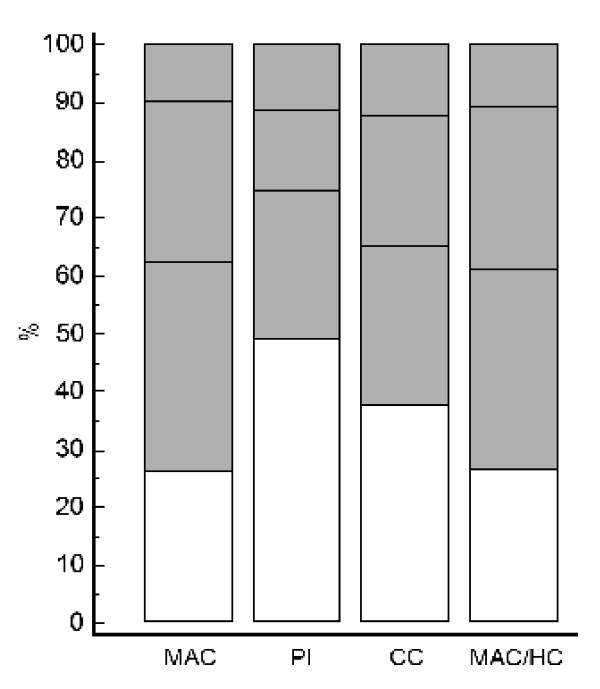
The agreement between the anthropometric indices was overall poor with a highest positive percent agreement of 62.5% and a lowest of 27.9% and the kappa ranging between 0.19 and 0.58. Moreover, 6% to 32% of babies having abnormal values in just one index were apparently well-grown and the median birth weight centile of babies having abnormal values of either of two indices was found to be as high as the 46th centile for gestational age (95%CI 35.5 to 60.4 and 29.8 to 63.9, respectively). On the contrary, the combination of anthropometric indices appeared to have better distinguishing properties among apparently and not apparently well-grown babies. The median birth weight centile of babies having abnormal values in two (or more) indices was the 11th centile for gestational age (95%CI 6.3 to 16.3).
Clinical assessment and anthropometric indices in combination can define a reference standard with better performance compared to the same indices used in isolation. This approach offers an easy-to-use tool for bedside diagnosis of in utero growth restriction.
在过去的二十年中,胎儿宫内生长受限的后果一直引起学者的关注。然而,生长受限新生儿的诊断至今仍是一个未解决的问题。本研究旨在评估简单、常用的营养状况指标在识别生长受限新生儿方面的性能。
在 418 例连续出生的足月和近足月新生儿队列中,应用了四种广泛使用的身体比例和皮下脂肪堆积的人体测量学指数,单独和组合使用,作为检测生长受限婴儿的诊断标志物。通过阳性和阴性百分比一致性和 Cohen 的 kappa 评估指数的一致性。
这些人体测量学指数之间的一致性总体较差,最高阳性百分比一致性为 62.5%,最低为 27.9%,kappa 值在 0.19 到 0.58 之间。此外,只有一个指数值异常的婴儿中有 6%到 32%的婴儿显然生长良好,而两个指数中任何一个指数值异常的婴儿的中位数出生体重百分位数都高达胎龄的第 46 百分位(95%CI 35.5 至 60.4 和 29.8 至 63.9)。相反,人体测量学指数的组合在明显和不明显生长良好的婴儿之间似乎具有更好的区分特性。两个(或更多)指数值异常的婴儿的中位数出生体重百分位数是胎龄的第 11 百分位(95%CI 6.3 至 16.3)。
与单独使用相同的指数相比,临床评估和人体测量学指数的组合可以定义出具有更好性能的参考标准。这种方法为床边诊断胎儿宫内生长受限提供了一种易于使用的工具。