Institute of Microbial Technology, Sector 39A, Chandigarh, India.
BMC Bioinformatics. 2010 Jan 18;11 Suppl 1(Suppl 1):S19. doi: 10.1186/1471-2105-11-S1-S19.
Antibacterial peptides are one of the effecter molecules of innate immune system. Over the last few decades several antibacterial peptides have successfully approved as drug by FDA, which has prompted an interest in these antibacterial peptides. In our recent study we analyzed 999 antibacterial peptides, which were collected from Antibacterial Peptide Database (APD). We have also developed methods to predict and classify these antibacterial peptides using Support Vector Machine (SVM).
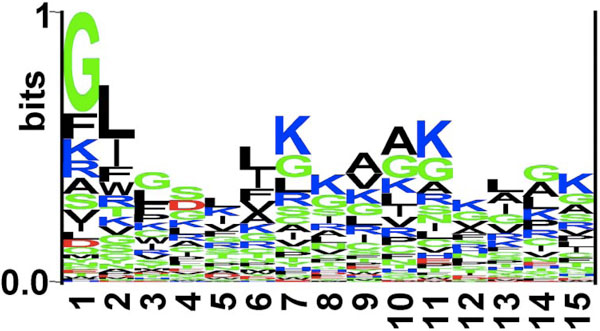
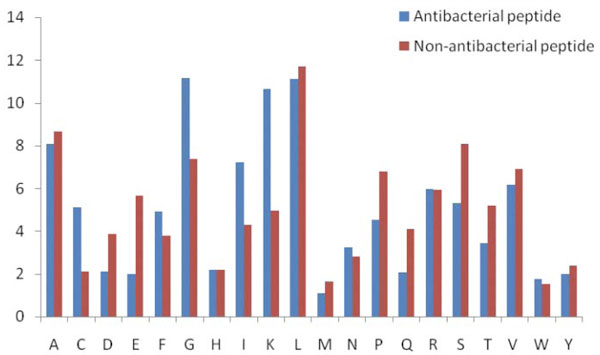
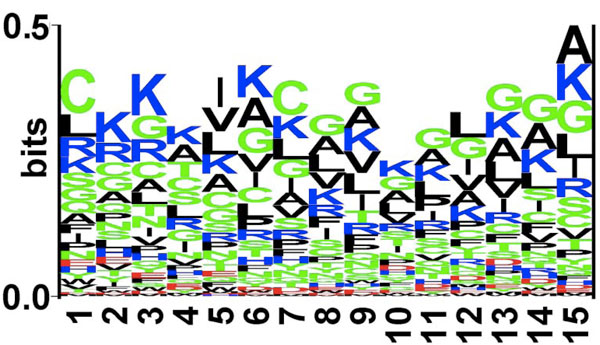
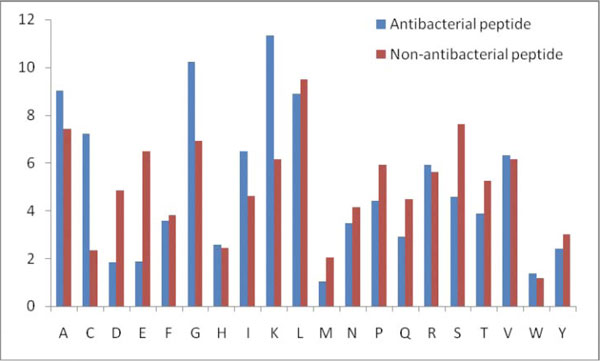
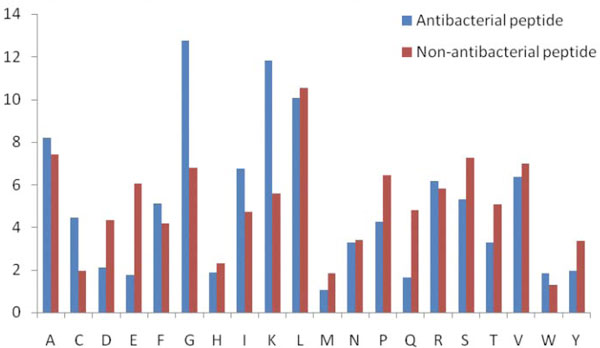
During analysis we observed that certain residues are preferred over other in antibacterial peptide, particularly at the N and C terminus. These observation and increased data of antibacterial peptide in APD encouraged us to again develop a new and more robust method for predicting antibacterial peptides in protein from their amino acid sequence or given peptide have antibacterial properties or not. First, the binary patterns of the 15 N terminus residues were used for predicting antibacterial peptide using SVM and achieved accuracy of 85.46% with 0.705 Mathew's Correlation Coefficient (MCC). Then we used the binary pattern of 15 C terminus residues and achieved accuracy of 85.05% with 0.701 MCC, latter on we developed prediction method by combining N & C terminus and achieved an accuracy of 91.64% with 0.831 MCC. Finally we developed SVM based model using amino acid composition of whole peptide and achieved 92.14% accuracy with MCC 0.843. In this study we used five-fold cross validation technique to develop all these models and tested the performance of these models on an independent dataset. We further classify antibacterial peptides according to their sources and achieved an overall accuracy of 98.95%. We further classify antibacterial peptides in their respective family and got a satisfactory result.
Among antibacterial peptides, there is preference for certain residues at N and C terminus, which helps to discriminate them from non-antibacterial peptides. Amino acid composition of antibacterial peptides helps to demarcate them from non-antibacterial peptide and their further classification in source and family. Antibp2 will be helpful in discovering efficacious antibacterial peptide, which we hope will be helpful against antibiotics resistant bacteria. We also developed user friendly web server for the biological community.
抗菌肽是先天免疫系统的效应分子之一。在过去的几十年中,有几种抗菌肽已被 FDA 成功批准为药物,这促使人们对这些抗菌肽产生了兴趣。在我们最近的研究中,我们分析了从抗菌肽数据库(APD)收集的 999 种抗菌肽。我们还开发了使用支持向量机(SVM)预测和分类这些抗菌肽的方法。
在分析过程中,我们观察到在抗菌肽中,某些残基比其他残基更受欢迎,特别是在 N 端和 C 端。这些观察结果和 APD 中抗菌肽数量的增加促使我们再次开发一种新的、更强大的方法,用于从氨基酸序列预测蛋白质中的抗菌肽,或者给定的肽是否具有抗菌特性。首先,使用 SVM 基于 15 个 N 端残基的二进制模式来预测抗菌肽,准确率为 85.46%,马修相关系数(MCC)为 0.705。然后,我们使用 15 个 C 端残基的二进制模式,准确率为 85.05%,MCC 为 0.701。后来,我们通过结合 N 端和 C 端开发了一种预测方法,准确率为 91.64%,MCC 为 0.831。最后,我们使用整个肽的氨基酸组成开发了基于 SVM 的模型,准确率为 92.14%,MCC 为 0.843。在这项研究中,我们使用五重交叉验证技术来开发所有这些模型,并在独立数据集上测试这些模型的性能。我们进一步根据来源对抗菌肽进行分类,总体准确率为 98.95%。我们进一步对它们进行分类到各自的家族,并得到了令人满意的结果。
在抗菌肽中,N 端和 C 端存在某些残基偏好,有助于将它们与非抗菌肽区分开来。抗菌肽的氨基酸组成有助于将它们与非抗菌肽区分开来,并进一步根据来源和家族对它们进行分类。Antbp2 将有助于发现有效的抗菌肽,我们希望这对抗生素耐药菌有所帮助。我们还为生物界开发了一个用户友好的网络服务器。