Department of Pediatrics, Child Health Research Center, University of Texas Medical Branch, Galveston, TX 77555-0366, USA.
Environ Health Perspect. 2010 Feb;118(2):273-7. doi: 10.1289/ehp.0901259.
We recently reported that various environmental estrogens induce mast cell degranulation and enhance IgE-mediated release of allergic mediators in vitro.
We hypothesized that environmental estrogens would enhance allergic sensitization as well as bronchial inflammation and responsiveness. To test this hypothesis, we exposed fetal and neonatal mice to the common environmental estrogen bisphenol A (BPA) via maternal loading and assessed the pups' response to allergic sensitization and bronchial challenge.
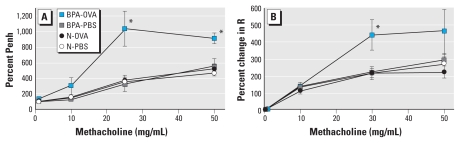
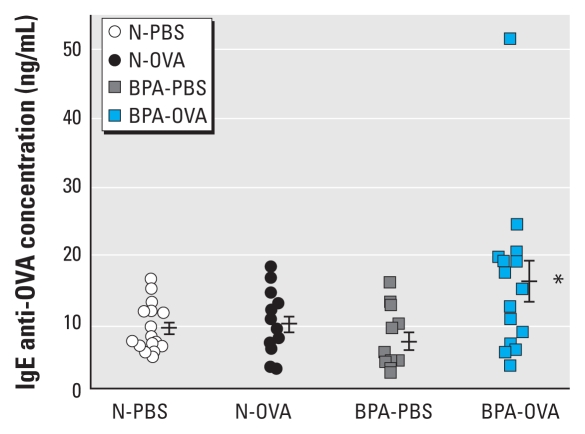
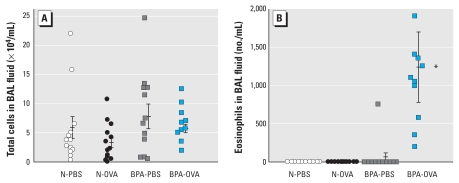
Female BALB/c mice received 10 microg/mL BPA in their drinking water from 1 week before impregnation to the end of the study. Neonatal mice were given a single 5 microg intraperitoneal dose of ovalbumin (OVA) with aluminum hydroxide on postnatal day 4 and 3% OVA by nebulization for 10 min on days 13, 14, and 15. Forty-eight hours after the last nebulization, we assessed serum IgE antibodies to OVA by enzyme-linked immunosorbent assay (ELISA) and airway inflammation and hyperresponsiveness by enumerating eosinophils in bronchoalveolar lavage fluid, whole-body barometric plethysmography, and a forced oscillation technique.
Neonates from BPA-exposed mothers responded to this "suboptimal" sensitization with higher serum IgE anti-OVA concentrations compared with those from unexposed mothers (p < 0.05), and eosinophilic inflammation in their airways was significantly greater. Airway responsiveness of the OVA-sensitized neonates from BPA-treated mothers was enhanced compared with those from unexposed mothers (p < 0.05).
Perinatal exposure to BPA enhances allergic sensitization and bronchial inflammation and responsiveness in a susceptible animal model of asthma.
我们最近报道称,各种环境雌激素可诱导肥大细胞脱颗粒,并增强体外 IgE 介导的过敏介质释放。
我们假设环境雌激素会增强过敏致敏以及支气管炎症和反应性。为了验证这一假设,我们通过母体负荷使胎儿和新生小鼠暴露于常见环境雌激素双酚 A(BPA),并评估幼鼠对过敏致敏和支气管激发的反应。
雌性 BALB/c 小鼠从受孕前 1 周开始至研究结束,在饮用水中摄入 10μg/mL 的 BPA。新生小鼠在出生后第 4 天给予 5μg 卵清蛋白(OVA)腹腔内注射,并在第 13、14 和 15 天每天进行 10 分钟的 3%OVA 雾化。在最后一次雾化后 48 小时,我们通过酶联免疫吸附试验(ELISA)评估血清 IgE 抗体对 OVA 的反应,并通过支气管肺泡灌洗液中嗜酸性粒细胞计数、全身气压 plethysmography 和强迫振荡技术评估气道炎症和高反应性。
来自 BPA 暴露母亲的新生儿对这种“亚最佳”致敏反应的血清 IgE 抗 OVA 浓度高于未暴露母亲(p <0.05),并且其气道中的嗜酸性粒细胞炎症明显更严重。来自 BPA 处理母亲的 OVA 致敏新生儿的气道反应性增强与未暴露母亲相比(p <0.05)。
围产期暴露于 BPA 可增强哮喘易感动物模型中的过敏致敏以及支气管炎症和反应性。