Sub-department of Environmental Technology, Wageningen University, Wageningen, The Netherlands.
Appl Microbiol Biotechnol. 2010 Apr;86(3):973-81. doi: 10.1007/s00253-010-2440-7. Epub 2010 Feb 2.
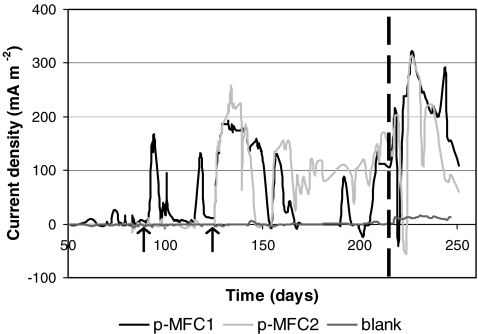
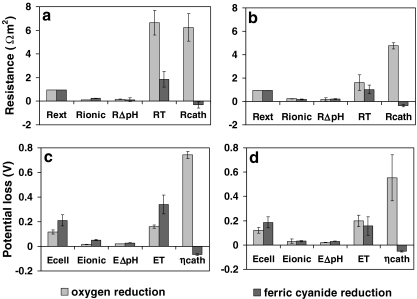
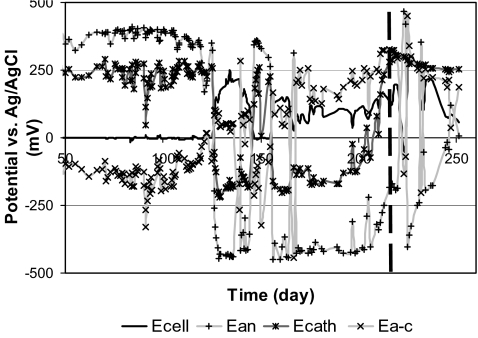
The plant microbial fuel cell is a sustainable and renewable way of electricity production. The plant is integrated in the anode of the microbial fuel cell which consists of a bed of graphite granules. In the anode, organic compounds deposited by plant roots are oxidized by electrochemically active bacteria. In this research, salt marsh species Spartina anglica generated current for up to 119 days in a plant microbial fuel cell. Maximum power production was 100 mW m(-2) geometric anode area, highest reported power output for a plant microbial fuel cell. Cathode overpotential was the main potential loss in the period of oxygen reduction due to slow oxygen reduction kinetics at the cathode. Ferricyanide reduction improved the kinetics at the cathode and increased current generation with a maximum of 254%. In the period of ferricyanide reduction, the main potential loss was transport loss. This research shows potential application of microbial fuel cell technology in salt marshes for bio-energy production with the plant microbial fuel cell.
植物微生物燃料电池是一种可持续且可再生的发电方式。植物被整合到微生物燃料电池的阳极中,阳极由一层石墨颗粒组成。在阳极中,植物根系沉积的有机化合物被电化学活性细菌氧化。在这项研究中,盐沼物种盐地碱蓬在植物微生物燃料电池中产生电流长达 119 天。最大功率产生为 100 mW m(-2)几何阳极面积,这是植物微生物燃料电池报告的最高功率输出。由于阴极处氧气还原动力学缓慢,阴极过电势是氧气还原期间的主要电势损失。铁氰化物还原改善了阴极的动力学,并使电流生成增加了最大值为 254%。在铁氰化物还原期间,主要的电势损失是传输损失。这项研究表明,微生物燃料电池技术在盐沼中具有生物能源生产的应用潜力,可利用植物微生物燃料电池来实现。