Mayo Clinic, Rochester, Minnesota, United States of America.
PLoS One. 2010 Feb 5;5(2):e9065. doi: 10.1371/journal.pone.0009065.
Cardiovascular disease (CVD) susceptibility differs between men and women and varies with ethnicity. This variability is not entirely explained by conventional CVD risk factors. We examined differences in circulating levels of 47 novel protein markers of CVD in 2561 men and women of African-American (AA) and non-Hispanic White (NHW) ethnicity, enrolled at geographically distinct sites.
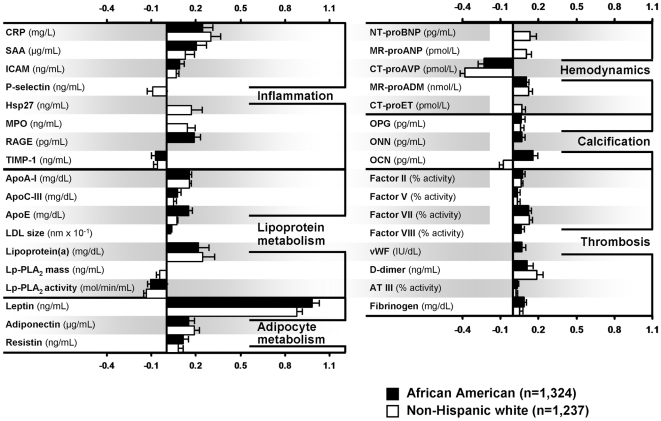
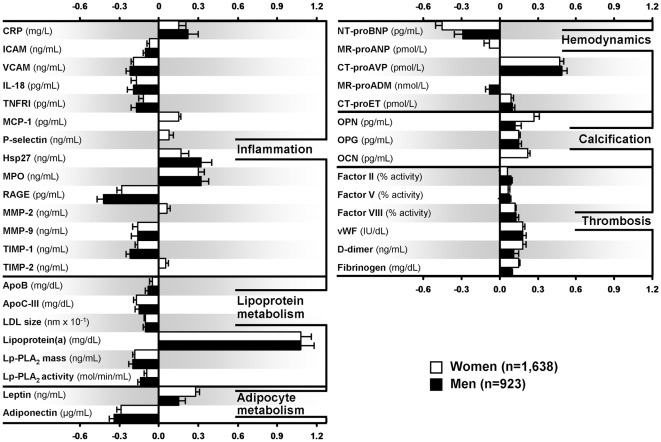
METHODOLOGY/PRINCIPAL FINDINGS: Participants (1,324 AAs, mean age 63.5 y, 71% women; 1,237 NHWs, mean age 58.9 y, 57% women) belonged to sibships ascertained on the basis of hypertension. Solid-phase immunoassays and immunoturbidometric, clot-based, chromogenic, and electrophoretic assays were used to measure the 47 protein markers in plasma or serum. Marker levels were log transformed and outliers were adjusted to within 4 SD. To identify markers independently associated with sex or ethnicity, we employed multivariable regression analyses that adjusted for conventional risk factors, prior history of CVD, medication use and lifestyle factors (physical activity, alcohol consumption and education). Generalized estimating equations were used to correct for intrafamilial correlations. After adjustment for the above covariates, female sex was associated with higher levels of 29 markers and lower levels of 6 markers. Female sex was independently associated with higher levels of several inflammatory markers as well as lipoproteins, adipokines, natriuretic peptides, vasoconstrictor peptides and markers of calcification and thrombosis. AA ethnicity was associated with higher levels of 19 markers and lower levels of 6 markers, including higher levels of several inflammatory makers, higher leptin and lower adiponectin levels, lower levels of vasodilator-natriuretic peptides, higher levels of vasoconstrictor-antidiuretic peptides and markers of calcification and thrombosis.
CONCLUSIONS/SIGNIFICANCE: Plasma levels of several novel protein markers of CVD differ significantly in the context of sex and ethnicity. These results have implications for individualized CVD risk assessment.
心血管疾病(CVD)的易感性在男性和女性之间存在差异,并且因种族而异。这种可变性不能完全用传统的 CVD 风险因素来解释。我们检查了 2561 名非裔美国人(AA)和非西班牙裔白人(NHW)种族的男性和女性循环中 47 种 CVD 新型蛋白标志物的水平差异,这些参与者是根据高血压在地理位置不同的地点招募的。
方法/主要发现:参与者(1324 名 AA,平均年龄 63.5 岁,71%为女性;1237 名 NHW,平均年龄 58.9 岁,57%为女性)属于基于高血压确定的同胞关系。固相免疫测定法和免疫比浊法、基于凝结的、显色的和电泳法用于测量血浆或血清中的 47 种蛋白标志物。标志物水平进行了对数转换,并且对离群值进行了调整,使其在 4SD 范围内。为了确定与性别或种族独立相关的标志物,我们采用了多变量回归分析,该分析调整了传统风险因素、CVD 病史、药物使用和生活方式因素(体育活动、饮酒和教育)。使用广义估计方程来校正家族内相关性。在调整上述协变量后,女性性别与 29 种标志物的水平较高和 6 种标志物的水平较低相关。女性性别与几种炎症标志物以及脂蛋白、脂肪因子、利钠肽、血管收缩肽和钙化及血栓形成标志物的水平较高独立相关。AA 种族与 19 种标志物的水平较高和 6 种标志物的水平较低相关,包括几种炎症标志物的水平较高、瘦素水平较高而脂联素水平较低、血管扩张性利钠肽水平较低、血管收缩性抗利尿肽和钙化及血栓形成标志物的水平较高。
结论/意义:CVD 的几种新型蛋白标志物的血浆水平在性别和种族背景下存在显著差异。这些结果对个体化 CVD 风险评估具有重要意义。