Section for Zoonotic Ecology and Epidemiology, Linnaeus University, Kalmar, Sweden.
PLoS One. 2010 Feb 5;5(2):e9082. doi: 10.1371/journal.pone.0009082.
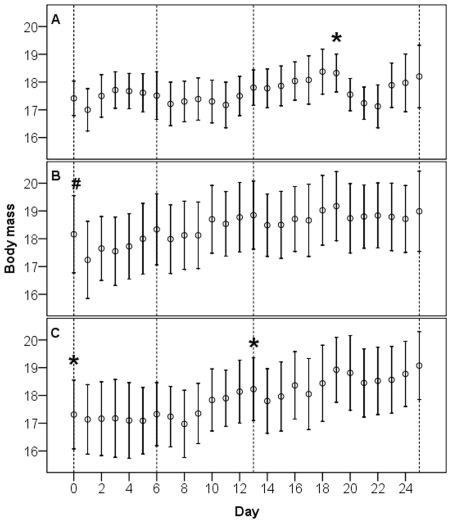
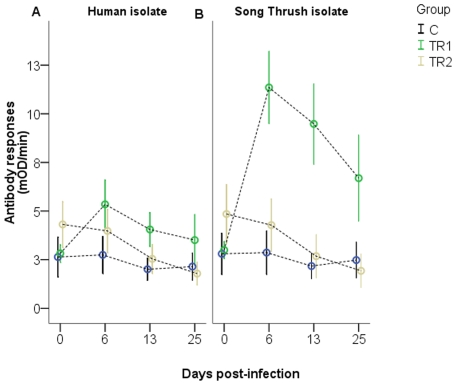
Campylobacter jejuni is a common cause of bacterial gastroenteritis in most parts of the world. The bacterium has a broad host range and has been isolated from many animals and environments. To investigate shedding patterns and putative effects on an avian host, we developed a colonization model in which a wild bird species, the European Robin Erithacus rubecula, was inoculated orally with C. jejuni from either a human patient or from another wild bird species, the Song Thrush Turdus philomelos. These two isolates were genetically distinct from each other and provoked very different host responses. The Song Thrush isolate colonized all challenged birds and colonization lasted 6.8 days on average. Birds infected with this isolate also showed a transient but significant decrease in body mass. The human isolate did not colonize the birds and could be detected only in the feces of the birds shortly after inoculation. European Robins infected with the wild bird isolate generated a specific antibody response to C. jejuni membrane proteins from the avian isolate, which also was cross-reactive to membrane proteins of the human isolate. In contrast, European Robins infected with the human isolate did not mount a significant response to bacterial membrane proteins from either of the two isolates. The difference in colonization ability could indicate host adaptations.
空肠弯曲菌是世界上大多数地区细菌性肠胃炎的常见病因。该细菌宿主范围广泛,已从许多动物和环境中分离出来。为了研究脱落模式和对禽类宿主的潜在影响,我们建立了一个定植模型,其中一种野生鸟类,欧洲知更鸟 Erithacus rubecula,经口接种来自人类患者或另一种野生鸟类,画眉 Turdus philomelos 的空肠弯曲菌。这两个分离株在遗传上彼此不同,并引起宿主非常不同的反应。画眉分离株定植于所有受挑战的鸟类,定植时间平均为 6.8 天。感染该分离株的鸟类也表现出短暂但明显的体重下降。人类分离株未定植于鸟类,仅在接种后不久的鸟类粪便中可检测到。感染野生鸟类分离株的欧洲知更鸟针对禽源分离株的空肠弯曲菌膜蛋白产生了特异性抗体反应,该反应也与人类分离株的膜蛋白发生交叉反应。相比之下,感染人类分离株的欧洲知更鸟对两种分离株的细菌膜蛋白均未产生显著反应。定植能力的差异可能表明宿主的适应性。