National Institute of Diabetes and Digestive and Kidney Diseases/Clinical Endocrinology Branch, National Institutes of Health, 10 Center Drive, Bethesda, MD 20892, USA.
Med Sci Sports Exerc. 2010 Sep;42(9):1785-92. doi: 10.1249/MSS.0b013e3181d5a984.
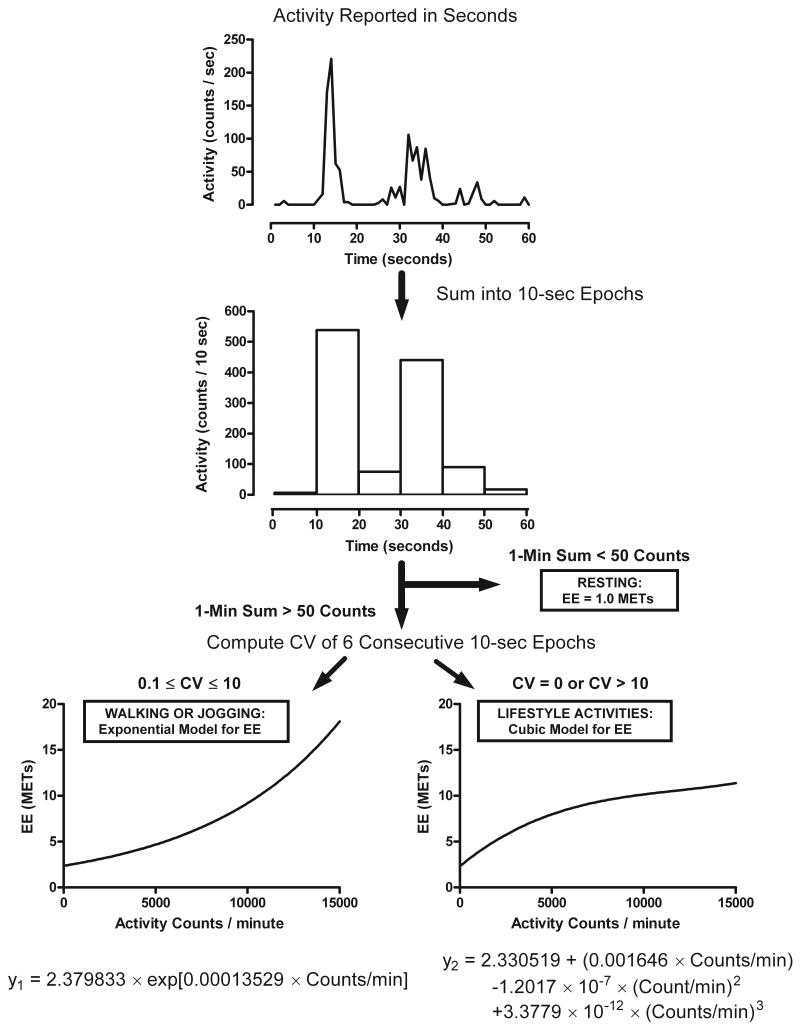
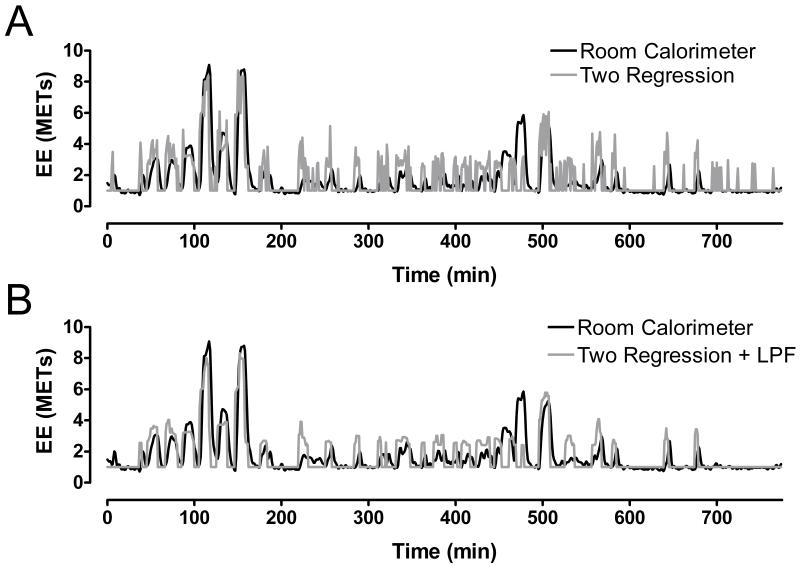
The purpose of this study was to validate a two-regression model for predicting energy expenditure (EE) from ActiGraph GT1M accelerometer-generated activity counts using a whole-room indirect calorimeter and the doubly labeled water (DLW) technique. We also investigated if a low-pass filter (LPF) approach would improve the model's accuracy in the minute-to-minute EE prediction.
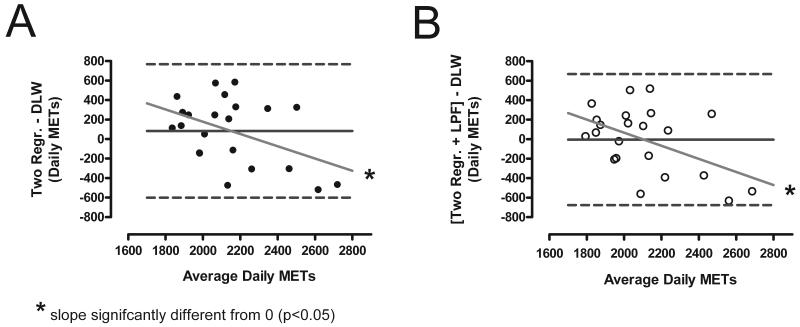
Thirty-four healthy volunteers (age = 20-67 yr, body mass index = 19.3-52.1 kg.m) spent approximately 24 h in a room calorimeter while wearing a GT1M monitor and performed structured and self-selected activities followed by overnight sleep. The EE predicted by the models and expressed in metabolic equivalents (MET-minutes) during waking times was compared with the room calorimeter-measured EE. A subset of volunteers (n = 22) completed a 14-d DLW protocol in free living while wearing an ActiGraph. The average daily EE predicted by the models (MET-minutes) was compared with the DLW.
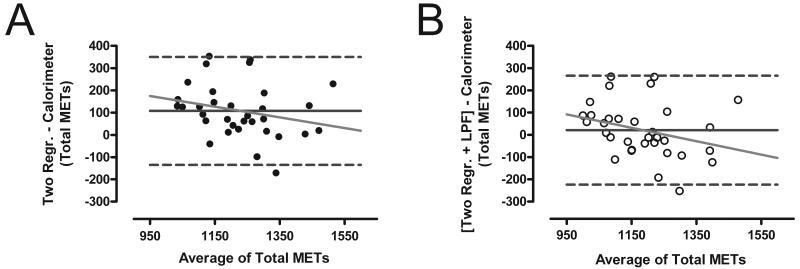
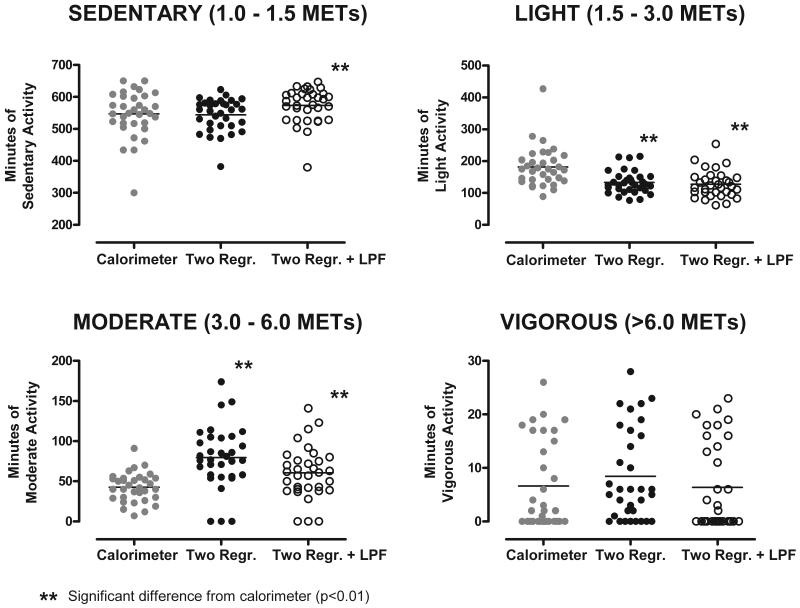
Compared with the room calorimeter, the two-regression model overpredicted EE by 10.2% +/- 11.4% (1282 +/- 125 and 1174 +/- 152 MET.min, P < 0.001) and time spent in moderate physical activity (PA) by 36.9 +/- 46.0 min while underestimating the time spent in light PA by -48.3 +/- 55.0 min (P < 0.05). The LPF reduced the squared and mean absolute error in the EE prediction (P < 0.05) but not the prediction error in time spent in moderate or light PA (both P > 0.05). The EE measured by DLW (2108 +/- 358 MET.min.d) and predicted by both filtered and unfiltered models (2104 +/- 218 and 2192 +/- 228 MET.min.d, respectively) were similar (P > 0.05).
The two-regression model with LPF showed good agreement with total EE measured using room calorimeter and DLW. However, the individual variability in assessing time spent in sedentary, low, and moderate PA intensities and related EE remains significant.
本研究旨在通过使用全身间接热量计和双标记水 (DLW) 技术验证一种从 ActiGraph GT1M 加速度计生成的活动计数中预测能量消耗 (EE) 的双回归模型。我们还研究了低通滤波器 (LPF) 方法是否会提高模型在分钟级 EE 预测中的准确性。
34 名健康志愿者(年龄=20-67 岁,体重指数=19.3-52.1kg.m)在房间热量计中大约度过 24 小时,同时佩戴 GT1M 监测器,并进行结构化和自选活动,随后进行夜间睡眠。用模型预测的 EE(以代谢当量-MET 分钟表示)与房间热量计测量的 EE 进行比较。志愿者的一个子集(n=22)在自由生活中佩戴 ActiGraph 完成了 14 天的 DLW 方案。用模型预测的平均每日 EE(MET 分钟)与 DLW 进行比较。
与房间热量计相比,双回归模型高估 EE 10.2%±11.4%(1282±125 和 1174±152MET.min,P<0.001)和中度体力活动(PA)时间 36.9±46.0min,同时低估轻 PA 时间-48.3±55.0min(P<0.05)。LPF 降低了 EE 预测的平方和平均绝对误差(P<0.05),但没有降低中度或轻度 PA 时间的预测误差(均 P>0.05)。通过 DLW 测量的 EE(2108±358MET.min.d)和通过过滤和未过滤模型预测的 EE(分别为 2104±218 和 2192±228MET.min.d)相似(P>0.05)。
带 LPF 的双回归模型与使用房间热量计和 DLW 测量的总 EE 具有良好的一致性。然而,评估久坐、低强度和中等强度 PA 时间以及相关 EE 的个体变异性仍然很大。