Division of General Internal Medicine and Clinical Epidemiology, University of North Carolina at Chapel Hill, Chapel Hill, North Carolina, USA.
Cancer. 2010 Apr 1;116(7):1664-73. doi: 10.1002/cncr.24962.
: Evidence-based interventions have been found effective in increasing colorectal cancer (CRC) screening. Translating these successful interventions into real world settings, such as health plans, can be challenging.
: CHOICE (Communicating Health Options through Information and Cancer Education) is a controlled trial to test the effectiveness of a patient- and practice-level intervention to increase use of recommended CRC screening tests. The patient-level intervention was a patient decision aid and stage-targeted brochures, mailed to eligible health plan members, to provide information about CRC, available screening tests, and how to obtain CRC screening at their physicians' practices. The practice-level intervention was academic detailing to prepare practices to facilitate CRC testing once the patient was activated by the decision aid. Surveys and claims data will be used to assess CRC screening test completion.
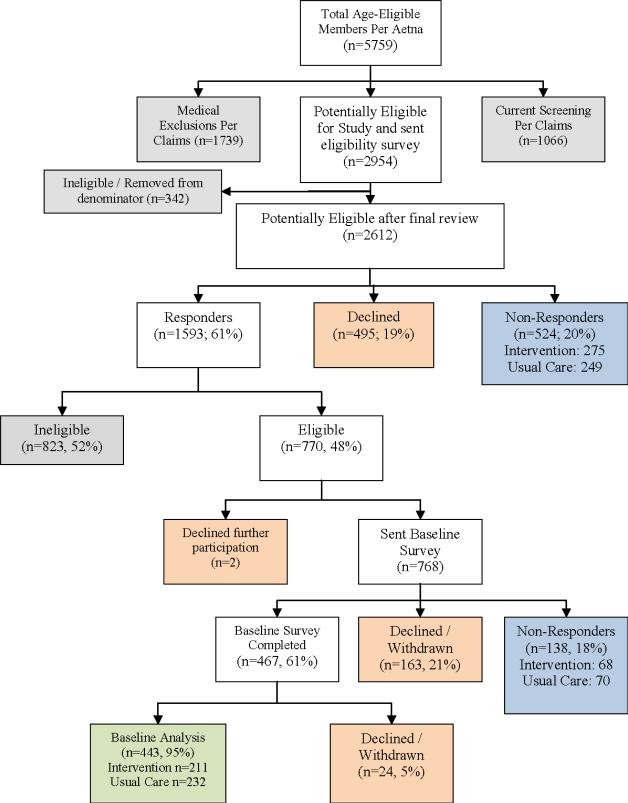
: Thirty-two primary care practices in Florida and Georgia participated. The authors recruited 443 participating health plan members for the trial; 211 were patients in intervention practices, and 232 were in usual care practices. Study participants reflected an insured population; the majority were white and aged <60 years. The authors also mailed the intervention to 343 people from intervention practices who did not respond to the eligibility or baseline survey. Receipt of screening in that group will be compared with screening among 319 people from usual care practices who did not respond to these surveys using claims data.
: The CHOICE study will demonstrate the effect of 2 combined evidence-based interventions on CRC screening test completion among health plan members. Cancer 2010. (c) 2010 American Cancer Society.
循证干预措施已被证明可有效提高结直肠癌(CRC)筛查率。但将这些成功的干预措施转化到实际环境中,如医疗保健计划中,可能具有挑战性。
CHOICE(通过信息和癌症教育传达健康选择)是一项对照试验,旨在测试患者和实践层面干预措施对提高推荐 CRC 筛查测试使用率的有效性。患者层面的干预措施是患者决策辅助工具和针对特定阶段的宣传册,寄给符合条件的医疗保健计划成员,以提供有关 CRC、可用筛查测试以及如何在医生诊所获得 CRC 筛查的信息。实践层面的干预措施是学术细化,以准备实践,以便在患者通过决策辅助工具被激活后促进 CRC 测试。将使用调查和索赔数据评估 CRC 筛查测试完成情况。
佛罗里达州和佐治亚州的 32 家初级保健诊所参与了该研究。作者招募了 443 名参加试验的医疗保健计划成员;其中 211 名患者来自干预实践,232 名患者来自常规护理实践。研究参与者反映了一个参保人群;大多数是白人,年龄<60 岁。作者还向干预实践中未回复资格或基线调查的 343 人邮寄了干预措施。将使用索赔数据比较该组的筛查率与常规护理实践中未回复这些调查的 319 人的筛查率。
CHOICE 研究将展示 2 种综合循证干预措施对医疗保健计划成员 CRC 筛查测试完成情况的影响。癌症 2010. (c)2010 年美国癌症协会。