Brenner Alison T, Getrich Christina M, Pignone Michael, Rhyne Robert L, Hoffman Richard M, McWilliams Andrew, de Hernandez Brisa Urquieta, Weaver Mark A, Tapp Hazel, Harbi Khalil, Reuland Daniel
Cecil Sheps Center for Health Services Research, University of North Carolina at Chapel Hill, 725 Martin Luther King Jr Boulevard, Campus Box 7590, Chapel Hill, NC 27599-7590, USA.
Trials. 2014 Jul 8;15:275. doi: 10.1186/1745-6215-15-275.
Screening can reduce colorectal cancer (CRC) incidence and mortality. However, screening is underutilized in vulnerable patient populations, particularly among Latinos. Patient-directed decision aids can increase CRC screening knowledge, self-efficacy, and intent; however, their effect on actual screening test completion tends to be modest. This is probably because decision aids do not address some of the patient-specific barriers that prevent successful completion of CRC screening in these populations. These individual barriers might be addressed though patient navigation interventions. This study will test a combined decision aid and patient navigator intervention on screening completion in diverse populations of vulnerable primary care patients.
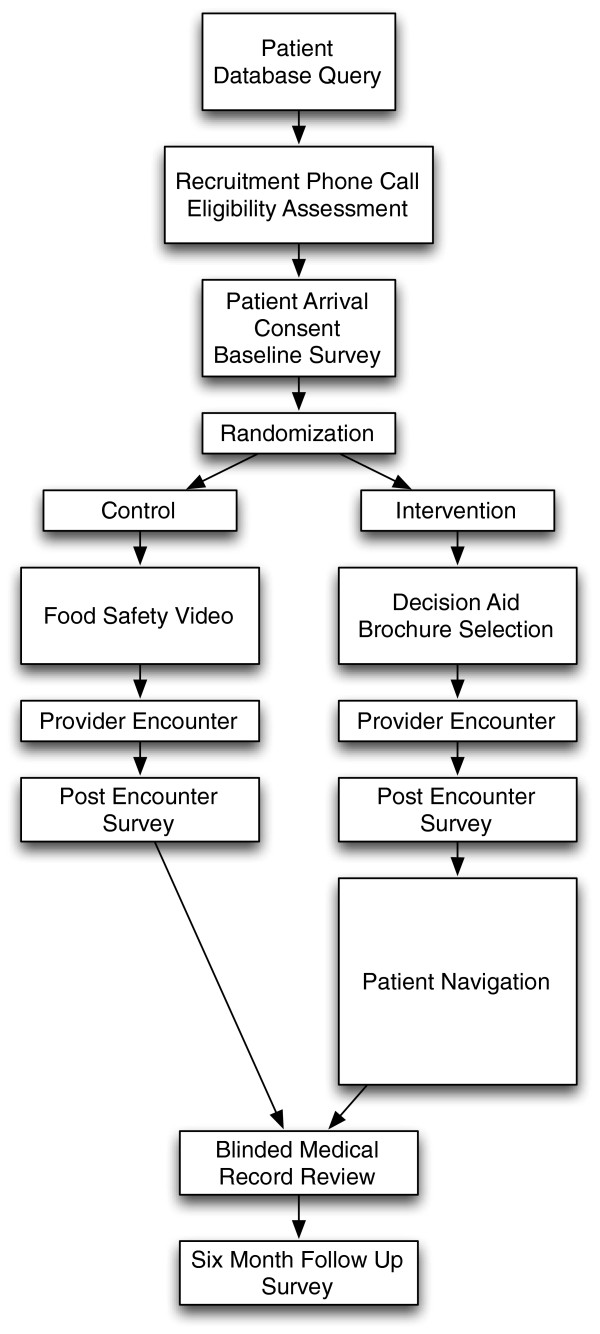
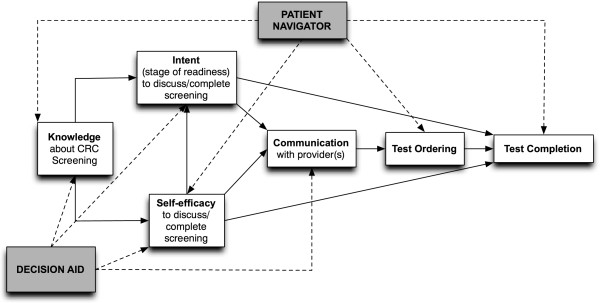
METHODS/DESIGN: We will conduct a multisite, randomized controlled trial with patient-level randomization. Planned enrollment is 300 patients aged 50 to 75 years at average CRC risk presenting for appointments at two primary clinics in North Carolina and New Mexico. Intervention participants will view a video decision aid immediately before the clinic visit. The 14 to 16 minute video presents information about fecal occult blood tests and colonoscopy and will be viewed on a portable computer tablet in English or Spanish. Clinic-based patient navigators are bilingual and bicultural and will provide both face-to-face and telephone-based navigation. Control participants will view an unrelated food safety video and receive usual care. The primary outcome is completion of a CRC screening test at six months. Planned subgroup analyses include examining intervention effectiveness in Latinos, who will be oversampled. Secondarily, the trial will evaluate the intervention effects on knowledge of CRC screening, self-efficacy, intent, and patient-provider communication. The study will also examine whether patient ethnicity, acculturation, language preference, or health insurance status moderate the intervention effect on CRC screening.
This pragmatic randomized controlled trial will test a combined decision aid and patient navigator intervention targeting CRC screening completion. Findings from this trial may inform future interventions and implementation policies designed to promote CRC screening in vulnerable patient populations and to reduce screening disparities.
ClinicalTrials.gov NCT02054598.
筛查可降低结直肠癌(CRC)的发病率和死亡率。然而,在弱势群体中,尤其是拉丁裔人群中,筛查的利用率较低。以患者为导向的决策辅助工具可增加结直肠癌筛查知识、自我效能感和意愿;然而,它们对实际完成筛查测试的影响往往不大。这可能是因为决策辅助工具未解决一些特定于患者的障碍,这些障碍阻碍了这些人群成功完成结直肠癌筛查。不过,通过患者导航干预措施或许可以解决这些个体障碍。本研究将测试一种联合决策辅助工具和患者导航员的干预措施对不同群体的弱势初级保健患者完成筛查的效果。
方法/设计:我们将进行一项多中心、患者水平随机分组的随机对照试验。计划招募300名年龄在50至75岁、平均患结直肠癌风险的患者,他们将在北卡罗来纳州和新墨西哥州的两家初级诊所预约就诊。干预组参与者将在就诊前立即观看视频决策辅助工具。这个14至16分钟的视频介绍粪便潜血试验和结肠镜检查的相关信息,将通过便携式电脑平板以英语或西班牙语观看。诊所的患者导航员具备双语和双文化能力,将提供面对面和电话导航服务。对照组参与者将观看一部无关的食品安全视频并接受常规护理。主要结局是在六个月时完成结直肠癌筛查测试。计划的亚组分析包括检查干预措施在拉丁裔人群中的效果,拉丁裔人群将被过度抽样。其次,该试验将评估干预措施对结直肠癌筛查知识、自我效能感、意愿以及患者与提供者沟通的影响。该研究还将考察患者的种族、文化适应程度、语言偏好或健康保险状况是否会调节干预措施对结直肠癌筛查的效果。
这项实用的随机对照试验将测试一种联合决策辅助工具和患者导航员的干预措施,目标是完成结直肠癌筛查。该试验的结果可能为未来旨在促进弱势群体中结直肠癌筛查并减少筛查差异的干预措施和实施政策提供参考。
ClinicalTrials.gov NCT02054598。