School of Chinese Medicine, Faculty of Science, The Chinese University of Hong Kong, Shatin, Hong Kong SAR, China.
Chin Med. 2010 Jan 12;5:1. doi: 10.1186/1749-8546-5-1.
The results of many clinical trials and experimental studies regarding acupoint specificity are contradictory. This review aims to investigate whether a difference in efficacy exists between ordinary acupuncture on specific acupoints and sham acupuncture controls on non-acupoints or on irrelevant acupoints.
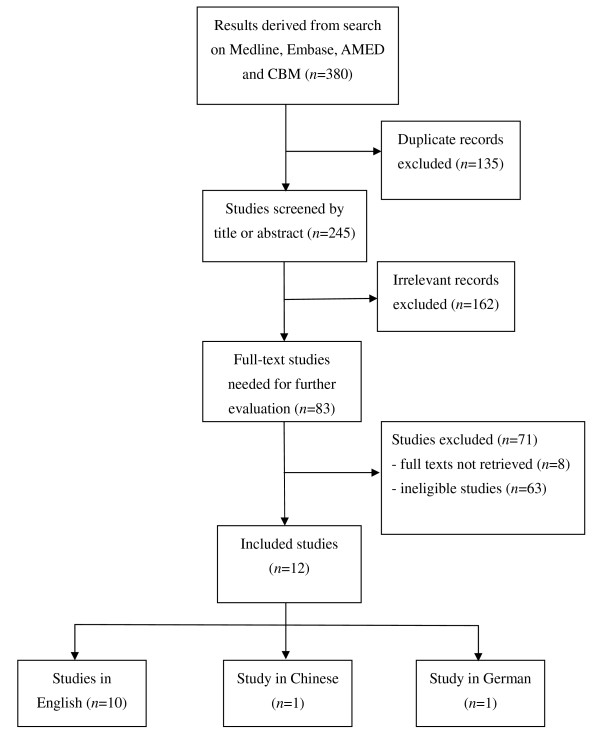
Databases including Medline, Embase, AMED and Chinese Biomedical Database were searched to identify randomized controlled trials published between 1998 and 2009 that compared traditional body acupuncture on acupoints with sham acupuncture controls on irrelevant acupoints or non-acupoints with the same needling depth. The Cochrane Collaboration's tool for assessing risk of bias was employed to address the quality of the included trials.
Twelve acupuncture clinical trials with sham acupuncture controls were identified and included in the review. The conditions treated varied. Half of the included trials had positive results on the primary outcomes and demonstrated acupoint specificity. However, among those six trials (total sample size: 985) with low risk of bias, five trials (sample size: 940) showed no statistically significant difference between proper and sham acupuncture treatments.
This review did not demonstrate the existence of acupoint specificity. Further clinical trials with larger sample sizes, optimal acupuncture treatment protocols and appropriate sham acupuncture controls are required to resolve this important issue.
许多关于穴位特异性的临床试验和实验研究结果存在矛盾。本综述旨在调查在特定穴位上进行普通针刺与非穴位或无关穴位上进行假针刺对照之间的疗效是否存在差异。
检索 Medline、Embase、AMED 和中国生物医学数据库,以确定 1998 年至 2009 年间发表的比较传统体针穴位与非穴位或无关穴位相同深度针刺的假针刺对照的随机对照试验。采用 Cochrane 协作组评估偏倚风险的工具来评估纳入试验的质量。
共确定了 12 项具有假针刺对照的针刺临床试验,并将其纳入综述。治疗的病症各不相同。纳入的试验中有一半在主要结局上有阳性结果,显示出穴位特异性。然而,在 6 项(总样本量:985)低偏倚风险的试验中,5 项(样本量:940)试验显示适当针刺与假针刺治疗之间无统计学显著差异。
本综述未显示穴位特异性的存在。需要进一步开展具有更大样本量、最佳针刺治疗方案和适当假针刺对照的临床试验,以解决这一重要问题。