Department of Pediatrics, Neonatology Section, Hospital Universitario Mútua de Terrassa, Barcelona, Spain.
BMC Pediatr. 2010 Feb 11;10:6. doi: 10.1186/1471-2431-10-6.
There is very little evidence of the similarity of the mechanics of maternal and bottle feeding. We assessed the mechanics of sucking in exclusive breastfeeding, exclusive bottle feeding, and mixed feeding. The hypothesis established was that physiological pattern for suckling movements differ depending on the type of feeding. According to this hypothesis, babies with breastfeeding have suckling movements at the breast that are different from the movements of suckling a teat of babies fed with bottle. Children with mixed feeding mix both types of suckling movements.
Cross-sectional study of infants aged 21-28 days with only maternal feeding or bottle feeding (234 mother-infant pairs), and a randomized open cross-over field trial in newborns aged 21-28 days and babies aged 3-5 months with mixed feeding (125 mother-infant pairs). Primary outcome measures were sucks and pauses.
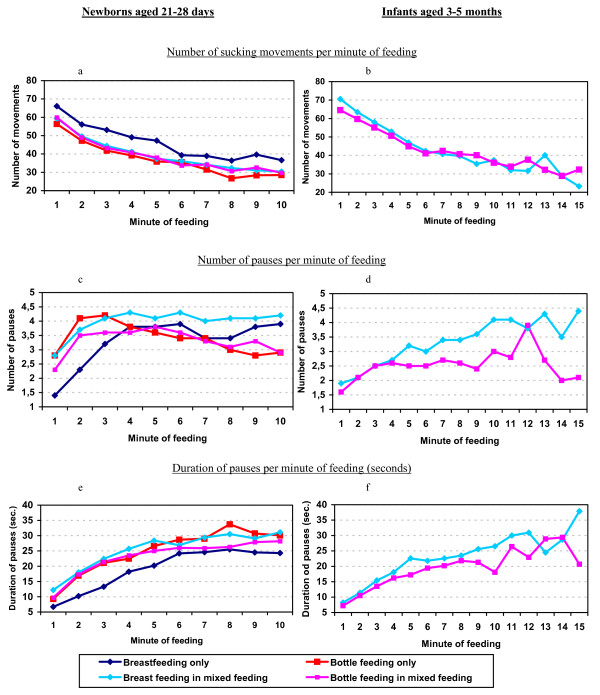
Infants aged 21-28 days exclusively bottle-fed showed fewer sucks and the same number of pauses but of longer duration compared to breastfeeding. In mixed feeding, bottle feeding compared to breastfeeding showed the same number of sucks but fewer and shorter pauses, both at 21-28 days and at 3-5 months. The mean number of breastfeedings in a day (in the mixed feed group) was 5.83 +/- 1.93 at 21-28 days and 4.42 +/- 1.67 at 3-5 months. In the equivalence analysis of the mixed feed group, the 95% confidence interval for bottle feeding/breastfeeding ratio laid outside the range of equivalence, indicating 5.9-8.7% fewer suction movements, and fewer pauses, and shorter duration of them in bottle feeding compared with breastfeeding.
The mechanics of sucking in mixed feeding lay outside the range of equivalence comparing bottle feeding with breastfeeding, although differences were small. Children with mixed feeding would mix both types of sucking movements (breastfeeding and bottle feeding) during the learning stage and adopt their own pattern.
目前很少有证据表明母乳喂养和奶瓶喂养的力学机制相似。我们评估了纯母乳喂养、纯奶瓶喂养和混合喂养时的吸吮力学。假设吸吮运动的生理模式因喂养方式而异。根据这一假设,母乳喂养的婴儿在乳房上的吸吮动作与奶瓶喂养的婴儿的吸吮动作不同。混合喂养的儿童会混合两种吸吮动作。
对仅接受母乳喂养或奶瓶喂养的 21-28 天婴儿(234 对母婴)进行横断面研究,对 21-28 天新生儿和 3-5 个月混合喂养婴儿(125 对母婴)进行随机开放交叉现场试验。主要观察指标为吸吮次数和暂停次数。
21-28 天纯奶瓶喂养的婴儿吸吮次数较少,暂停次数相同,但持续时间较长。在混合喂养中,与母乳喂养相比,奶瓶喂养在 21-28 天和 3-5 个月时表现为吸吮次数相同,但暂停次数更少,持续时间更短。(在混合喂养组中)每天母乳喂养的平均次数为 21-28 天时为 5.83±1.93,3-5 个月时为 4.42±1.67。在混合喂养组的等效性分析中,奶瓶喂养/母乳喂养比值的 95%置信区间落在等效范围之外,表明与母乳喂养相比,奶瓶喂养时吸吮运动次数减少 5.9%-8.7%,暂停次数减少,暂停时间缩短。
混合喂养时的吸吮力学在奶瓶喂养与母乳喂养的等效性范围之外,尽管差异较小。混合喂养的儿童在学习阶段会混合两种吸吮动作(母乳喂养和奶瓶喂养),并采用自己的模式。