Cardiology Unit, San Camillo de Lellis Hospital, Manfredonia, Foggia, Italy.
Mediators Inflamm. 2009;2009:737282. doi: 10.1155/2009/737282. Epub 2010 Jan 26.
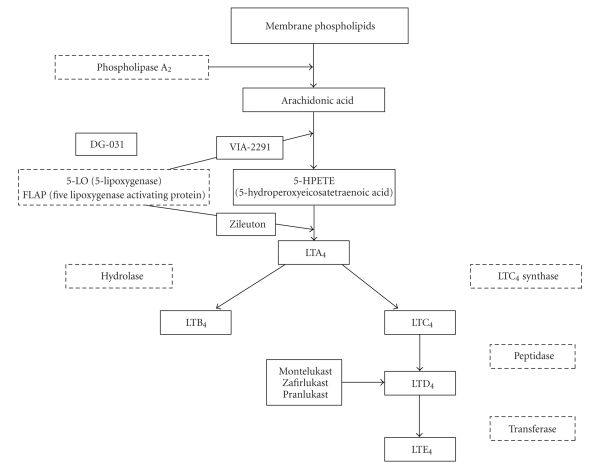
Atherosclerosis represents an important chronic inflammatory process associated with several pathophysiological reactions in the vascular wall. The arachidonic acid, released by phospholipase A2, is an important substrate for the production of a group of lipid mediators known as leukotrienes, which induce proinflammatory signaling through the activation of specific BLT and CysLT receptors. The interaction of these substances in the vascular wall determines important morphological alterations like the early lipid retention and the accumulation of foam cells, the development of intimal hyperplasia, and advanced atherosclerotic lesions, and it plays an important role in the rupture of atherosclerotic plaque. Many studies regarding myocardial ischemia and reperfusion show that leukotriene signaling may be involved in the development of ischemic injury. For these, reasons both leukotriene synthesis inhibitors and leukotriene receptor antagonists have been suggested for inducing beneficial effects at different stages of the atherosclerosis process and may represent a new therapeutic target in the treatment of atherosclerotic vessel diseases, in particular in acute coronary syndrome.
动脉粥样硬化是一种重要的慢性炎症过程,与血管壁中的几种病理生理反应有关。磷脂酶 A2 释放的花生四烯酸是一组称为白三烯的脂质介质产生的重要底物,通过激活特定的 BLT 和 CysLT 受体诱导促炎信号。这些物质在血管壁中的相互作用决定了重要的形态改变,如早期脂质蓄积和泡沫细胞的积累、内膜增生的发展以及进展期动脉粥样硬化病变,并在动脉粥样硬化斑块破裂中发挥重要作用。许多关于心肌缺血再灌注的研究表明,白三烯信号可能参与缺血性损伤的发生。基于这些原因,白三烯合成抑制剂和白三烯受体拮抗剂已被提议用于在动脉粥样硬化过程的不同阶段诱导有益效果,并且可能成为治疗动脉粥样硬化血管疾病的新的治疗靶点,特别是在急性冠状动脉综合征中。