State Key Laboratory for Agrobiotechnology and College of Biological Sciences, China Agricultural University, Beijing 100193, P. R. China.
Int J Biol Sci. 2010 Feb 6;6(1):96-106. doi: 10.7150/ijbs.6.96.
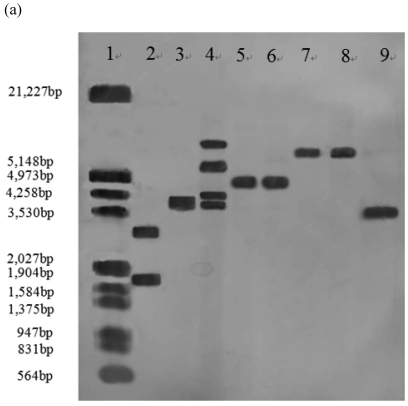
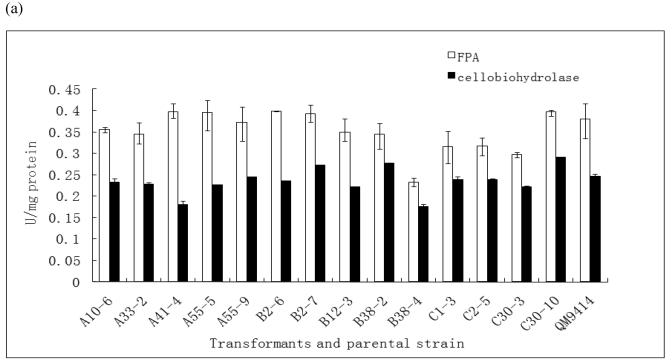
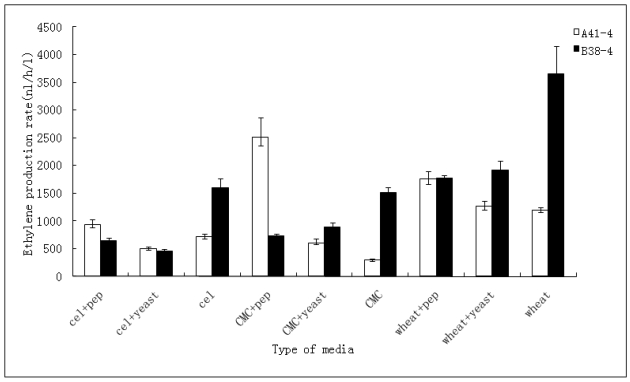
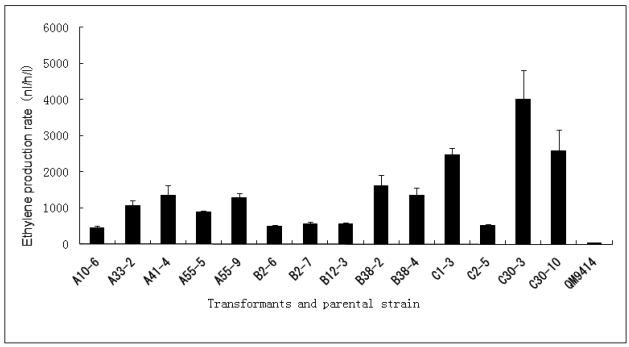
In order to efficiently utilize natural cellulose materials to produce ethylene, three expression vectors containing the ethylene-forming enzyme (efe) gene from Pseudomonas syringae pv. glycinea were constructed. The target gene was respectively controlled by different promoters: cbh I promoter from Trichoderma reesei cellobiohydrolases I gene, gpd promoter from Aspergillus nidulans glyceraldehyde-3-phosphate dehydrogenase gene and pgk I promoter from T. reesei 3-phosphoglycerate kinase I gene. After transforming into T. reesei QM9414, 43 stable transformants were obtained by PCR amplification and ethylene determination. Southern blot analysis of 14 transformants demonstrated that the efe gene was integrated into chromosomal DNA with copy numbers from 1 to 4. Reverse transcription polymerase chain reaction (RT-PCR) analysis of 6 transformants showed that the heterologous gene was transcribed. By using wheat straw as a carbon source, the ethylene production rates of aforementioned 14 transformants were measured. Transformant C30-3 with pgk I promoter had the highest ethylene production (4,012 nl h(-1) l(-1)). This indicates that agricultural wastes could be used to produce ethylene in recombinant filamentous fungus T. reesei.
为了高效利用天然纤维素材料生产乙烯,构建了三个表达载体,其中包含来自大豆丁香假单胞菌 pv. 甘氨酸的乙烯形成酶(efe)基因。目的基因分别由不同的启动子控制:来自里氏木霉纤维二糖水解酶 I 基因的 cbh I 启动子、来自aspergillus nidulans 甘油醛-3-磷酸脱氢酶基因的 gpd 启动子和来自里氏木霉 3-磷酸甘油酸激酶 I 基因的 pgk I 启动子。转化到 T. reesei QM9414 后,通过 PCR 扩增和乙烯测定获得了 43 个稳定转化体。14 个转化体的 Southern blot 分析表明,efe 基因已整合到染色体 DNA 中,拷贝数从 1 到 4 不等。6 个转化体的反转录聚合酶链反应(RT-PCR)分析表明,异源基因被转录。以小麦秸秆为碳源,测定了上述 14 个转化体的乙烯生成率。带有 pgk I 启动子的 C30-3 转化体具有最高的乙烯生成率(4012 nl h(-1) l(-1))。这表明农业废弃物可用于生产重组丝状真菌 T. reesei 中的乙烯。