Transfusion Medicine, Sunnybrook Health Sciences Centre, University of Toronto, 2075 Bayview Ave, C160, Toronto, ON M4N 3M5, Canada.
Crit Care. 2010;14(1):202. doi: 10.1186/cc8205. Epub 2010 Jan 28.
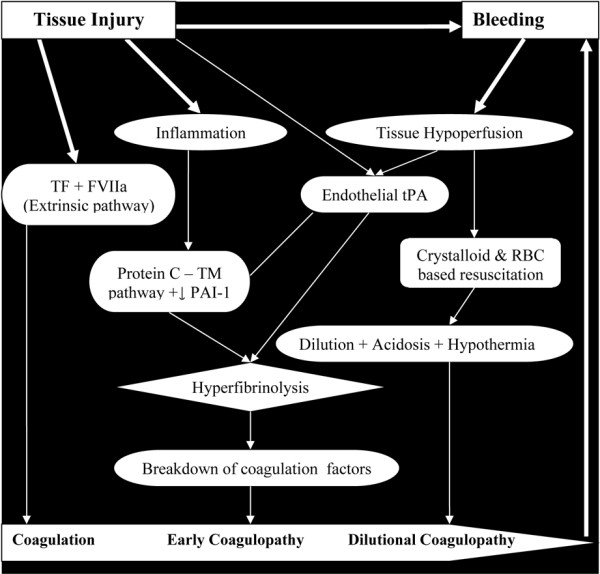
Fresh frozen plasma (FFP) is indicated for the management of massive bleedings. Recent audits suggest physician knowledge of FFP is inadequate and half of the FFP transfused in critical care is inappropriate. Trauma is among the largest consumers of FFP. Current trauma resuscitation guidelines recommend FFP to correct coagulopathy only after diagnosed by laboratory tests, often when overt dilutional coagulopathy already exists. The evidence supporting these guidelines is limited and bleeding remains a major cause of trauma-related death. Recent studies demonstrated that coagulopathy occurs early in trauma. A novel early formula-driven haemostatic resuscitation proposes addressing coagulopathy early in massive bleedings with FFP at a near 1:1 ratio with red blood cells. Recent retrospective reports suggest such strategy significantly reduces mortality, and its use is gradually expanding to nontraumatic bleedings in critical care. The supporting studies, however, have bias limiting the interpretation of the results. Furthermore, logistical considerations including need for immediately available universal donor AB plasma, short life after thawing, potential waste and transfusion-associated complications have challenged its implementation. The present review focuses on FFP transfusion in massive bleeding and critically appraises the evidence on formula-driven resuscitation, providing resources to allow clinicians to develop informed opinion, given the current deficient and conflicting evidence.
新鲜冷冻血浆(FFP)用于治疗大量出血。最近的审计表明,医生对 FFP 的了解不足,而且在重症监护中输注的一半 FFP 是不适当的。创伤是 FFP 的最大消耗者之一。目前的创伤复苏指南建议仅在实验室检查诊断出凝血功能障碍后才使用 FFP,通常是在已经存在明显稀释性凝血功能障碍时。支持这些指南的证据有限,出血仍然是创伤相关死亡的主要原因。最近的研究表明,创伤后早期即出现凝血功能障碍。一种新的早期公式驱动的止血复苏方案建议在大量出血时,以接近 1:1 的比例与红细胞一起早期使用 FFP 来纠正凝血功能障碍。最近的回顾性报告表明,这种策略显著降低了死亡率,其应用逐渐扩展到重症监护中非创伤性出血。然而,支持该策略的研究存在偏倚,限制了对结果的解释。此外,包括需要立即获得通用供体 AB 血浆、解冻后寿命短、潜在浪费和与输血相关的并发症在内的后勤问题也对其实施提出了挑战。本综述重点关注大量出血中的 FFP 输注,并批判性地评估了公式驱动复苏的证据,为临床医生提供了资源,让他们能够根据当前不足和相互矛盾的证据形成自己的意见。