Department of Pharmacology, University of Michigan, Ann Arbor, Michigan, USA.
Heart Rhythm. 2010 Sep;7(9):1309-15. doi: 10.1016/j.hrthm.2010.02.017. Epub 2010 Feb 13.
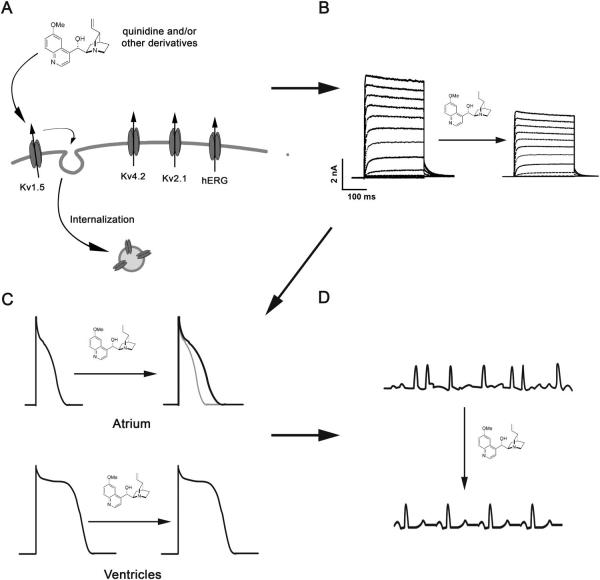
Atrial fibrillation (AF) is a common cardiac arrhythmia with potentially life-threatening complications. Drug therapies for treatment of AF that seek long-term maintenance of normal sinus rhythm remain elusive due in large part to proarrhythmic ventricular actions. Kv1.5, which underlies the atrial specific I(Kur) current, is a major focus of research efforts seeking new therapeutic strategies and targets. Recent work has shown a novel effect of antiarrhythmic drugs where compounds that block Kv1.5 channel current also can alter ion channel trafficking. This work further suggests that the pleiotropic effects of antiarrhythmic drugs may be separable. Although this finding highlights the therapeutic potential for selective manipulation of ion channel surface density, it also reveals an uncertainty regarding the specificity of modulating trafficking pathways without risk of off-target effects. Future studies may show that specific alteration of Kv1.5 trafficking can overcome the proarrhythmic limitations of current pharmacotherapy and provide an effective method for long-term cardioversion in AF.
心房颤动(AF)是一种常见的心律失常,可能有生命危险的并发症。药物治疗 AF 寻求长期维持正常窦性节律仍难以捉摸,主要是由于致心律失常的心室作用。Kv1.5,它是基础的心房特异性 I(Kur)电流,是寻求新的治疗策略和靶点的研究工作的主要焦点。最近的工作表明,抗心律失常药物的一种新的作用,其中阻断 Kv1.5 通道电流的化合物也可以改变离子通道运输。这项工作进一步表明,抗心律失常药物的多效性作用可能是可分离的。尽管这一发现突出了选择性操纵离子通道表面密度的治疗潜力,但它也揭示了在没有脱靶效应风险的情况下,调节运输途径的特异性的不确定性。未来的研究可能表明,Kv1.5 运输的特定改变可以克服当前药物治疗的致心律失常局限性,并为 AF 中的长期电转换提供一种有效方法。