Institute of Sportmedicine and Sportnutritition, Ruhr-University Bochum, Bochum, Germany.
Eur J Med Res. 2009 Dec 7;14 Suppl 4(Suppl 4):134-9. doi: 10.1186/2047-783x-14-s4-134.
Exhaled breath condensate (EBC) contains among a large number of mediators hydrogen peroxide (H2O2) as a marker of airway inflammation and oxidative stress. Similarly EBC pH also changes in respiratory diseases. It was the aim of our investigation to prove if hydrogen peroxide release and changes in pH of EBC changes with exercise.
EBC was collected from 100 litres exhaled air along with samples of arterialized blood of 16 healthy subjects (9 males, 7 females, age 23 +/- 1 years). EBC hydrogen peroxide was analyzed with EcoCheck amperometer (FILT, Berlin). The rate of H(2)O(2) release was calculated from the concentration and collection time. pH and PCO(2) in blood and in EBC were measured with the Radiometer blood gas analyzer, EBC was equilibrated with a gas mixture (5% CO(2) in O(2)). The bicarbonate concentration was calculated according to the law of mass action for CO(2) and HCO(3)(-) (pK = 6.1).
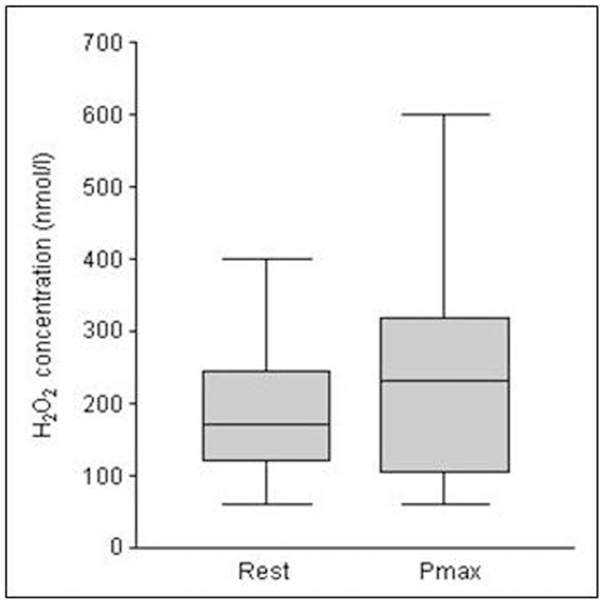
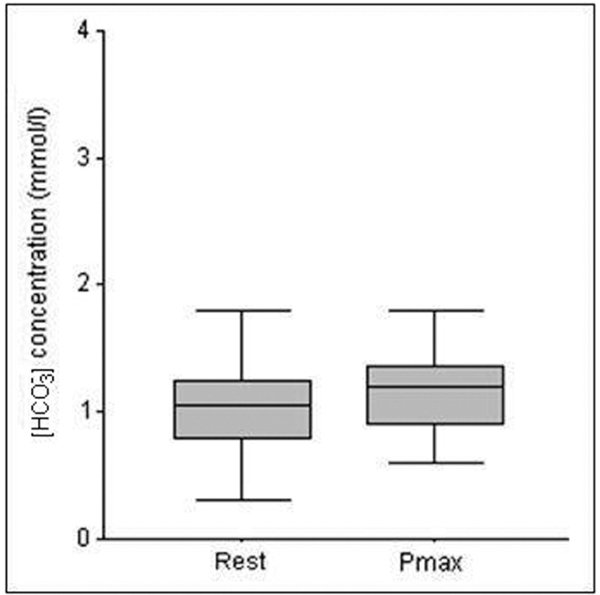
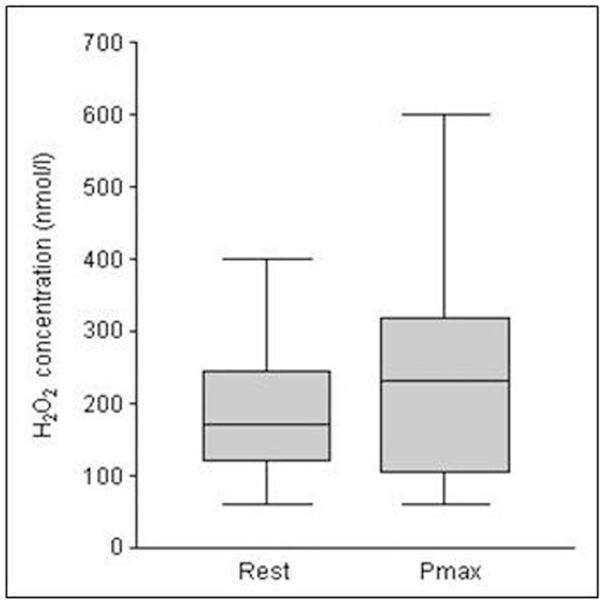
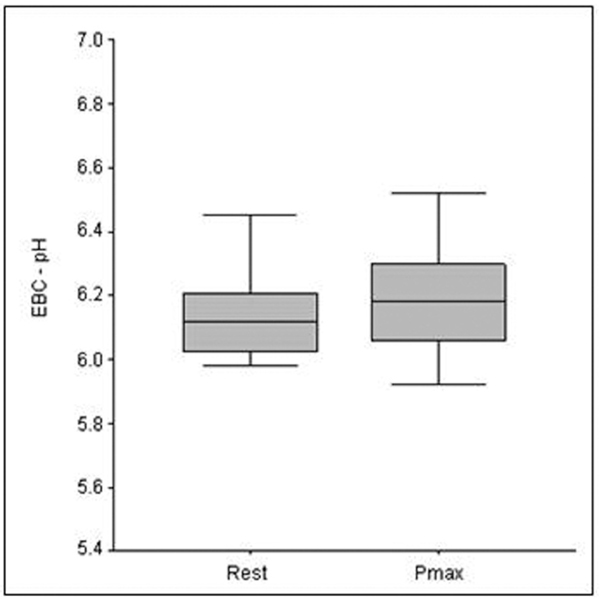
H(2)O(2) concentration in EBC was 190 +/- 109 nmol/l, and H (2)O(2) release at rest was 31.0 +/- 18.3 pmol/min. At maximal exercise, the H(2)O(2) concentration in EBC increased to 250 +/- 120 nmol/l, and H(2)O(2) release significantly increased at maximal exercise to 84.4 +/- 39.9 pmol/min (P<0.01). At rest pH of the CO(2) equilibrated EBC was at 6.08 +/- 0.23 and the [HCO(3)(-)] was 1.03 +/- 0.40 mmol/l. At maximum exercise, pH 6.18 +/- 0.17 and [HCO(3)(-)] 1.23 +/- 0.30 mmol/l remained almost unaltered.
The rate of H(2)O(2) release in EBC increased during exhausting exercise (external load: 300 Watt) by a factor of 2, whereas the pH and the bicarbonate concentration of the EBC, equilibrated with 5% CO(2) at 37 degrees C were not significantly altered. It has to be proven by further experiments whether there is a linear relationship between the rates of H(2)O(2) release in EBC in graded submaximal exercise.
呼出气冷凝物(EBC)中含有大量介质过氧化氢(H2O2),作为气道炎症和氧化应激的标志物。同样,EBC 的 pH 值也会在呼吸疾病中发生变化。我们的研究目的是证明 EBC 中的过氧化氢释放和 pH 值变化是否随运动而变化。
从 16 名健康受试者(9 名男性,7 名女性,年龄 23 +/- 1 岁)的 100 升呼出空气中收集 EBC 和动脉化血样本。使用 EcoCheck 安培计(柏林 FILT)分析 EBC 中的过氧化氢。根据浓度和收集时间计算 H2O2 的释放速率。使用 Radiometer 血气分析仪测量血液和 EBC 中的 pH 值和 PCO2,EBC 用 5% CO2 在 O2 中的混合气平衡。根据 CO2 和 HCO3-的质量作用定律(pK = 6.1)计算 HCO3-浓度。
EBC 中的 H2O2 浓度为 190 +/- 109 nmol/L,静息时 H2O2 释放量为 31.0 +/- 18.3 pmol/min。在最大运动时,EBC 中的 H2O2 浓度增加到 250 +/- 120 nmol/L,H2O2 释放量在最大运动时显著增加至 84.4 +/- 39.9 pmol/min(P<0.01)。静息时,CO2 平衡 EBC 的 pH 值为 6.08 +/- 0.23,[HCO3-]为 1.03 +/- 0.40 mmol/L。在最大运动时,pH 值为 6.18 +/- 0.17,[HCO3-]为 1.23 +/- 0.30 mmol/L,几乎没有变化。
在耗尽运动(外部负荷:300 瓦)期间,EBC 中 H2O2 的释放速率增加了 2 倍,而 EBC 的 pH 值和 37°C 下用 5% CO2 平衡的 HCO3-浓度没有明显改变。需要通过进一步的实验来证明,在递增的亚最大运动中,EBC 中 H2O2 释放率是否存在线性关系。