St. George Medical Center, Robert-Koch-Hospital, Leipzig, Germany.
Eur J Med Res. 2009 Dec 7;14 Suppl 4(Suppl 4):205-9. doi: 10.1186/2047-783x-14-s4-205.
Myrtol standardized is established in the treatment of acute and chronic bronchitis and sinusitis. It increases mucociliar clearance and has muco-secretolytic effects. Additional anti-inflammatory and antioxidative properties have been confirmed for Myrtol standardized, eucalyptus oil, and orange oil in several in vitro studies.
The aim of this study was to prove the ability of essential oils to reduce cytokines release and reactive oxygen species (ROS) production derived from ex vivo cultured alveolar macrophages.
Alveolar macrophages from patients with chronic obstructive pulmonary disease (COPD, n=26, GOLD III-IV) were pre-cultured with essential oils (10(3)-10(-8)%) for 1 h and then stimulated with LPS (1 microg/ml). After 4 h and 20 h respectively a) cellular reactive oxygen species (ROS) using 2',7'-dichlorofluorescein (DCF), and b) TNF-alpha, IL-8, and GM-CSF secretion were quantified.
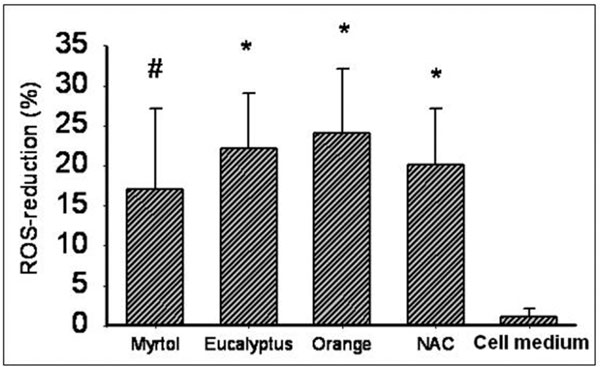
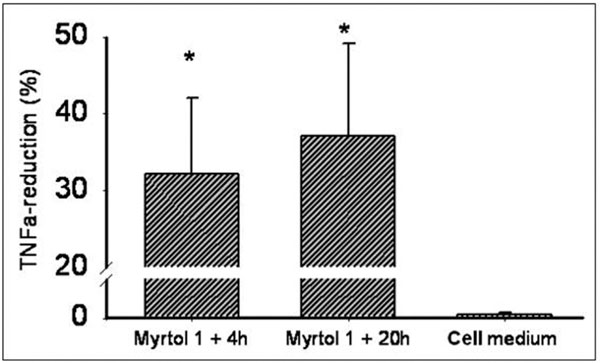
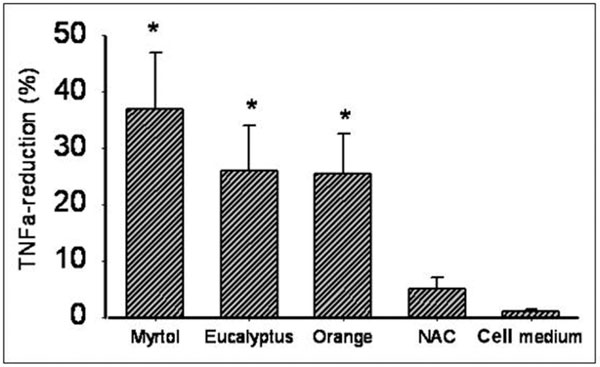
In comparison with negative controls, pre-cultured Myrtol, eucalyptus oil and orange oil (10-4%) reduced in the LPS-activated alveolar macrophages ROS release significantly after 1+20 h as follows: Myrtol -17.7% (P=0.05), eucalyptus oil -21.8% (P<0.01) and orange oil -23.6% (P<0.01). Anti-oxidative efficacy was comparable to NAC (1 mmol/l). Essential oils also induced a TNF-alpha reduction: Myrtol (-37.3%, P<0.001), eucalyptus oil (-26.8%, P<0.01) and orange oil (-26.6%, P<0.01). TNF-a reduction at 1+4 h and 1+20 h did not vary (Myrtol: -31.9% and -37.3% respectively, P= 0.372) indicating that this effect occurs early and cannot be further stimulated. Myrtol reduced the release of GM-CSF by -35.7% and that of IL-8 only inconsiderably.
All essential oils tested have effective antioxidative properties in ex vivo cultured and LPS-stimulated alveolar macrophages. Additionally, Myrtol inhibited TNF-a and GM-CSF release best indicating additional potent anti-inflammatory activity.
标准化桃金娘油在治疗急性和慢性支气管炎及鼻窦炎方面已得到确立。它可增加黏液纤毛清除功能,并具有黏液溶解作用。在多项体外研究中,标准化桃金娘油、桉树油和橘油已证实具有额外的抗炎和抗氧化特性。
本研究旨在证明精油能够减少源自体外培养肺泡巨噬细胞的细胞因子释放和活性氧(ROS)的产生。
对 26 例慢性阻塞性肺疾病(COPD,GOLD III-IV 级)患者的肺泡巨噬细胞进行预培养,所用精油浓度为 10(3)-10(-8)%,培养 1 小时,然后用 LPS(1μg/ml)刺激。分别在 4 小时和 20 小时后,a)用 2',7'-二氯荧光素(DCF)检测细胞内活性氧(ROS),b)检测 TNF-α、IL-8 和 GM-CSF 的分泌情况。
与阴性对照相比,经预培养的桃金娘油、桉树油和橘油(10-4%)可显著减少 LPS 激活的肺泡巨噬细胞 ROS 的释放,具体如下:桃金娘油 -17.7%(P=0.05),桉树油 -21.8%(P<0.01)和橘油 -23.6%(P<0.01)。抗氧化效果与 NAC(1mmol/L)相当。精油还可诱导 TNF-α减少:桃金娘油(-37.3%,P<0.001)、桉树油(-26.8%,P<0.01)和橘油(-26.6%,P<0.01)。在 1+4 小时和 1+20 小时时,TNF-α的减少没有差异(桃金娘油分别为-31.9%和-37.3%,P=0.372),这表明该作用发生较早,且不能进一步被刺激。桃金娘油可使 GM-CSF 的释放减少-35.7%,而对 IL-8 的释放仅有轻微影响。
所有测试的精油在体外培养和 LPS 刺激的肺泡巨噬细胞中均具有有效的抗氧化特性。此外,桃金娘油可最佳抑制 TNF-α和 GM-CSF 的释放,表明其具有额外的抗炎活性。