Ageing Research Laboratories, Institute for Ageing and Health, Newcastle University, Newcastle upon Tyne, UK.
Mol Syst Biol. 2010;6:347. doi: 10.1038/msb.2010.5. Epub 2010 Feb 16.
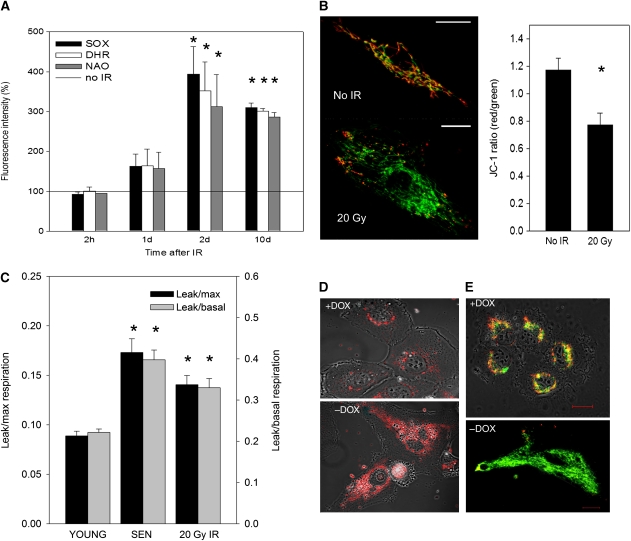
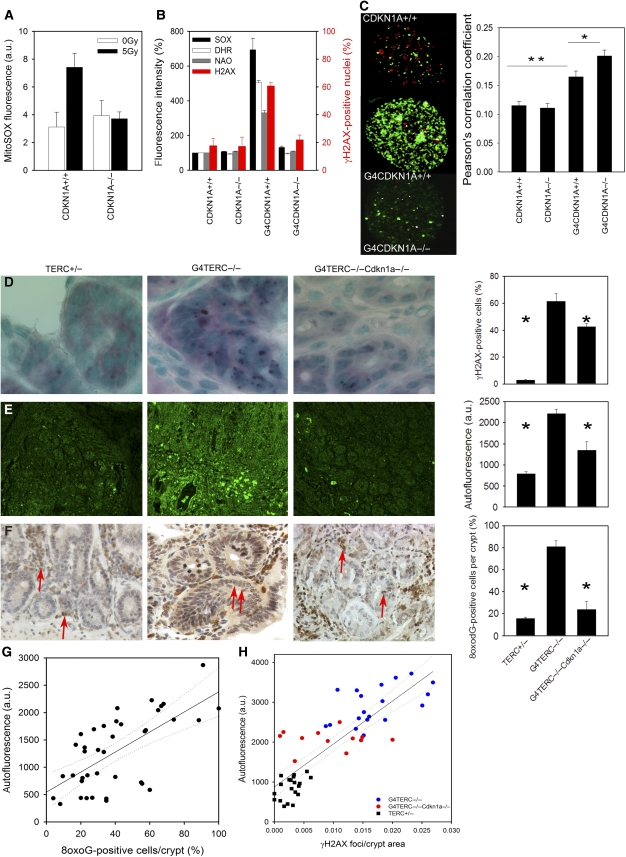
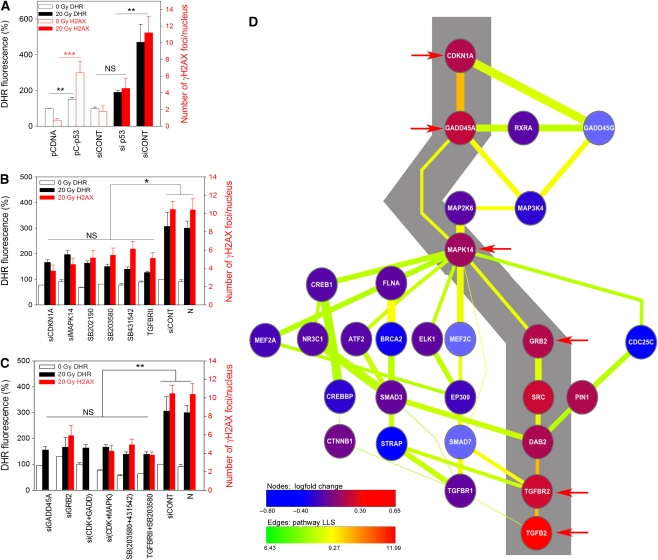
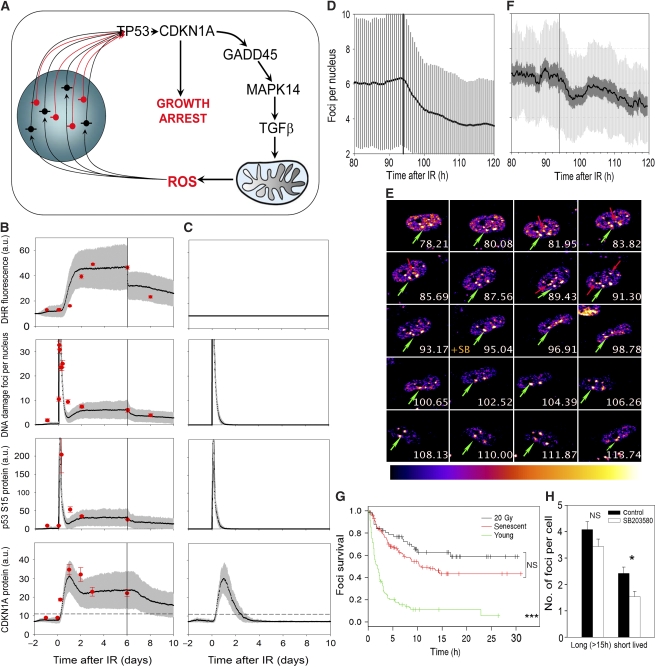
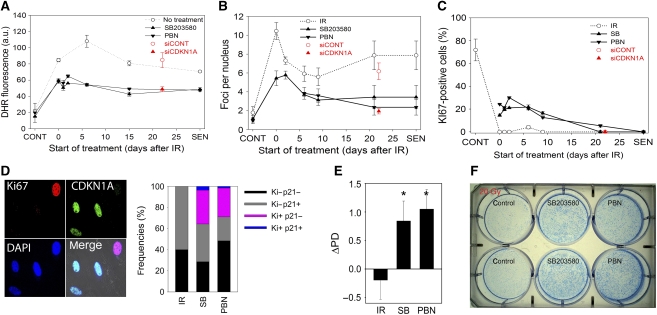
Cellular senescence--the permanent arrest of cycling in normally proliferating cells such as fibroblasts--contributes both to age-related loss of mammalian tissue homeostasis and acts as a tumour suppressor mechanism. The pathways leading to establishment of senescence are proving to be more complex than was previously envisaged. Combining in-silico interactome analysis and functional target gene inhibition, stochastic modelling and live cell microscopy, we show here that there exists a dynamic feedback loop that is triggered by a DNA damage response (DDR) and, which after a delay of several days, locks the cell into an actively maintained state of 'deep' cellular senescence. The essential feature of the loop is that long-term activation of the checkpoint gene CDKN1A (p21) induces mitochondrial dysfunction and production of reactive oxygen species (ROS) through serial signalling through GADD45-MAPK14(p38MAPK)-GRB2-TGFBR2-TGFbeta. These ROS in turn replenish short-lived DNA damage foci and maintain an ongoing DDR. We show that this loop is both necessary and sufficient for the stability of growth arrest during the establishment of the senescent phenotype.
细胞衰老——正常增殖细胞(如成纤维细胞)周期的永久停滞——既导致了与年龄相关的哺乳动物组织稳态丧失,又作为一种肿瘤抑制机制发挥作用。导致衰老的途径被证明比以前想象的更为复杂。通过计算机模拟互作分析和功能靶基因抑制、随机建模和活细胞显微镜,我们在这里显示存在一个动态反馈回路,该回路由 DNA 损伤反应 (DDR) 触发,并且在数天的延迟后,将细胞锁定在“深度”细胞衰老的主动维持状态中。该回路的基本特征是,检查点基因 CDKN1A (p21) 的长期激活通过 GADD45-MAPK14(p38MAPK)-GRB2-TGFBR2-TGFbeta 的级联信号转导导致线粒体功能障碍和活性氧 (ROS) 的产生。这些 ROS 反过来又补充了寿命短的 DNA 损伤焦点,并维持持续的 DDR。我们表明,在衰老表型建立过程中,该回路对于生长抑制的稳定性是必需和充分的。