Carver Charles S, Johnson Sheri L, Joormann Jutta
University of Miami.
Curr Dir Psychol Sci. 2009 Aug 1;18(4):195-199. doi: 10.1111/j.1467-8721.2009.01635.x.
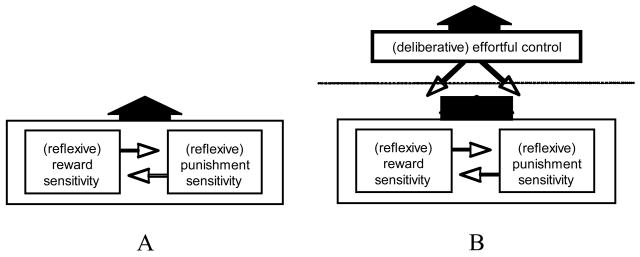
The serotonin system is a collection of neural pathways whose overall level of functioning (from low to high) relates to diverse kinds of psychological and behavioral variability. Individual differences in serotonergic function are important both in personality and in vulnerability to psychological disorders. These disorders range widely-from impulsive aggression to depression. One way to understand such diverse reflections of differences in serotonergic function is by viewing serotonergic function through the lens of two-mode (or dual-process) models of self-regulation. Such theories posit a lower-order system that responds quickly to associative cues of the moment and a higher-order system that responds reflectively and planfully. Low serotonergic function appears to enhance influence of the lower-order system. This often yields impulsive reactivity. Why, then, does low serotonergic function also relate to depression, which is characterized by lethargy and unresponsiveness? The answer must be that ascendance of the lower system interacts with other factors. One hypothesis is that low serotonergic function plus high sensitivity to incentives yields vulnerability to impulsive approach, whereas low serotonergic function plus low incentive sensitivity yields vulnerability to depression. Conceptualizing serotonergic function this way helps integrate information pertaining to very different disorders into a coherent picture.
血清素系统是一组神经通路,其整体功能水平(从低到高)与各种心理和行为变化相关。血清素能功能的个体差异在人格和心理障碍易感性方面都很重要。这些障碍范围广泛,从冲动攻击到抑郁。理解血清素能功能差异的这种多样表现的一种方法是通过自我调节的双模式(或双过程)模型来审视血清素能功能。这类理论假定存在一个对当下联想线索快速做出反应的低阶系统和一个进行反思性和计划性反应的高阶系统。血清素能功能低下似乎会增强低阶系统的影响。这通常会产生冲动反应性。那么,为什么血清素能功能低下还与以无精打采和反应迟钝为特征的抑郁有关呢?答案肯定是低阶系统的优势与其他因素相互作用。一种假设是,血清素能功能低下加上对奖励高度敏感会导致冲动接近的易感性,而血清素能功能低下加上奖励敏感性低会导致抑郁的易感性。以这种方式对血清素能功能进行概念化有助于将与非常不同的障碍相关的信息整合到一个连贯的图景中。