Division of Cell and Molecular Biology, Imperial College London, London, United Kingdom.
PLoS One. 2010 Feb 10;5(2):e9156. doi: 10.1371/journal.pone.0009156.
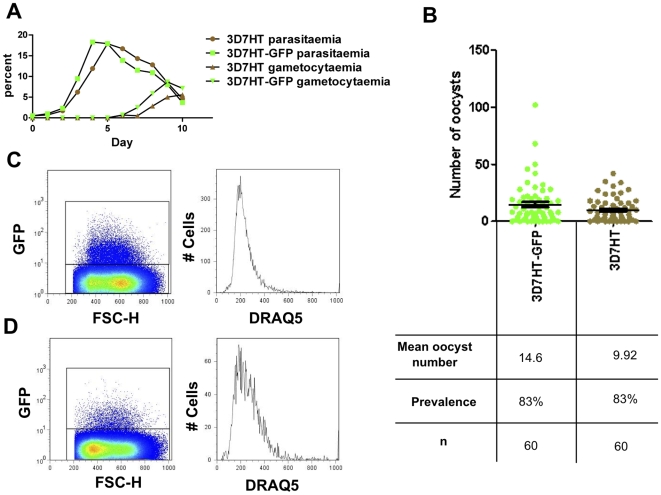
The human malaria parasite Plasmodium falciparum is responsible for the majority of malaria-related deaths. Tools allowing the study of the basic biology of P. falciparum throughout the life cycle are critical to the development of new strategies to target the parasite within both human and mosquito hosts. We here present 3D7HT-GFP, a strain of P. falciparum constitutively expressing the Green Fluorescent Protein (GFP) throughout the life cycle, which has retained its capacity to complete sporogonic development. The GFP expressing cassette was inserted in the Pf47 locus. Using this transgenic strain, parasite tracking and population dynamics studies in mosquito stages and exo-erythrocytic schizogony is greatly facilitated. The development of 3D7HT-GFP will permit a deeper understanding of the biology of parasite-host vector interactions, and facilitate the development of high-throughput malaria transmission assays and thus aid development of new intervention strategies against both parasite and mosquito.
人类疟疾寄生虫恶性疟原虫是导致大多数与疟疾相关的死亡的罪魁祸首。能够研究恶性疟原虫整个生命周期的基础生物学的工具,对于在人类和蚊子宿主中靶向寄生虫的新策略的发展至关重要。我们在此介绍 3D7HT-GFP,这是一种在整个生命周期中持续表达绿色荧光蛋白(GFP)的恶性疟原虫株,它保留了完成孢子发生发育的能力。GFP 表达盒被插入 Pf47 基因座。利用这种转基因株系,可以极大地促进蚊子阶段和红细胞外裂殖阶段的寄生虫跟踪和种群动态研究。3D7HT-GFP 的发展将有助于深入了解寄生虫-宿主-媒介相互作用的生物学,并促进高通量疟疾传播检测方法的发展,从而有助于开发针对寄生虫和蚊子的新干预策略。