Bolaños Juan P, Heales Simon J R
Department of Biochemistry and Molecular Biology, Institute of Neurosciences of Castilla- Leon, University of Salamanca Salamanca, Spain.
Front Neuroenergetics. 2010 Feb 3;2:1. doi: 10.3389/neuro.14.001.2010. eCollection 2010.
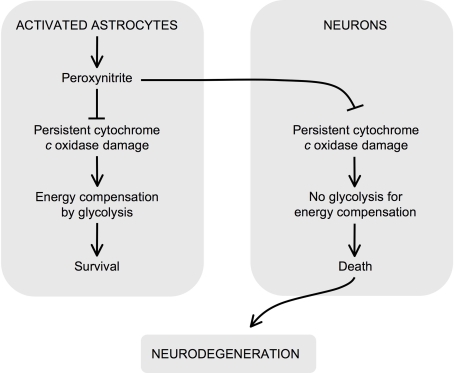
Approximately 15 years ago we reported that cytochrome c oxidase (CcO) was persistently inhibited as a consequence of endogenous induction and activation of nitric oxide (()NO) synthase-2 (NOS2) in astrocytes. Furthermore, the reactive nitrogen species implicated was peroxynitrite. In contrast to the reversible inhibition by ()NO, which occurs rapidly, in competition with O(2), and has signaling regulatory implications, the irreversible CcO damage by peroxynitrite is progressive in nature and follows and/or is accompanied by damage to other key mitochondrial bioenergetic targets. In purified CcO it has been reported that the irreversible inhibition occurs through a mechanism involving damage of the heme a(3)-Cu(B) binuclear center leading to an increase in the K(m) for oxygen. Astrocyte survival, as a consequence of peroxynitrite exposure, is preserved due to their robust bioenergetic and antioxidant defense mechanisms. However, by releasing peroxynitrite to the neighboring neurons, whose antioxidant defense can, under certain conditions, be fragile, activated astrocytes trigger bioenergetic stress leading to neuronal cell death. Thus, such irreversible inhibition of CcO by peroxynitrite may be a plausible mechanism for the neuronal death associated with neurodegenerative diseases, in which the activation of astrocytes plays a crucial role.
大约15年前,我们报道过,由于星形胶质细胞中一氧化氮(NO)合酶-2(NOS2)的内源性诱导和激活,细胞色素c氧化酶(CcO)会受到持续抑制。此外,涉及的活性氮物质是过氧亚硝酸根。与NO引起的可逆性抑制不同,后者发生迅速,与O(2)竞争,具有信号调节意义,而过氧亚硝酸根对CcO的不可逆损伤本质上是渐进性的,并且在其他关键线粒体生物能量靶点受损之后发生和/或与之伴随。据报道,在纯化的CcO中,不可逆抑制是通过一种机制发生的,该机制涉及血红素a(3)-Cu(B)双核中心的损伤,导致氧的米氏常数(K(m))增加。由于其强大的生物能量和抗氧化防御机制,过氧亚硝酸根暴露后的星形胶质细胞存活得以保留。然而,通过向邻近神经元释放过氧亚硝酸根,其抗氧化防御在某些情况下可能很脆弱,被激活的星形胶质细胞会引发生物能量应激,导致神经元细胞死亡。因此,过氧亚硝酸根对CcO的这种不可逆抑制可能是与神经退行性疾病相关的神经元死亡的一种合理机制,其中星形胶质细胞的激活起着关键作用。