Department of Intensive Care, Medical Spectrum Twente, Haaksbergerstraat 55, 7513 ER, Enschede, The Netherlands.
Intensive Care Med. 2010 Apr;36(4):697-701. doi: 10.1007/s00134-010-1776-x. Epub 2010 Feb 18.
The haemodynamics of crystalloid and colloid fluid loading may depend on underlying disease, i.e. sepsis versus non-sepsis.
A single-centre, single-blinded, randomized clinical trial was carried out on 24 critically ill sepsis and 24 non-sepsis patients with clinical hypovolaemia, assigned to loading with normal saline, gelatin 4%, hydroxyethyl starch 6% or albumin 5% in a 90-min (delta) central venous pressure (CVP)-guided fluid loading protocol. Transpulmonary thermodilution was done each 30 min, yielding, among others, global end-diastolic volume and cardiac indices (GEDVI, CI).
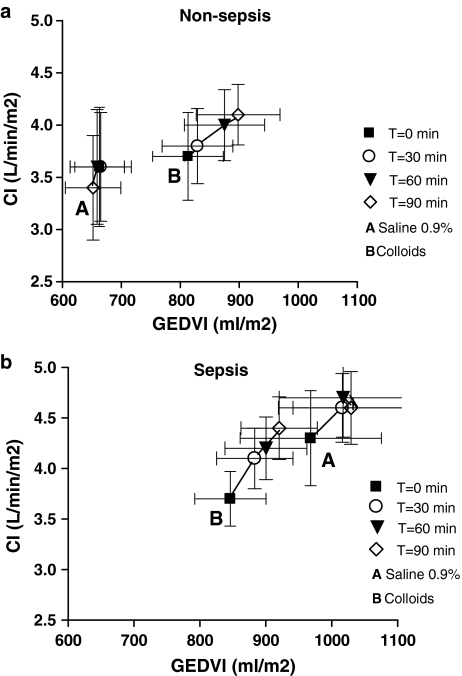
Sepsis patients had hyperdynamic hypotension in spite of myocardial depression and dilatation, and greater inotropic/vasopressor requirements than non-sepsis patients. Independent of underlying disease, CVP and GEDVI increased more after colloid than saline loading (P < 0.018), so that CI increased by about 2% after saline and 12% after colloid loading (P = 0.029). The increase in preload-recruitable stroke work was also greater with colloids and did not differ among conditions.
Fluid loading with colloids results in a greater linear increase in cardiac filling, output and stroke work than does saline loading, in both septic and non-septic clinical hypovolaemia, in spite of myocardial depression and presumably increased vasopermeability potentially decreasing the effects of colloid fluid loading in the former.
晶体液和胶体液的血流动力学效应可能取决于潜在的疾病状态,例如脓毒症与非脓毒症。
这是一项单中心、单盲、随机临床试验,纳入了 24 例患有临床低血容量的脓毒症和非脓毒症危重症患者,按照 90 分钟(Δ)中心静脉压(CVP)指导的液体负荷方案,分别接受生理盐水、4%明胶、6%羟乙基淀粉或 5%白蛋白负荷。每 30 分钟进行一次经肺温度稀释法,获得全心舒张末期容积和心指数(GEDVI、CI)等参数。
尽管脓毒症患者存在心肌抑制和扩张,但仍存在高动力性低血压,且比非脓毒症患者需要更多的正性肌力/血管加压药物。与潜在疾病无关,胶体液负荷后 CVP 和 GEDVI 的增加大于生理盐水(P<0.018),因此生理盐水和胶体液负荷后 CI 分别增加约 2%和 12%(P=0.029)。前负荷储备性每搏功的增加也与胶体液相关,且在不同条件下没有差异。
在脓毒症和非脓毒症临床低血容量患者中,与生理盐水相比,胶体液负荷引起的心脏充盈、输出和每搏功的线性增加更大,尽管存在心肌抑制和潜在的血管通透性增加,可能会降低胶体液负荷的效果,但前者的作用更大。