Department of Biotechnology, University of Verona, 37134 Verona, Italy.
BMC Genomics. 2010 Feb 18;11:117. doi: 10.1186/1471-2164-11-117.
Downy mildew is a destructive grapevine disease caused by Plasmopara viticola (Berk. and Curt.) Berl. and de Toni, which can only be controlled by intensive fungicide treatments. Natural sources of resistance from wild grapevine (Vitis) species are used in conventional breeding approaches, but the signals and effectors involved in resistance in this important crop species are not well understood.
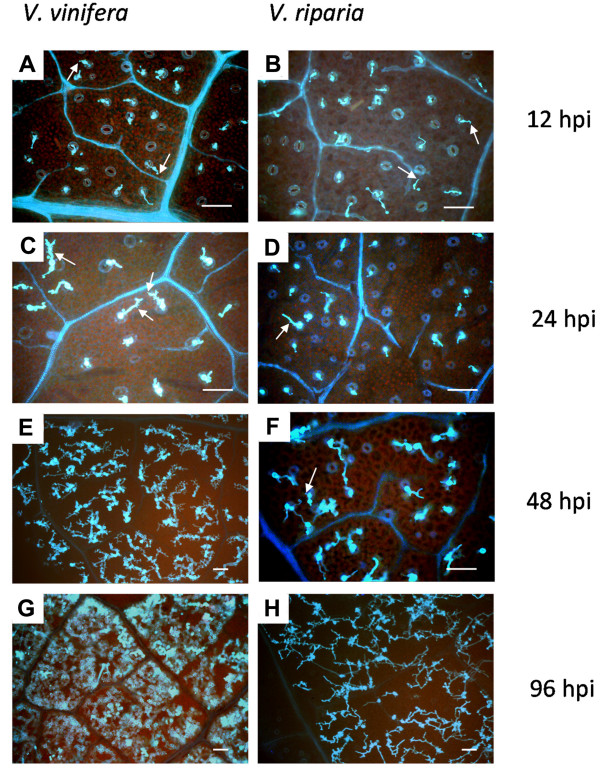
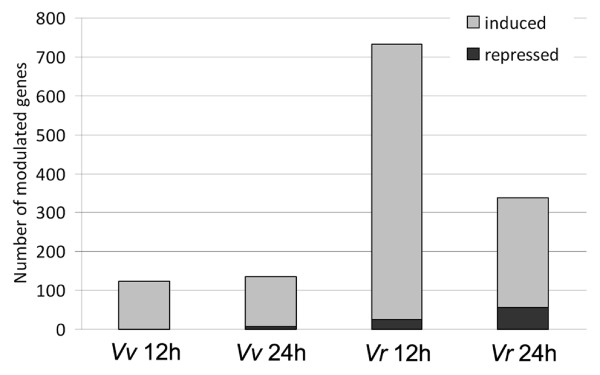
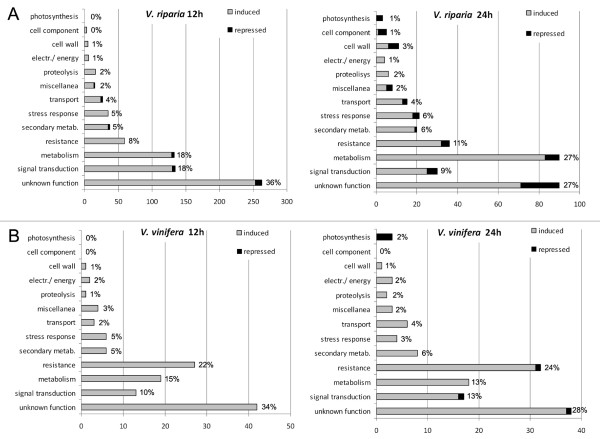
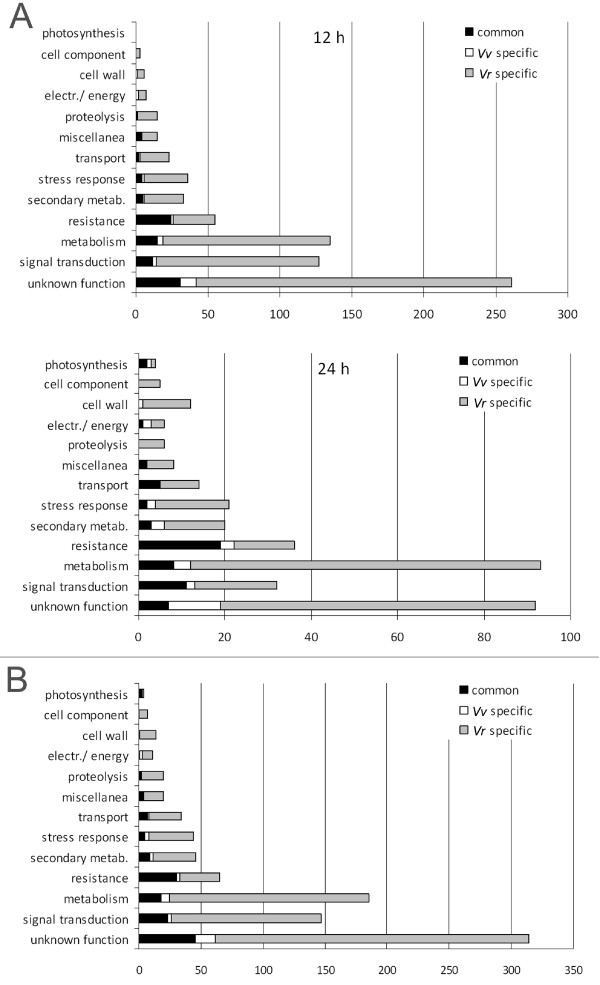
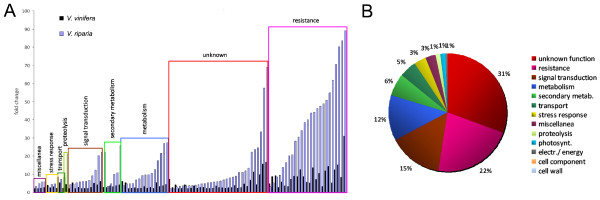
Early transcriptional changes associated with P. viticola infection in susceptible V. vinifera and resistant V. riparia plants were analyzed using the Combimatrix microarray platform. Transcript levels were measured 12 and 24 h post-inoculation, reflecting the time points immediately preceding the onset of resistance in V. riparia, as determined by microscopic analysis. Our data indicate that resistance in V. riparia is induced after infection, and is not based on differences in basal gene expression between the two species. The strong and rapid transcriptional reprogramming involves the induction of pathogenesis-related proteins and enzymes required for the synthesis of phenylpropanoid-derived compounds, many of which are also induced, albeit to a lesser extent, in V. vinifera. More interestingly, resistance in V. riparia also involves the specific modulation of numerous transcripts encoding components of signal transduction cascades, hypersensitive reaction markers and genes involved in jasmonate biosynthesis. The limited transcriptional modulation in V. vinifera represents a weak attempted defense response rather than the activation of compatibility-specific pathways.
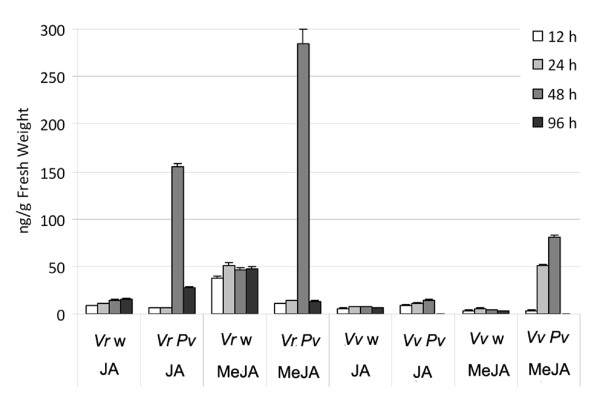
Several candidate resistance genes were identified that could be exploited in future biotechnological approaches to increase disease resistance in susceptible grapevine species. Measurements of jasmonic acid and methyl jasmonate in infected leaves suggest that this hormone may also be involved in V. riparia resistance to P. viticola.
由 Plasmopara viticola(Berk. 和 Curt.)Berl. 和 de Toni 引起的霜霉病是一种破坏性的葡萄藤疾病,只能通过密集的杀菌剂处理来控制。来自野生葡萄(Vitis)物种的天然抗性来源被用于常规育种方法,但在这种重要作物物种中涉及抗性的信号和效应子尚未得到很好的理解。
使用 Combimatrix 微阵列平台分析了易感 V. vinifera 和抗性 V. riparia 植物中与 P. viticola 感染相关的早期转录变化。在接种后 12 和 24 小时测量转录水平,反映了 V. riparia 抗性开始之前的时间点,这是通过显微镜分析确定的。我们的数据表明,V. riparia 的抗性是在感染后诱导的,而不是基于两个物种之间的基础基因表达差异。强烈而快速的转录重编程涉及到诱导与苯丙烷类化合物合成所需的病程相关蛋白和酶,其中许多在 V. vinifera 中也被诱导,尽管程度较小。更有趣的是,V. riparia 的抗性还涉及到许多编码信号转导级联组件、过敏反应标记物和茉莉酸生物合成相关基因的转录本的特异性调节。V. vinifera 中有限的转录调节代表了一种较弱的尝试防御反应,而不是相容性特异性途径的激活。
鉴定出了几个候选抗性基因,可用于未来的生物技术方法,以提高易感葡萄物种的抗病性。感染叶片中茉莉酸和茉莉酸甲酯的测量表明,这种激素也可能参与 V. riparia 对 P. viticola 的抗性。