Department of Human Nutrition, Kansas State University, Manhattan, KS, USA.
BMC Public Health. 2010 Feb 19;10:81. doi: 10.1186/1471-2458-10-81.
Girl Scouting may offer a viable channel for health promotion and obesity prevention programs. This study evaluated the effectiveness of an intervention program delivered through Girl Scout Junior troops that was designed to foster healthful troop meeting environments and increase obesity prevention behaviors at home.
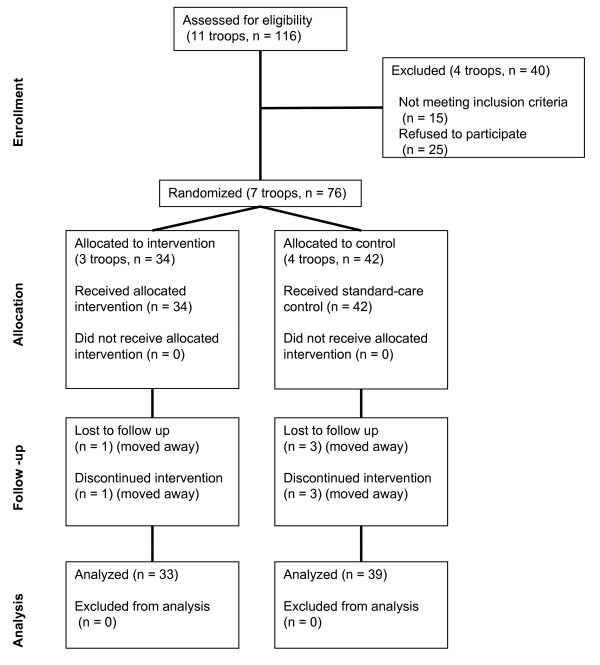
Seven Girl Scout troops were randomized to intervention (n = 3, with 34 girls) or standard-care control (n = 4, with 42 girls) conditions. Girls ranged in age from 9 to 13 years (mean 10.5 years). Intervention troop leaders were trained to implement policies promoting physical activity (PA) and healthful eating opportunities at troop meetings, and to implement a curriculum promoting obesity-prevention behaviors at home. The primary outcome variable was child body mass index (BMI) z-score. Secondary outcomes included accelerometer-assessed PA levels in troop meetings, direct observations of snack offerings, time spent in physically active meeting content, and leader encouragement of PA and healthful eating.
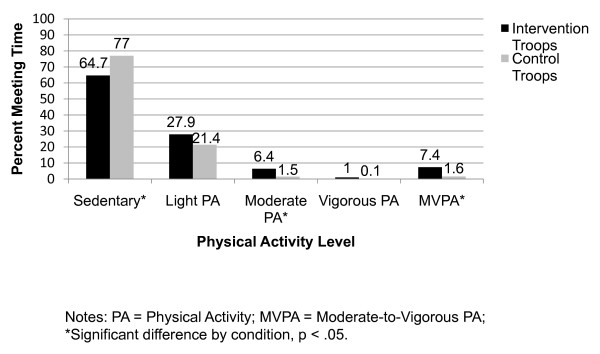
The intervention was delivered with good fidelity, and intervention troops provided greater opportunities for healthful eating and PA (x2 = 210.8, p < .001), relative to control troops. In troop meetings, intervention troop leaders promoted PA (x2 = 23.46, p < .001) and healthful eating (x2 = 18.14, p < .001) more frequently, and discouraged healthful eating and PA less frequently (x2 = 9.63, p = .002) compared to control troop leaders. Most effects of the intervention on individual-level variables of girls and parents were not significantly different from the control condition, including the primary outcome of child BMI z-score (F1, 5 = 0.42, p = .544), parent BMI (F1, 5 = 1.58, p = .264), and related behavioral variables. The notable exception was for objectively assessed troop PA, wherein girls in intervention troops accumulated significantly less sedentary (x2 = 6.3, p = .011), significantly more moderate (x2 = 8.2, p = .004), and more moderate-to-vigorous physical activity, (x2 = 18.4, p < .001), than girls in control troops.
Implementing a health promotion curriculum and supporting policies to provide more healthful environments in Girl Scout troop meetings appears feasible on a broader scale. Additional work is needed to bridge health promotion from such settings to other environments if lasting individual-level behavior change and obesity prevention remain targeted outcomes.
NCT00949637.
女童子军可能为健康促进和肥胖预防计划提供了一个可行的渠道。本研究评估了通过女童子军初级部队提供的干预计划的有效性,该计划旨在培养健康的部队会议环境,并增加家庭的肥胖预防行为。
将 7 个女童子军部队随机分为干预组(n=3,34 名女孩)和标准护理对照组(n=4,42 名女孩)。女孩年龄在 9 至 13 岁之间(平均 10.5 岁)。干预组的领队接受了培训,以实施促进部队会议中体育活动(PA)和健康饮食机会的政策,并实施促进家庭中肥胖预防行为的课程。主要结局变量是儿童体重指数(BMI)z 分数。次要结局包括在部队会议中评估 PA 水平的加速度计、零食供应的直接观察、投入到活跃会议内容的时间以及领队对 PA 和健康饮食的鼓励。
该干预措施具有良好的保真度,与对照组相比,干预组提供了更多的健康饮食和 PA 机会(x2=210.8,p<.001)。在部队会议中,干预组的领队更频繁地促进 PA(x2=23.46,p<.001)和健康饮食(x2=18.14,p<.001),并且更不鼓励健康饮食和 PA(x2=9.63,p=.002),与对照组相比。干预对女孩和家长个体水平变量的大多数影响与对照组没有显著差异,包括儿童 BMI z 分数的主要结局(F1,5=0.42,p=.544)、家长 BMI(F1,5=1.58,p=.264)和相关行为变量。一个显著的例外是部队的客观评估 PA,其中干预组的女孩明显较少久坐(x2=6.3,p=.011),明显更多中等强度(x2=8.2,p=.004),以及更多中等至剧烈的体力活动(x2=18.4,p<.001),而对照组的女孩。
在女童子军部队会议中实施健康促进课程和支持政策以提供更健康的环境似乎在更大范围内是可行的。如果持久的个人行为改变和肥胖预防仍然是目标结果,那么需要进一步努力将健康促进从这些环境扩展到其他环境。
NCT00949637。