Gupta Ravi, Pathak Rahul, Bhatia Manjeet Singh, Banerjee Basu Deb
Departments of Psychiatry, University College of Medical Sciences and GTB Hospital, Dilshad Garden, Delhi-110 095, India.
Ann Indian Acad Neurol. 2009 Jul;12(3):167-72. doi: 10.4103/0972-2327.56316.
A primary headache, particularly migraine, is associated with oxidative stress during the attack. However, data regarding the interictal state in migraineurs and in those with tension-type headache (TTH) is limited.
(1) To assess the oxidative stress in migraineurs and TTH subjects in between the episodes and (2) to see if there is a difference in the degree of oxidative stress in the different subtypes of migraine and TTH.
Fifty migraineurs, 50 patients with TTH, and 50 control subjects were included in this study after screening for the exclusion criteria. Diagnosis of headache was made according to the International Classification of Headache Disorders (ICHD)-2 criteria. A venous blood sample was collected from the antecubital vein at least 3 days after the last attack of headache. The sample was centrifuged immediately and the plasma was stored at -70 degrees C. The ferric reducing activity of plasma (FRAP) and the malondialdehyde (MDA) levels were assessed using colorimetric methods. Statistical analysis was done with the help of SPSS for Windows, v 11.0. One way ANOVA with post hoc Tukey test, independent sample t test, univariate regression, and multivariate regression analysis were done as indicated.
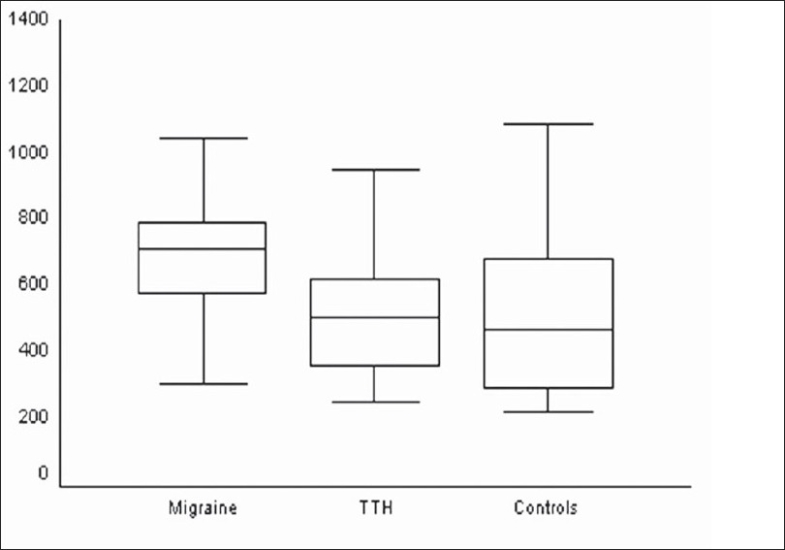
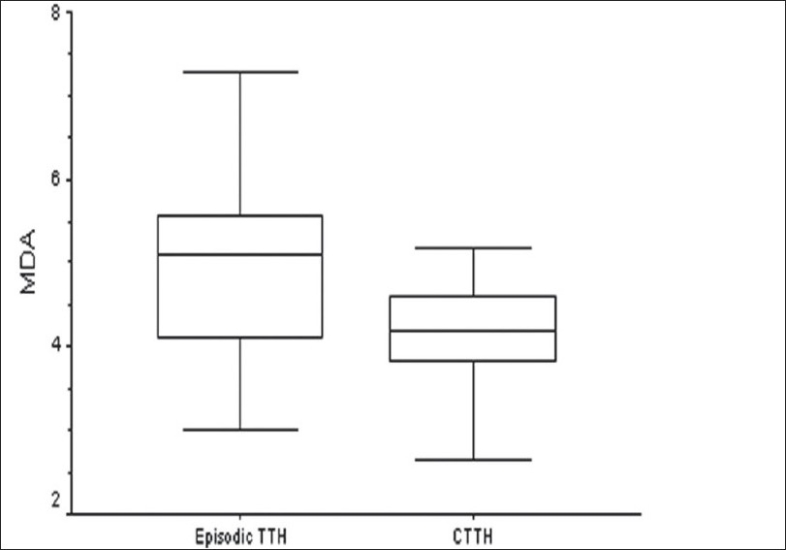
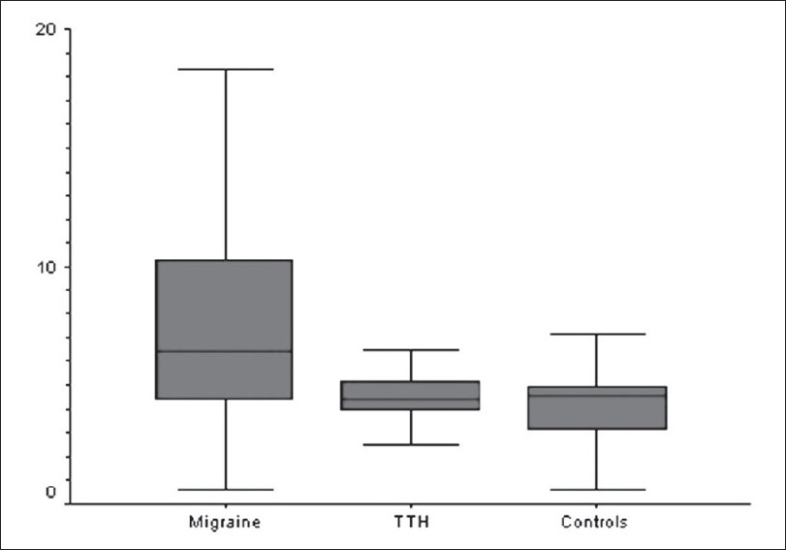
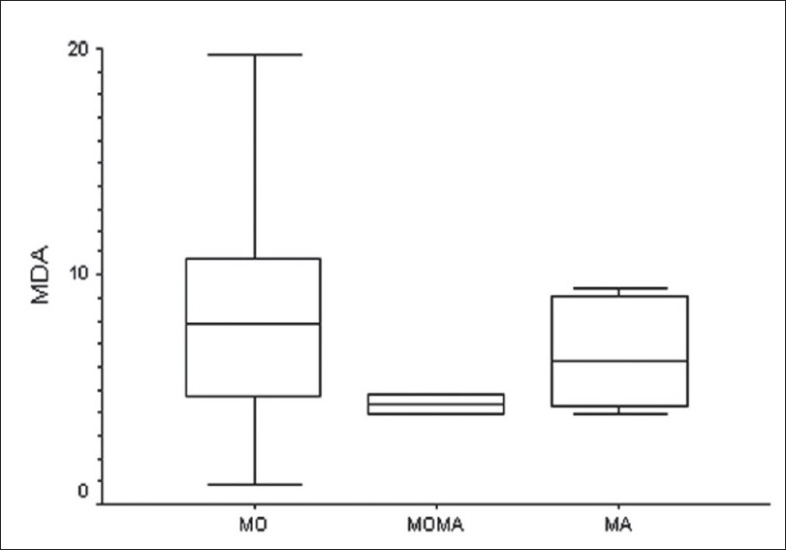
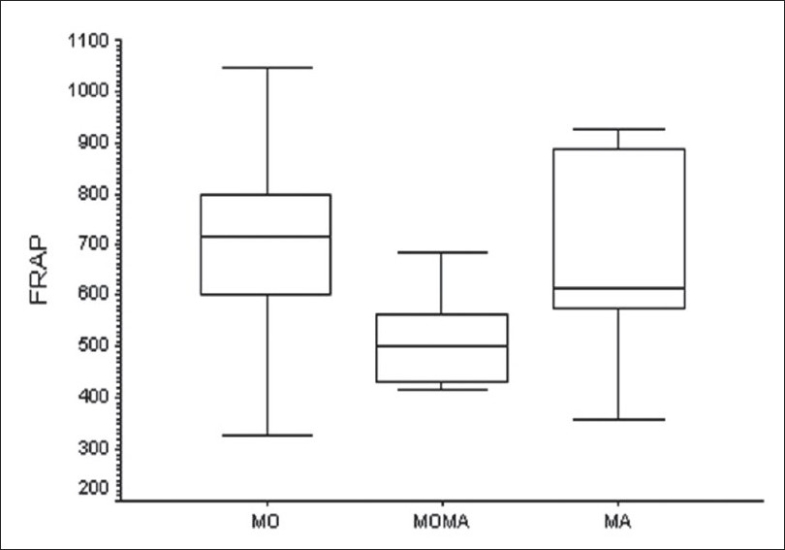
Migraineurs had higher values of MDA and FRAP than the subjects in the other two groups (P<0.001). No difference was observed between the TTH group and the control group. FRAP levels were significantly higher in subjects who had mixed migraine (migraine with aura and without aura) as compared to those with only migraine without aura (mean difference 196.1; 95% CI = 27.3 to 364.9; P = 0.01). Similarly, oxidative stress was significantly higher in patients with episodic TTH as compared to those with chronic TTH (FRAP t = 3.16; P = 0.003 and MDA t = 2.75; P = 0.008).
This study suggests that oxidative stress continues even between headache episodes in migraineurs but not in those with TTH. This could probably be consequent to the different pathophysiological mechanisms of TTH and migraine.
原发性头痛,尤其是偏头痛,在发作期间与氧化应激相关。然而,关于偏头痛患者和紧张型头痛(TTH)患者发作间期状态的数据有限。
(1)评估偏头痛患者和TTH患者发作间期的氧化应激情况;(2)观察偏头痛和TTH不同亚型的氧化应激程度是否存在差异。
在对排除标准进行筛查后,本研究纳入了50名偏头痛患者、50名TTH患者和50名对照受试者。根据国际头痛疾病分类(ICHD)-2标准进行头痛诊断。在最后一次头痛发作至少3天后,从前臂肘静脉采集静脉血样本。样本立即离心,血浆储存在-70℃。采用比色法评估血浆的铁还原活性(FRAP)和丙二醛(MDA)水平。借助Windows版SPSS 11.0进行统计分析。按指示进行单因素方差分析及事后Tukey检验、独立样本t检验、单变量回归和多变量回归分析。
偏头痛患者的MDA和FRAP值高于其他两组受试者(P<0.001)。TTH组和对照组之间未观察到差异。与仅有无先兆偏头痛的受试者相比,混合性偏头痛(有先兆和无先兆偏头痛)患者的FRAP水平显著更高(平均差异196.1;95%可信区间=27.3至364.9;P = 0.01)。同样,发作性TTH患者的氧化应激明显高于慢性TTH患者(FRAP t = 3.16;P = 0.003,MDA t = 2.75;P = 0.008)。
本研究表明,氧化应激在偏头痛患者的头痛发作间期也持续存在,但在TTH患者中则不然。这可能是由于TTH和偏头痛不同的病理生理机制所致。