Research Centre for Qinghao, Guangzhou University of Chinese Medicine, Guangzhou, PR China.
Malar J. 2010 Feb 23;9:57. doi: 10.1186/1475-2875-9-57.
Previous efforts to eradicate malaria parasites, particularly Plasmodium falciparum, have failed in part due to the emergence of drug resistant parasites and mosquitoes resistant to insecticides. Using an artemisinin-based combination therapy (ACT) that kills parasites quickly, a strategy was designed to eliminate the source of transmission by mass treatment of human populations in malaria-endemic areas Cambodia.
A combination drug of artemisinin and piperaquine given with low doses of primaquine was used to eliminate all stages of parasites from human carriers.
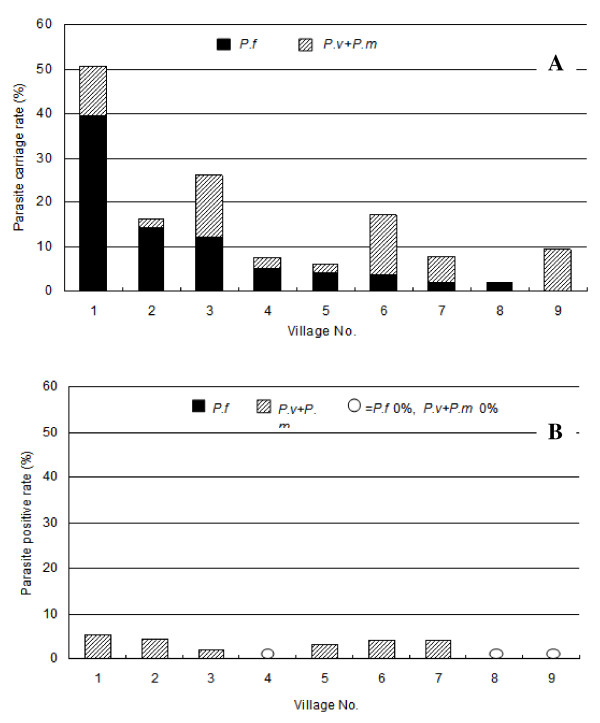
In a pilot study, mass administration of artemisinin-piperaquine (two tablets of 62.5 mg artemisinin and 375 mg piperaquine for adults aged > or =16 years at 0 and 24 hrs; 1.5 tablet for children aged 11-15 years; and one tablet for children aged 6-10 years) and primaquine (9 mg for adults, at 10 day intervals for 6 months) was carried out in 17 villages (3,653 individuals). Parasite rates were dramatically reduced from 52.3% to 2.6% after three years. The P. falciparum rate in children decreased from 37.0% to 1.4%, reaching 0% in eight of 17 villages. In a second field study, that included one additional mass treatment of artemisinin-piperaquine, the P. falciparum rate in children was reduced from 20.8% to 0% within six months. No major adverse effects were observed.
Mass administration of artemisinin-piperaquine and low doses of primaquine can be an effective, safe, and affordable strategy for efficiently eliminating malaria parasites in human carriers and interrupting parasite transmission. This study provides important information for future strategies for the eradication of malaria.
先前消灭疟原虫(尤其是恶性疟原虫)的努力部分失败了,这是因为出现了抗药性寄生虫和对杀虫剂有抗性的蚊子。采用一种以青蒿素为基础的联合疗法(ACT),这种疗法能迅速杀死寄生虫,从而设计了一种策略,即在疟疾流行地区的柬埔寨用大规模治疗人类的方法来消灭传播源。
用青蒿素和哌喹组成的联合药物,并用低剂量的伯氨喹来消灭人类带虫者体内的所有寄生虫阶段。
在一项试点研究中,对 17 个村庄(3653 人)进行了青蒿素-哌喹(成人在 0 小时和 24 小时各服两片,每片含 62.5 毫克青蒿素和 375 毫克哌喹;年龄在 11-15 岁的儿童服 1.5 片;年龄在 6-10 岁的儿童服 1 片)和伯氨喹(成人 9 毫克,每 10 天服 1 次,共服 6 个月)的集体投药。经过 3 年,寄生虫率从 52.3%急剧降至 2.6%。儿童中的恶性疟原虫率从 37.0%降至 1.4%,在 17 个村庄中有 8 个达到了 0%。在第二项现场研究中,又进行了一次青蒿素-哌喹集体投药,6 个月内儿童中的恶性疟原虫率从 20.8%降至 0%。没有观察到严重的不良反应。
大规模使用青蒿素-哌喹和低剂量伯氨喹可以作为一种有效、安全和经济的策略,用于在人类带虫者中有效消灭疟原虫并中断寄生虫传播。本研究为未来消灭疟疾的策略提供了重要信息。