Takahashi Nobunori, Knudson Cheryl B, Thankamony Sai, Ariyoshi Wataru, Mellor Liliana, Im Hee-Jeong, Knudson Warren
The Brody School of Medicine, East Carolina University, Greenville, North Carolina 27834-4354, USA.
Arthritis Rheum. 2010 May;62(5):1338-48. doi: 10.1002/art.27410.
The hyaluronan receptor CD44 provides chondrocytes with a mechanism for sensing and responding to changes in the extracellular matrix. The purpose of this study was to document the fragmentation and loss of CD44 and to determine the likely mechanisms involved.
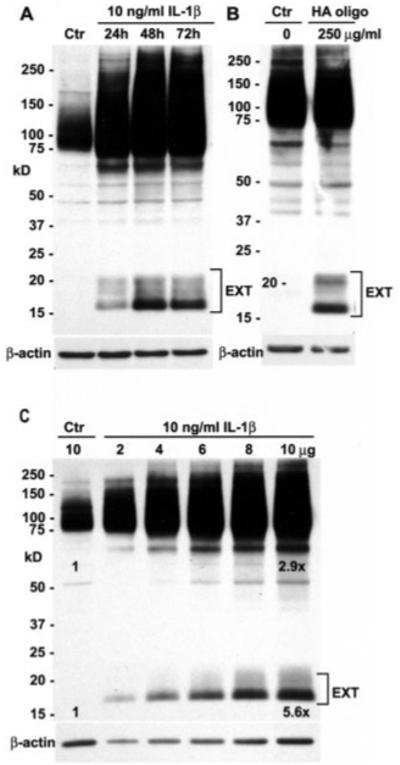
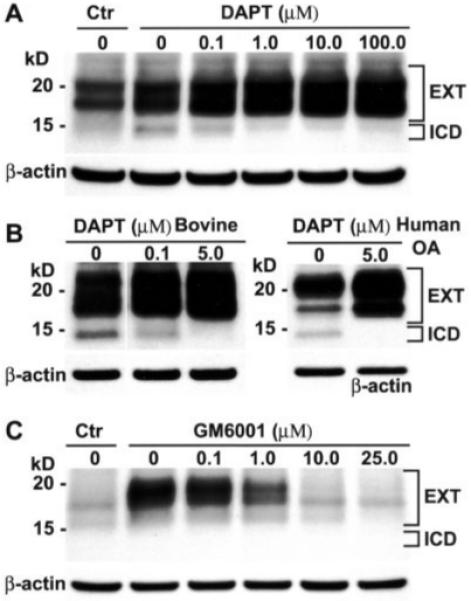
A polyclonal anti-CD44 cytotail antibody was generated to detect CD44 fragmentation by Western blot analysis. Chondrocytes were isolated from human or bovine articular cartilage. Primary articular chondrocytes were treated with interleukin-1beta (IL-1beta), hyaluronan oligosaccharides, or phorbol myristate acetate or were passaged and subcultured in monolayer to induce dedifferentiation. Conditions that altered the capacity of CD44 to transit into lipid rafts, or pharmacologic inhibitors of metalloproteinase or gamma-secretase activity were used to define the mechanism of fragmentation of CD44.
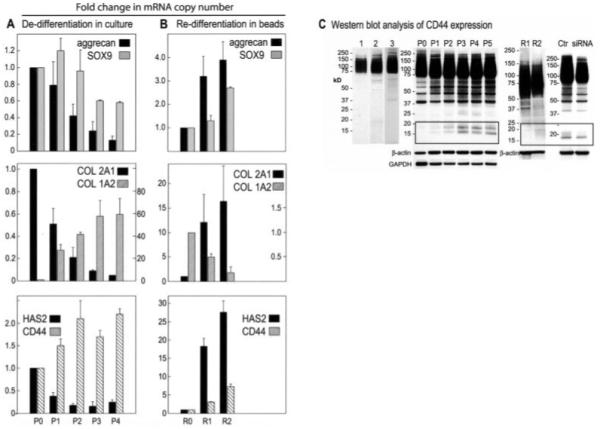
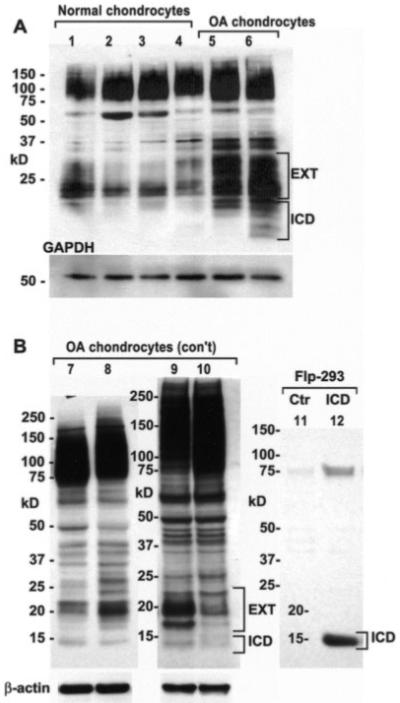
Chondrocytes from osteoarthritic cartilage exhibited CD44 fragmentation as low molecular mass bands, corresponding to the CD44-EXT and CD44-ICD bands. Following dedifferentiation of chondrocytes or treatment of primary chondrocytes with hyaluronan oligosaccharides, IL-1beta, or phorbol myristate acetate, CD44 fragmentation was enhanced. Subsequent culture of the dedifferentiated chondrocytes in 3-dimensional alginate beads rescued the chondrocyte phenotype and diminished the fragmentation of CD44. Fragmentation of CD44 in chondrocytes was blocked in the presence of the metalloproteinase inhibitor GM6001 and the gamma-secretase inhibitor DAPT.
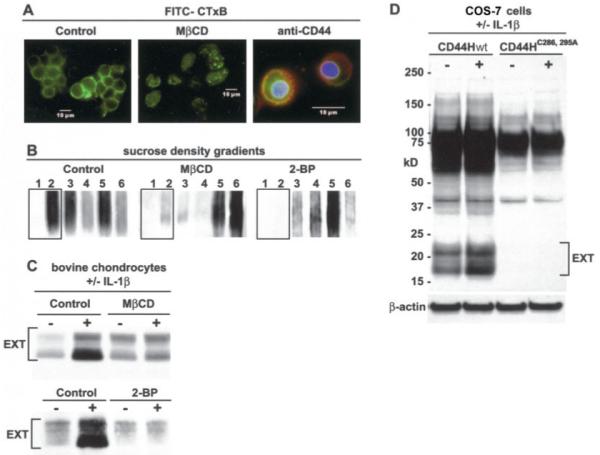
CD44 fragmentation, consistent with a signature pattern reported for sequential metalloproteinase/gamma-secretase cleavage of CD44, is a common metabolic feature of chondrocytes that have undergone dedifferentiation in vitro and osteoarthritic chondrocytes. Transit of CD44 into lipid rafts may be required for its fragmentation.
透明质酸受体CD44为软骨细胞提供了一种感知和响应细胞外基质变化的机制。本研究的目的是记录CD44的片段化和丢失情况,并确定其中可能涉及的机制。
制备了一种抗CD44胞尾多克隆抗体,通过蛋白质印迹分析检测CD44的片段化。从人或牛关节软骨中分离软骨细胞。原代关节软骨细胞用白细胞介素-1β(IL-1β)、透明质酸寡糖或佛波醇肉豆蔻酸酯乙酸盐处理,或进行传代并在单层中传代培养以诱导去分化。使用改变CD44进入脂筏能力的条件,或金属蛋白酶或γ-分泌酶活性的药理抑制剂来确定CD44片段化的机制。
骨关节炎软骨中的软骨细胞表现出CD44片段化,呈现低分子量条带,对应于CD44-EXT和CD44-ICD条带。软骨细胞去分化或原代软骨细胞用透明质酸寡糖、IL-1β或佛波醇肉豆蔻酸酯乙酸盐处理后,CD44片段化增强。随后将去分化的软骨细胞在三维藻酸盐珠中培养可挽救软骨细胞表型并减少CD44的片段化。在金属蛋白酶抑制剂GM6001和γ-分泌酶抑制剂DAPT存在下,软骨细胞中CD44的片段化被阻断。
CD44片段化与报道的CD44顺序金属蛋白酶/γ-分泌酶切割的特征模式一致,是体外经历去分化的软骨细胞和骨关节炎软骨细胞的常见代谢特征。CD44进入脂筏可能是其片段化所必需的。