Department of Sociology, The University of North Carolina, Chapel Hill, North Carolina, United States of America.
PLoS One. 2010 Feb 22;5(2):e9352. doi: 10.1371/journal.pone.0009352.
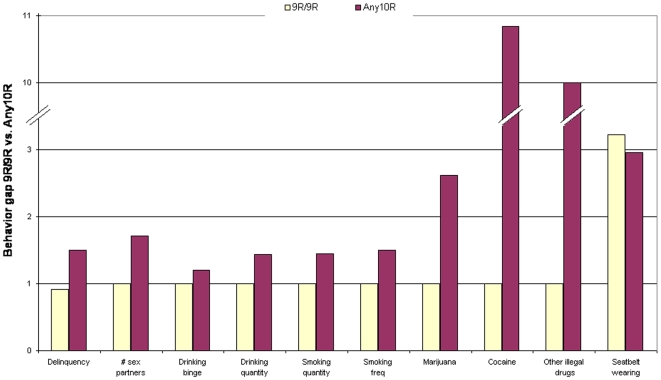
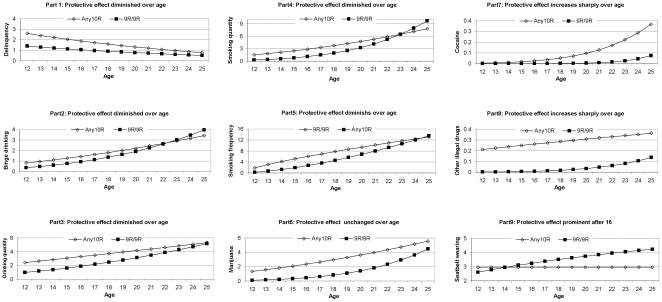
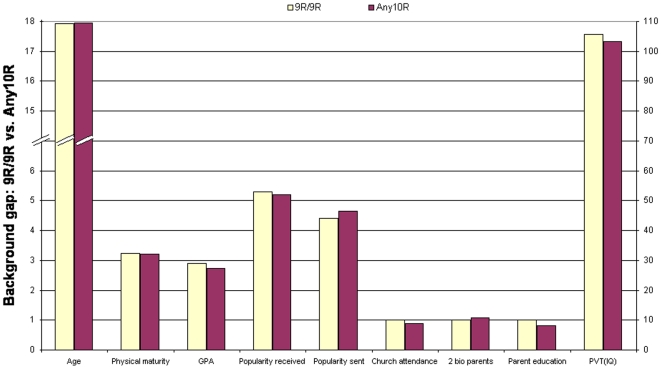
This study tests the specific hypothesis that the 9R/9R genotype in the VNTR of the dopamine transporter gene (DAT1) exerts a general protective effect against a spectrum of risky behaviors in comparison to the 10R/9R and 10R/10R genotypes, drawing on three-time repeated measures of risky behaviors in adolescence and young adulthood on about 822 non-Hispanic white males from the Add Health study. Our data have established two empirical findings. The first is a protective main effect in the DAT1 gene against risky behaviors. The second finding is that the protective effect varies over age, with the effect prominent at ages when a behavior is illegal and the effect largely vanished at ages when the behavior becomes legal or more socially tolerated. Both the protective main effect and the gene-lifecourse interaction effect are replicated across a spectrum of most common risky behaviors: delinquency, variety of sexual partners, binge drinking, drinking quantity, smoking quantity, smoking frequency, marijuana use, cocaine use, other illegal drug use, and seatbelt non-wearing. We also compared individuals with the protective genotype and individuals without it in terms of age, physical maturity, verbal IQ, GPA, received popularity, sent popularity, church attendance, two biological parents, and parental education. These comparisons indicate that the protective effect of DAT1*9R/9R cannot be explained away by these background characteristics. Our work demonstrates how legal/social contexts can enhance or reduce a genetic effect on risky behaviors.
这项研究检验了一个具体的假设,即在多巴胺转运体基因(DAT1)的 VNTR 中,9R/9R 基因型与 10R/9R 和 10R/10R 基因型相比,对一系列风险行为具有普遍的保护作用,这是基于对大约 822 名非西班牙裔白人男性在青少年和成年早期的三次重复风险行为测量得出的,这些数据来自 Add Health 研究。我们的数据已经确定了两个经验发现。第一个是 DAT1 基因对风险行为具有保护的主效应。第二个发现是,保护效应随年龄而变化,在行为违法的年龄具有显著影响,而在行为合法或更被社会容忍的年龄,这种影响则大大消失。DAT1 基因的保护主效应和基因与生命历程的相互作用效应在一系列最常见的风险行为中都得到了复制:犯罪行为、性伴侣的多样性、狂饮、饮酒量、吸烟量、吸烟频率、大麻使用、可卡因使用、其他非法药物使用和不系安全带。我们还比较了具有保护基因型的个体和没有该基因型的个体在年龄、身体成熟度、言语智商、平均绩点、受欢迎程度、受关注程度、参加教堂活动、有两个生物学父母和父母教育程度方面的差异。这些比较表明,DAT1*9R/9R 的保护效应不能用这些背景特征来解释。我们的工作表明,法律/社会环境可以增强或降低基因对风险行为的影响。