Department of Internal Medicine, Central Hospital of Bolzano, Lorenz-Böhler-Street 5, 39100 Bolzano (BZ), Italy.
Thromb J. 2010 Jan 29;8(1):2. doi: 10.1186/1477-9560-8-2.
Interaction of fibrinogen with specific leukocyte integrins of monocytes may link coagulation and inflammation, however, the precise mechanism of fibrinogen leading to the pro-inflammatory and pro-coagulatory response on monocytes is yet unknown.
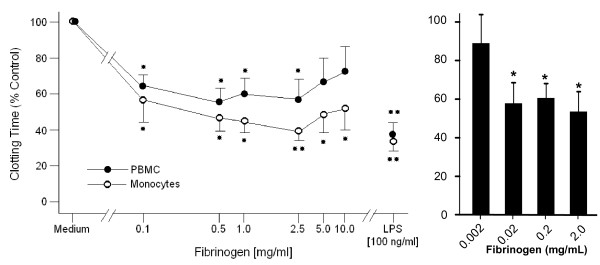
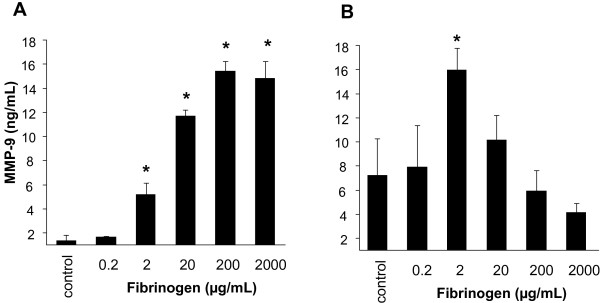
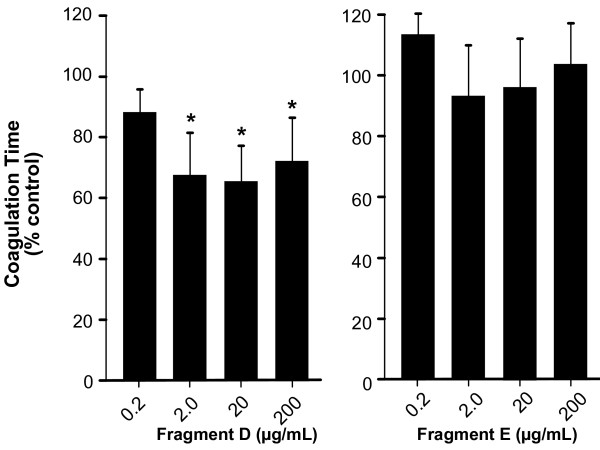
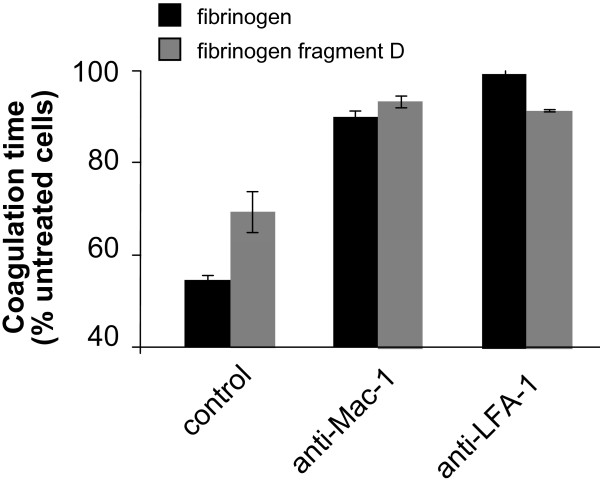
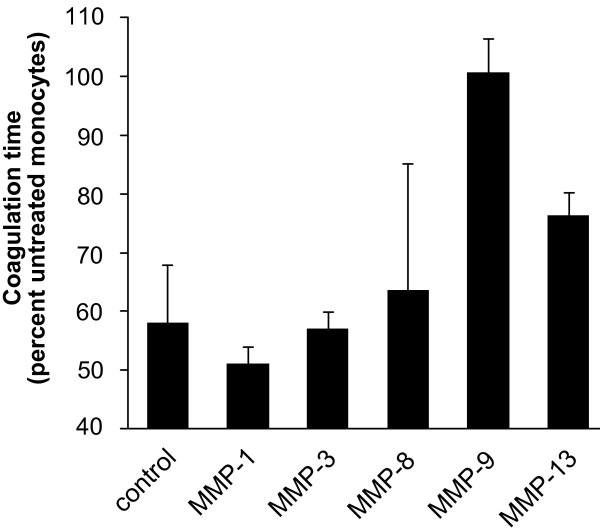
Fibrinogen and its digestion fragment D induced pro-coagulant activation of monocytes as assessed in a cellular coagulation assay by reductions in clotting times. Pro-coagulant activation was reversed by blocking antibodies against Mac-1 or LFA-1. Pre-exposure of monocytes to the p38 MAPK inhibitor SB 202190 and the MEK1.2 inhibitor U0126 led to significant increasees in coagulation times whereas blocking JNKII with its inhibitor had no such effect. Blocking NFkappaB with MG-132 also inhibited pro-coagulant activation of monocytes by fibrinogen. A selective inhibitor of matrix metalloproteinase-9 increased times to clot formation whereas other matrix metalloproteinase inhibitors did not significantly interfere with fibrinogen-augmented clot formation in this assay. Treatment of monocytes with fibrinogen increased concentrations of matrix metalloproteinase-9 immunoreactivity in their supernatants.
Fibrinogen induces monocyte pro-coagulant activation in an integrin-, nuclear factor kappaB-, p38 MAPK-, and MEK1.2-dependent manner. Activation of monocytes by fibrinogen increases metalloproteinase-9 secretion, metalloproteinase-9 itself enhances monocyte coagulation by an autocrine mechanism. Results provide further evidence that mediators of hemostasis have a profound impact on cells of the immune system and are closely related to inflammatory pathways.
纤维蛋白原与单核细胞特定白细胞整合素的相互作用可能将凝血和炎症联系起来,然而,纤维蛋白原导致单核细胞产生促炎和促凝反应的确切机制尚不清楚。
纤维蛋白原及其消化片段 D 通过缩短凝血时间,在细胞凝血测定中诱导单核细胞的促凝活性。抗 Mac-1 或 LFA-1 的阻断抗体可逆转促凝活性。预先暴露于 p38 MAPK 抑制剂 SB 202190 和 MEK1.2 抑制剂 U0126 的单核细胞导致凝血时间显著增加,而用其抑制剂阻断 JNKII 则没有这种作用。用 MG-132 阻断 NFkappaB 也抑制了纤维蛋白原对单核细胞的促凝活性。基质金属蛋白酶-9 的选择性抑制剂增加了形成血栓的时间,而其他基质金属蛋白酶抑制剂在该测定中没有显著干扰纤维蛋白原增强的血栓形成。用纤维蛋白原处理单核细胞增加了其上清液中基质金属蛋白酶-9 免疫反应性的浓度。
纤维蛋白原以整合素、核因子 kappaB、p38 MAPK 和 MEK1.2 依赖的方式诱导单核细胞促凝活性。纤维蛋白原激活单核细胞增加金属蛋白酶-9 的分泌,金属蛋白酶-9 本身通过自分泌机制增强单核细胞的凝血。结果进一步证明,止血介质对免疫系统的细胞有深远的影响,并且与炎症途径密切相关。