Neuroanesthesia Research Laboratory, University of Illinois at Chicago, Chicago, IL 60612, USA.
J Alzheimers Dis. 2010;20 Suppl 1(Suppl 1):S51-62. doi: 10.3233/JAD-2010-091261.
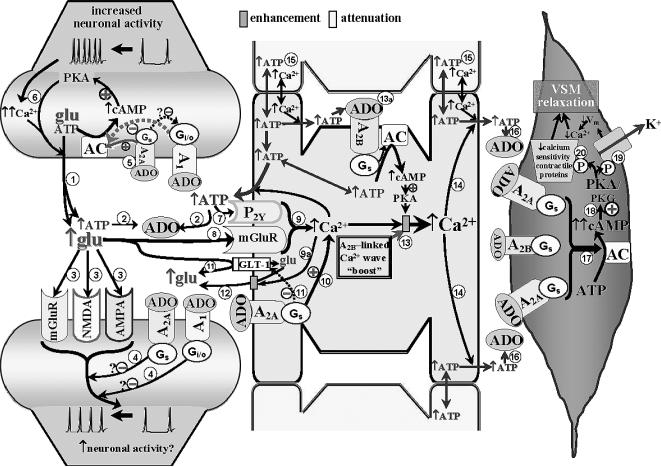
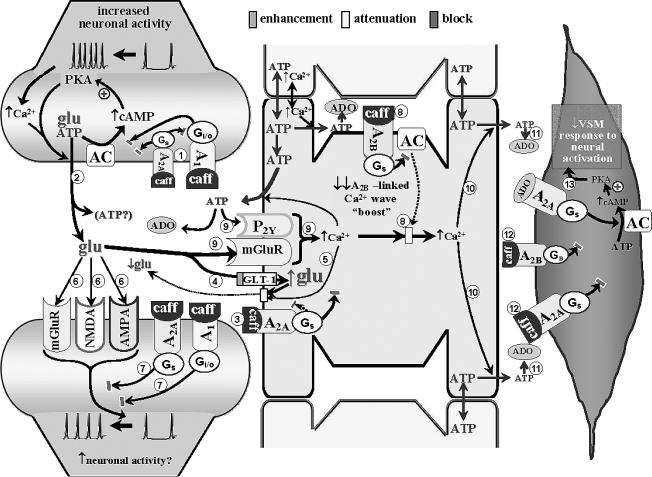
While the influence of caffeine on the regulation of brain perfusion has been the subject of multiple publications, the mechanisms involved in that regulation remain unclear. To some extent, that uncertainty is a function of a complex interplay of processes arising from multiple targets of caffeine located on a variety of different cells, many of which have influence, either directly or indirectly, on cerebral vascular smooth muscle tone. Adding to that complexity are the target-specific functional changes that may occur when comparing acute and chronic caffeine exposure. In the present review, we discuss some of the mechanisms behind caffeine influences on cerebrovascular function. The major effects of caffeine on the cerebral circulation can largely be ascribed to its inhibitory effects on adenosine receptors. Herein, we focus mostly on the A1, A2A, and A2B subtypes located in cells comprising the neurovascular unit (neurons, astrocytes, vascular smooth muscle); their roles in the coupling of increased neuronal (synaptic) activity to vasodilation; how caffeine, through blockade of these receptors, may interfere with the "neurovascular coupling" process; and receptor-linked changes that may occur in cerebrovascular regulation when comparing acute to chronic caffeine intake.
尽管咖啡因对脑灌注调节的影响已经在多个出版物中进行了研究,但涉及的调节机制仍不清楚。在某种程度上,这种不确定性是由于咖啡因的多个靶点位于多种不同细胞上,这些靶点之间的复杂相互作用所产生的,其中许多靶点直接或间接地影响脑血管平滑肌的张力。使情况变得更加复杂的是,当比较急性和慢性咖啡因暴露时,可能会发生针对特定目标的功能变化。在本综述中,我们讨论了咖啡因对脑血管功能影响的一些机制。咖啡因对脑循环的主要影响很大程度上可以归因于其对腺苷受体的抑制作用。在此,我们主要关注位于组成神经血管单元(神经元、星形胶质细胞、血管平滑肌)的细胞中的 A1、A2A 和 A2B 亚型;它们在增加神经元(突触)活动与血管舒张的偶联中的作用;咖啡因如何通过阻断这些受体来干扰“神经血管偶联”过程;以及当比较急性和慢性咖啡因摄入时,在脑血管调节中可能发生的受体相关变化。