Majetschak Matthias, Zedler Siegfried, Romero Jacqueline, Albright Joslyn M, Kraft Robert, Kovacs Elizabeth J, Faist Eugen, Gamelli Richard L
Department of Surgery, Burn and Shock Trauma Institute, Loyola University Chicago Stritch School of Medicine, Maywood, Illinois, USA.
J Burn Care Res. 2010 Mar-Apr;31(2):243-50. doi: 10.1097/BCR.0b013e3181d0f55d.
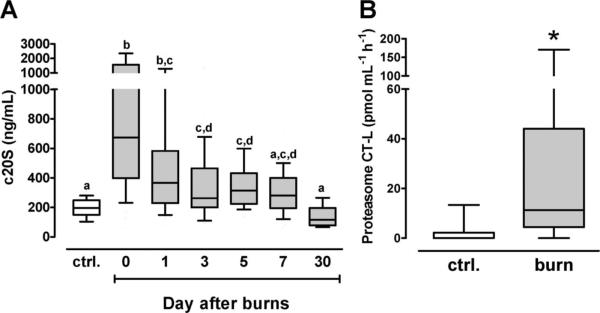
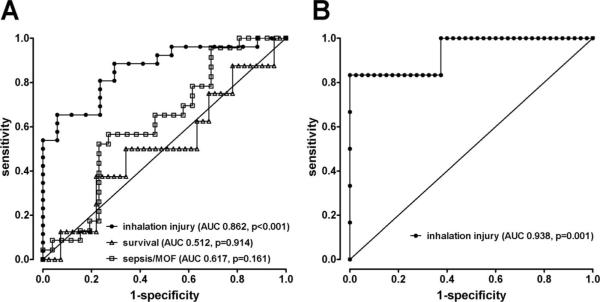
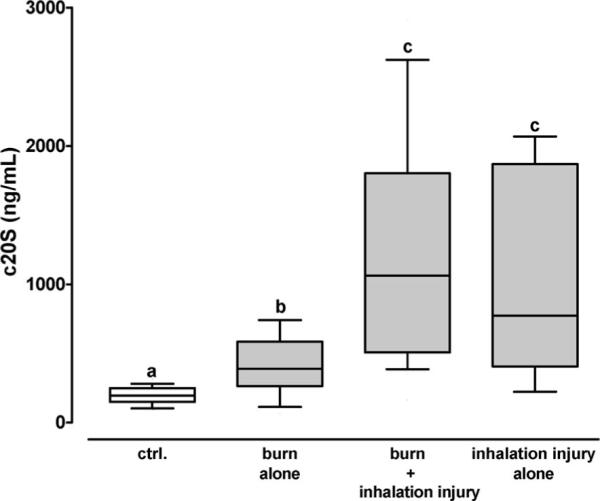
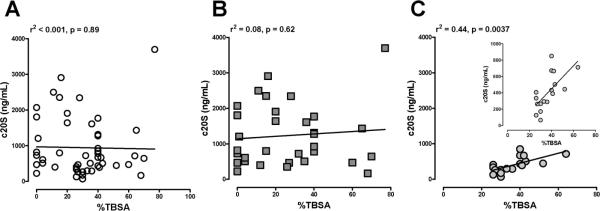
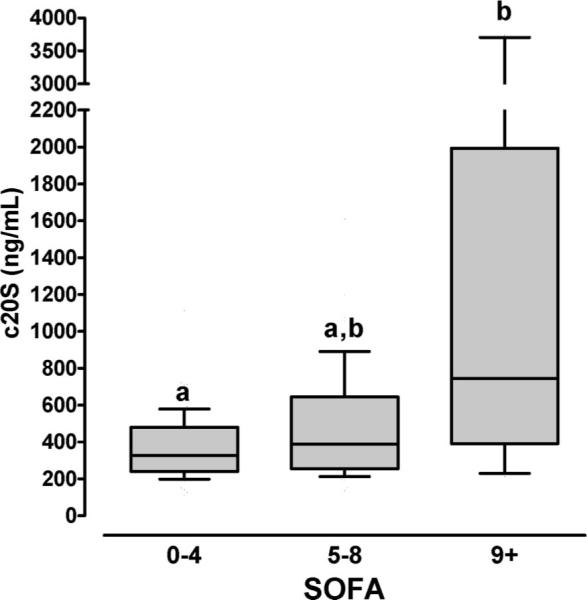
The objective of the study is to test whether circulating proteasomes are increased in burn patients and to assess whether possible alterations are associated with severity of injury, organ failure, and/or clinically relevant outcomes. In this study, plasma was obtained from burn patients on days 0 (admission, n = 50), 1 (n = 36), 3 (n = 35), 5 (n = 28), 7 (n=34), and 30 (n = 10) (controls: 40 volunteers). The 20S/26S proteasome levels were measured by enzyme-linked immunosorbent assay. Proteasome peptidase activity was assessed using a chymotryptic-like peptide substrate in combination with epoxomicin (specific proteasome inhibitor). Percentage of TBSA burned, presence of inhalation injury, development of sepsis/multiple organ failure, and sequential organ failure assessment scores were documented. On admission, plasma proteasome activity was higher in patients than in controls (P = .011). 26S proteasomes were not detectable. The 20S proteasome concentrations (median [25th/75th percentile]) peaked on day 0 (673 [399/1566] ng/mL; control: 195 [149/249] ng/mL, P < .001), gradually declined within 7 days, and fully returned to baseline at day 30 (116.5 [78/196] ng/mL). Elevated 20S proteasomes were associated with the presence of inhalation injury and correlated linearly with %TBSA in patients without inhalation injury. Initial 20S proteasome concentrations discriminated the presence of inhalation injury in patients with (sensitivity 0.88 and specificity 0.71) and without (sensitivity 0.83 and specificity 0.97) cutaneous burns but did not discriminate sepsis/multiple organ failure development or survival. Circulating 20S proteasome is a biomarker of tissue damage. The 20S proteasome plasma concentrations in patients with burns and/or inhalation injury are unlikely to predict outcomes but may be useful for the diagnosis of inhalation injury.
本研究的目的是检测烧伤患者循环中的蛋白酶体是否增加,并评估可能的变化是否与损伤严重程度、器官衰竭和/或临床相关结局有关。在本研究中,于第0天(入院时,n = 50)、第1天(n = 36)、第3天(n = 35)、第5天(n = 28)、第7天(n = 34)和第30天(n = 10)从烧伤患者获取血浆(对照组:40名志愿者)。通过酶联免疫吸附测定法测量20S/26S蛋白酶体水平。使用类胰凝乳蛋白酶样肽底物结合环氧霉素(特异性蛋白酶体抑制剂)评估蛋白酶体肽酶活性。记录烧伤总面积百分比、吸入性损伤的存在、脓毒症/多器官衰竭的发生以及序贯器官衰竭评估评分。入院时,患者血浆蛋白酶体活性高于对照组(P = 0.011)。未检测到26S蛋白酶体。20S蛋白酶体浓度(中位数[第25/75百分位数])在第0天达到峰值(673[399/1566]ng/mL;对照组:195[149/249]ng/mL,P < 0.001),在7天内逐渐下降,并在第30天完全恢复至基线水平(116.5[78/196]ng/mL)。升高的20S蛋白酶体与吸入性损伤的存在相关,并且在无吸入性损伤的患者中与烧伤总面积呈线性相关。初始20S蛋白酶体浓度可区分有(敏感性0.88,特异性0.71)和无(敏感性0.83,特异性0.97)皮肤烧伤患者中吸入性损伤的存在,但不能区分脓毒症/多器官衰竭的发生或生存情况。循环中的20S蛋白酶体是组织损伤的生物标志物。烧伤和/或吸入性损伤患者的20S蛋白酶体血浆浓度不太可能预测结局,但可能有助于吸入性损伤的诊断。